
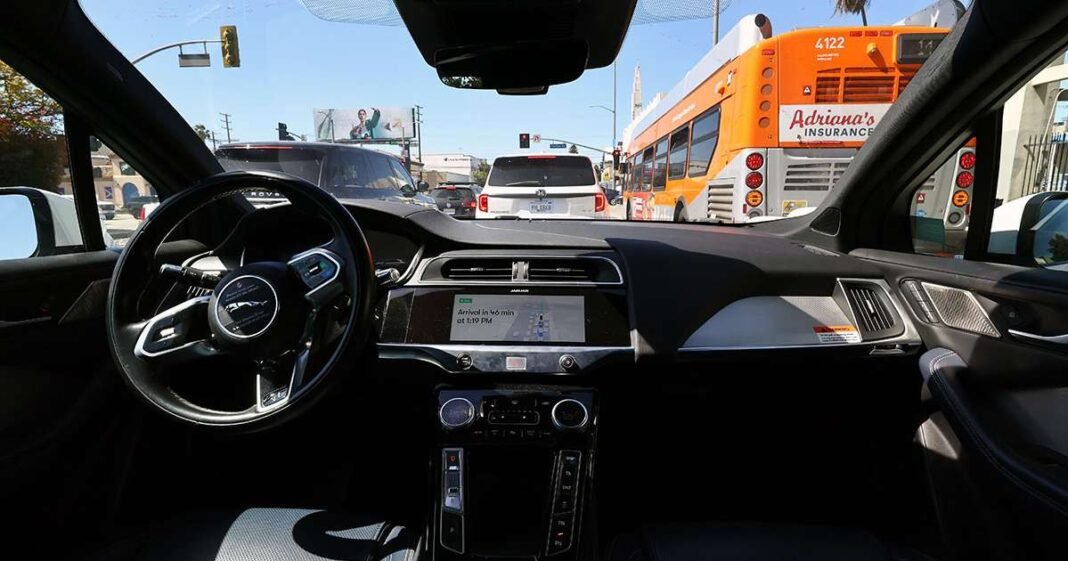

An autonomous self-driving taxi in Los Angeles. (Mario Tama/Getty Images)
February 17, 2026 3:25 PM, EST
The market for AI-powered robots and autonomous machines has the potential to balloon into a trillion-dollar opportunity by 2035, orders of magnitude bigger than it is now, according to a team of Barclays analysts.
Autonomous vehicles, which are already relatively advanced, will lead the way, followed by drones and then more complicated general-purpose humanoid robots, the analysts wrote in a report Feb. 17 titled “The Decade of the Robot.”
“Advances in brains, brawn and batteries are pushing AI-enabled robotics to an inflection point, setting the investment agenda for the next decade,” wrote the team led by Zornitsa Todorova, head of thematic fixed-income research at Barclays.
The development of robotics and other real-world, “physical AI” marks a paradigm shift from digital-focused AI, one that lays the foundation for a “value chain” that will be more diverse and deeper than the first wave of AI products, they said.
While China dominates humanoid and industrial robot deployment, the Barclays analysts identified close to 200 public issuers that could be involved in the theme over the next decade, including 100 with at least one corporate bond outstanding.
“We see automakers emerging as potential major participants, alongside growing deployment of robotic systems across warehousing, logistics and retail,” they wrote. Examples include Mercedes-Benz Group AG’s use of Nvidia Corp.’s Omniverse to “virtually retool factories with minimal disruption” and Tesla Inc.’s focus on robots during its fourth-quarter earnings call.
The team highlighted the software and hardware underpinning the technology, including semiconductor and infrastructure providers such as Taiwan Semiconductor Manufacturing Co., Samsung Electronics Co. and Nvidia Corp. They also flag “robotic hardware and motion systems that perform physical tasks,” along with batteries, which “provide the energy backbone for these platforms,” citing Chinese manufacturers like EVE Energy Co. and Contemporary Amperex Technology Co.
The Barclays analysts also point to a group they call enablers, which are companies that either build full robots, like Tesla, or “shape the broader ecosystem” by developing technology, like Amazon.com Inc.
A shift toward physical AI is already showing in large-scale logistics and retail operations at companies such as Amazon and Walmart Inc. They note Amazon has more than 1 million robots operating in its fulfillment network, “which is likely still only a fraction of the long-term potential.”
Amazon ranks No. 1 on the Transport Topics Top 100 list of the largest logistics companies in North America, No. 15 on the TT Top 100 list of the largest private carriers and No. 1 on the TT Top 50 list of the largest global freight companies.
Walmart ranks No. 1 on the private TT100 and No. 32 on the global TT50.

