
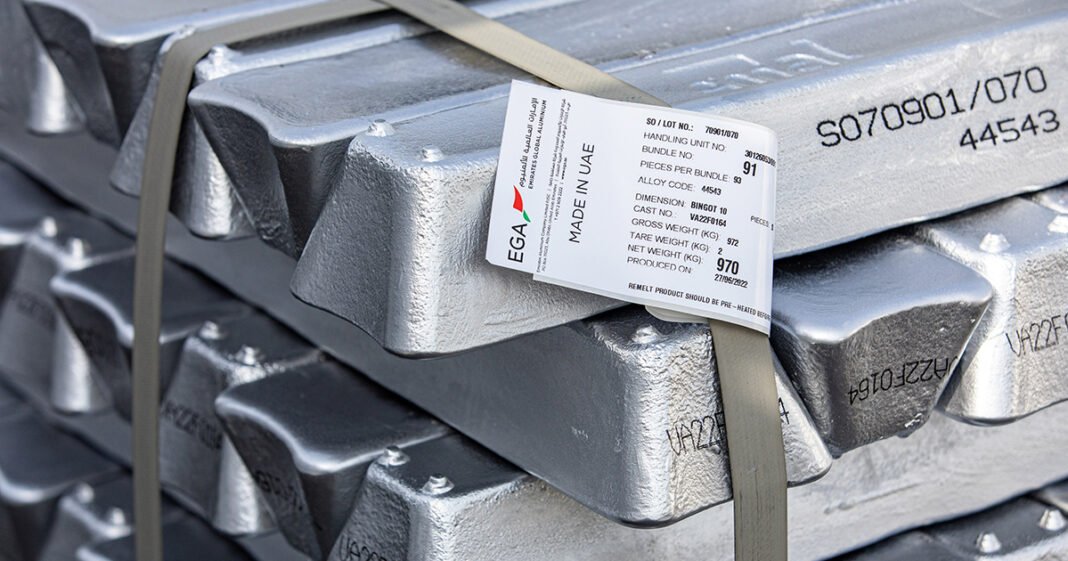

Stacked aluminum ingots in the cast house yard at the Emirates Global Aluminium plant in Abu Dhabi. (Christopher Pike/Bloomberg)
March 30, 2026 9:08 AM, EDT
| Updated: March 30, 2026 2:16 PM, EDT
Iran’s weekend strikes on Persian Gulf aluminum plants are threatening to send a fragile market into crisis, raising the prospect of record prices for the metal used in everything from airplanes to food packaging and solar panels.
On the first day of trading after two major producers confirmed attacks by Iranian drones and missiles, futures on the London Metal Exchange surged as much as 6%.
The Middle East accounts for about 9% of global production, but its impact is being amplified because constraints on output elsewhere have eroded inventories, leaving the market with little buffer to cushion any shocks.
Even before the industry became a direct target, the closure of the Strait of Hormuz had left the Middle East’s giant smelters running short of key inputs, and the industry had been bracing for a cascading series of production cuts in coming weeks.
On March 28, the region’s top supplier, Emirates Global Aluminium, said it sustained “significant damage” at its site in Abu Dhabi, while Aluminium Bahrain said it was assessing the extent of the damage to its facility.
“Traders need to face the reality of significant cuts to Middle East supplies,” said Li Xuezhi, head of research at Chaos Ternary Futures Co.
Shutting down and restarting an aluminum smelter is a lengthy and costly task, and the strikes on two of the world’s biggest facilities raise the risk that the effect on global production may persist long after the strait is reopened.
Aluminum is the most widely used metal after steel, and a sustained price spike would heap further pressure on manufacturers already reeling from the surge in energy costs. Potentially more worrying for the global economy, the disruption to supplies could be so acute that some industrial consumers would run out of certain specialized products, forcing factories into temporary shutdowns.
LME aluminum rose 3.2% to settle at $3,401 a ton in London. Shares of aluminum companies also rose, with Alcoa Corp. up as much as 13% and Century Aluminum Co. surging more than 20% in New York.
Confirming the strikes in a statement to Iranian state media on March 28, the nation’s Islamic Revolutionary Guard Corps. said the two companies were suppliers to the U.S. military, and the action was retaliation for U.S.-Israeli strikes on infrastructure in Iran.
“The aluminum supply chain has entered a new phase of disruption,” AZ Global Consulting said in a note after the attacks. “We will wait to hear from both companies, but it is clear the system is now exposed to sudden production loss, not just gradual constraint.”
Prices have swung wildly since the war begun, surging at the start of the conflict, and then easing due to growing worries about the global economic impact of the war. Traders and industry executives have warned that if shipping doesn’t resume soon in the Strait of Hormuz, the inevitable production cuts would drive prices above 2022’s record high of $4,073.50 a ton.
Some smelters had already begun to curtail operations. Qatar’s Qatalum has reduced production by about 40%, while Alba — as the Bahraini producer is known — had announced the shutdown of 19% of its capacity.
Historic Shock
The hit to aluminum production in the Middle East threatens to be one of the biggest supply shocks in the history of the market. The two facilities struck by Iran have combined production of 3.2 million tons a year, while Gulf Cooperation Council countries as a whole produce more than 6 million tons — although not all suppliers ship through the Strait of Hormuz.
By comparison, the threat of an interruption to supplies from Russia’s United Co. Rusal PJSC, which produces about 4 million tons a year, was enough to send aluminum prices up 30% in three weeks in 2022.
Still, an extended closure of the strait could also cause an energy price spike that would knock global growth, and hurt demand for aluminum and other industrial metals.
An Emirates Global Aluminium site in Abu Dhabi. (Christopher Pike/Bloomberg)
The Middle East accounts for a smaller share of the world’s aluminum production than it does oil or liquefied natural gas, but the market context is also different. While oil and gas traders have for the most part been warning of gluts before the U.S. and Israel started their campaign against Iran on Feb. 28, aluminum traders had been gearing up for a bull market for months.
Available stocks on the LME, which for the past three years have been hovering around the lowest level in more than two decades, have dropped sharply since the war began, as traders rush to withdraw metal in anticipation of a supply squeeze.
And while aluminum futures have been weighed down by worries over the war’s economic impact, the brewing supply squeeze can already be seen in the premiums that buyers are paying to secure physical metal. The price of aluminum billet — an alloyed form that is shaped into everything from building parts to airplanes — has jumped by 63% in Europe since the war began, according to pricing agency Fastmarkets Ltd.
Spot prices for aluminum have also surged above futures on the LME, in a condition known as backwardation that’s a hallmark of spot demand exceeding supply. Cash contracts closed at a $47.21 premium over three-month futures on the LME on March 30, after reaching a premium of $61.23 on March 27, the highest level since 2007.
Analysts at Goldman Sachs Group Inc. — which has been a bearish voice in the aluminum market for months — said on March 24 they expect a 900,000-ton deficit to emerge during the second quarter. That would lead to a drawdown in inventories, leaving global market cover at just 45 days of consumption — lower than in 2022, when the energy crunch pushed aluminum to its record high
Military Needs
For aluminum buyers, the impact is likely to be felt in coming months. Some shipments from the Middle East had already cleared the Strait of Hormuz when the war began, delaying the worst of the shortfall until the third quarter, said Rob Van Gils, CEO of Hammerer Aluminium Industries, which manufactures aluminum products.
Fresh from TMC, ATA President Chris Spear takes a candid look at what today’s fleet maintenance trends reveal about the broader state of trucking. Tune in above or by going to RoadSigns.ttnews.com.
But the price move has already had an impact. Rio Tinto Group hiked its offer for aluminum in Japan to a premium of $350 over the LME price, the strongest in more than a decade.
The biggest supply squeeze is being seen in higher-cost aluminum alloys used by aircraft and auto manufacturers and in the construction industry.
Middle Eastern smelters were a key supplier of such products, particularly to Europe, but also to the US, where anxiety has grown about shortfalls in the availability of high-purity aluminum used by the military. Bahrain’s Alba had already said it was reducing production of value-added products in favor of commodity-grade aluminum, to give it more flexibility in a period of disruption.
Van Gils, whose company buys commodity-grade aluminum from smelters in Iceland and Norway and sells value-added products, said Hammerer has become much more cautious about quoting premiums for third-quarter sales given the uncertainty facing the market.
For industry in Europe, the prospect of a series of Middle Eastern smelter closures represents “an unbelievable threat,” he said. And that was before the strikes over the weekend.

