
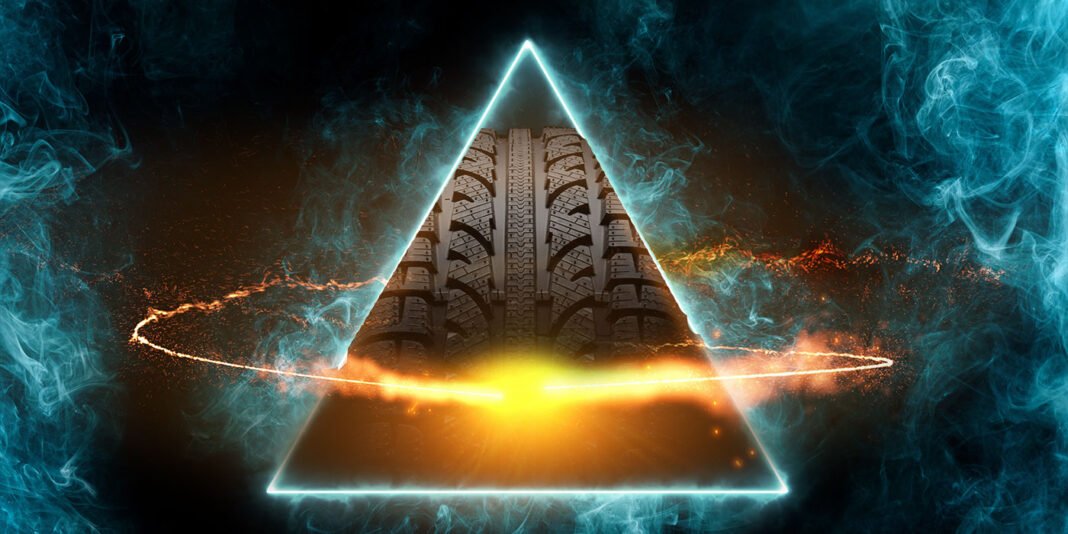

The “magic triangle” in tires is the colloquial term for a known challenge in tire compounding. While a triangle implies three “sides” or performance characteristics, tire and vehicle technology evolution is challenging this premise.
The compound of a tire tread has a significant impact on a number of tire performance characteristics. There are three in particular that are deeply interconnected:
- Rolling resistance: Rolling resistance is the force that acts in opposition to the rolling motion of a tire. If a tire has high rolling resistance, then more energy is required to keep the tire moving forward. Lower rolling resistance, on the other hand, translates to better fuel economy for the vehicle.
- Tread wear: Tread wear is the rate at which the tire tread gradually wears down. Tread wear is unavoidable, given constant tread-road friction, but tread composition, alignment, inflation, and driving habits influence rate and distribution.
- Wet grip: Handling and braking performance in wet driving conditions are critical safety considerations. Wet grip refers to how well a tire maintains traction with a wet road surface.
Rolling resistance, tread wear, and wet grip are the three vertices of the magic triangle. Any compound adjustment that affects one of these characteristics can affect the others in positive or negative ways.
For example, a softer tire tread offers better performance in wet driving conditions, since the tread can deform to “grip” the road surface. However, softer tire treads are also more vulnerable to abrasion and wear, which reduces the lifespan of the tire. Optimizing the tread for wet grip means making sacrifices in terms of wear and abrasion resistance.
In simple terms, optimizing one of these three performance attributes often comes at the expense of the other two. This poses a challenge for tire manufacturers, who must balance rolling resistance, tread wear, and wet grip while staying competitive.
Silica & the Magic Triangle in Tires
In the early 1990s, researchers at Michelin shared that they had begun working on a “green tire” by adding silica to their tire tread compounds. The researchers succeeded in improving rolling resistance and wet grip while maintaining abrasion resistance. In other words, they “stretched” the magic triangle past previous limitations, improving one performance area without impairing the others.
This tremendous breakthrough came with a fresh set of challenges. Reaping silica benefits in tire treads, especially rolling resistance, relies on excellent dispersion. Smaller surface areas disperse more easily but reinforce less. Silica particles with smaller surface areas are the easiest to disperse, but that reduced surface area provides less reinforcement of the rubber, which has an adverse effect on tire properties. Once again, tire compounding experts must seek a balance between competing characteristics.
Other variables affecting the Magic Triangle in Tires
New technologies, regulatory changes, and other variables are adding criteria to the traditional three performance characteristics or sides of the magic triangle.
- EV-specific challenges: The tremendous weight of electric vehicle (EV) batteries puts a lot of strain on EV tires, which contributes to faster wear rates. Harder treads can combat the wear issue, but this tactic introduces a new challenge: Increased cabin noise and drive comfort. Some companies are using foam inserts inside the tire to cut down on noise. However, the tread wear challenge remains pressing. Many EV drivers value sustainability and may reject the shortened lifespan of a tire that wears down quickly under the weight of an EV battery.
- Regulatory changes: The regulatory landscape for tires is always changing to account for new technologies and discoveries. The European Union (EU) projects new tire wear regulations, which will push tire manufacturers to further optimize carbon black and silica grade mixes in tire treads.
- Sustainability and Environmental Impact: Governments and consumers challenge manufacturers to improve their environmental performance, so they develop new materials from sustainable or circular sources. For example, researchers investigate recycled carbon black for use in tire applications. Also, studies identified 6PPD as an ingredient that can affect certain fish species. Developers are creating alternatives, but these must also support durability requirements. Finally, some tire manufacturers investigate whether high-performance resins and high surface area silicas can improve rolling resistance.
- Cost: Ultimately, every innovation is at the mercy of the customer’s price sensitivity. Tweaks to materials and design almost always affect the price of the tire, so every change must be balanced against what the customer is willing to pay.
What does this mean for everyday drivers?
Consumer demand and feedback are extremely important to tire manufacturers and factor heavily into the tire development process.
Most drivers are more sensitive to the price and lifespan of their tires than the science behind them. The principles of the magic triangle can empower tire shop owners and employees to provide better education to their customers and help them get the most out of their purchase. Below are real-world lessons that tire shop owners can share with their customers:
- Drivers can slow tread wear and increase the lifespan of their tires by maintaining proper inflation, getting their tires rotated regularly, and refraining from aggressive driving behaviors, such as hard braking and acceleration.
- Vehicle choice alone does not determine fuel economy. Drivers can increase the fuel economy of their vehicle by choosing a replacement tire with lower rolling resistance and by refraining from aggressive driving behaviors.
Josh Guilliams is the Vice President of Consultancy at Smithers.

