
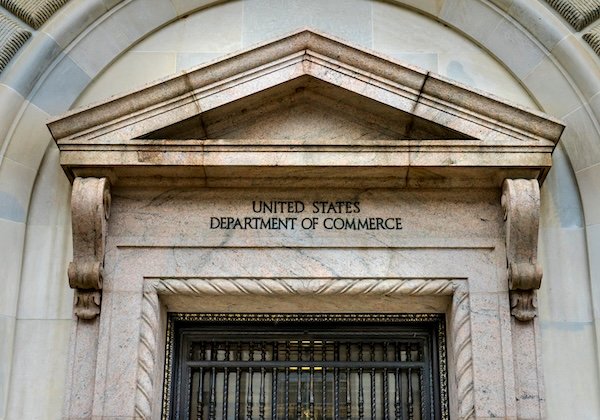

United States August retail sales saw modest gains, according to data issued today by the Department of Commerce’s Census Bureau.
August retail sales, adjusted for seasonal variation and holiday and trading day differences but not price changes, came in at $732.0 billion, up 0.6% over July’s $727.4 billion, which was revised from an initial reading of $726.3 billion, and were up 5.0% annually. Total retail sales from June through August saw a 4.5% increase over the same period a year ago.
Commerce reported that retail trade sales increased 0.6% over July and 4.8% annually, and non-store retailers, which includes e-commerce, posted an 10.1% annual gain. And food service and drinking places saw a 6.5% annual gain.
The recently-released CNBC/NRF Retail Monitor, in partnership with Affinity Solutions, also highlighted August retail sales growth.
It reported that total retail sales, excluding automobiles and gasoline, rose 0.5% sequentially on a seasonally-adjusted basis and were up 6.81% annually on an unadjusted basis, compared to a 1.45% sequential gain from June to July and a 5.89% annual increase in July.
And its core calculation of retail sales (excluding restaurants in addition to automobile dealers and gasoline stations) increased 0.26% sequentially and 6.67% annually, compared to a 1.55% sequential gain and 5.89% annual gain in July. Through the first eight months of 2025, CNBC/NRF Retail Monitor said that total sales were up 5.08% annually, with core sales seeing a 5.27% gain.
The report observed that retail spending still showed growth in August, with consumers buying school supplies in order to try and get ahead of rising tariffs it said could be continuing to impact prices.
“Consumer spending rose again in August, fueled by a still-stable consumer and a robust back-to-school shopping season,” NRF President and CEO Matthew Shay said. “Spending was supported by lower fuel costs, tax-free holidays and consumers buying products before tariff increases take effect. We may be seeing inflationary impacts from tariffs since recent data shows price increases in commodity goods. Even with weaker job growth than many expected, employment remains stable and at a high level, giving consumers the ability to spend thoughtfully on household priorities. Nonetheless, consumers are preserving spending power by cutting back on less-essential services.”

