
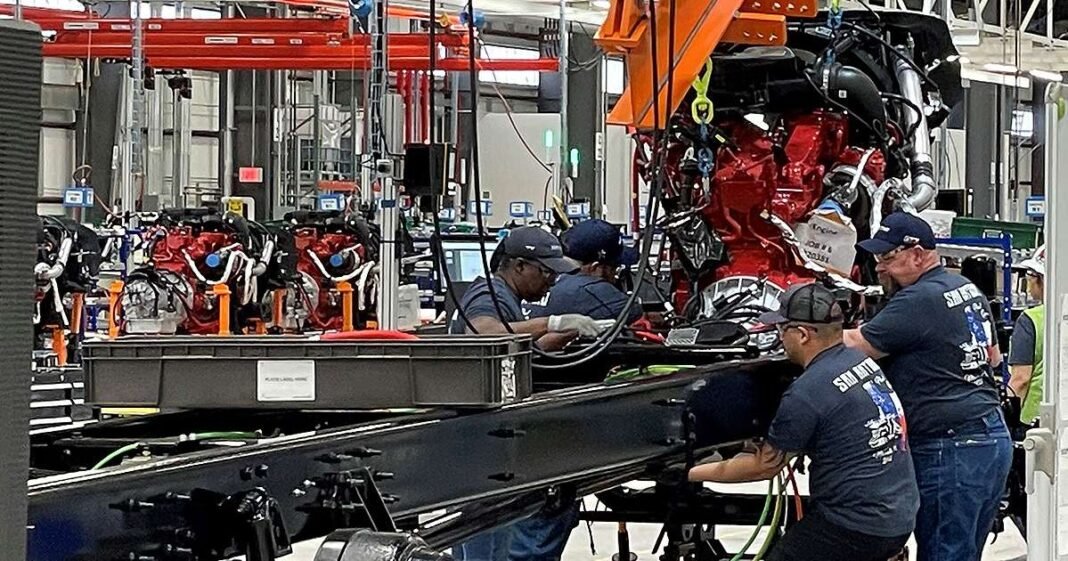

A truck being manufactured at International’s assembly plant in San Antonio. Class 8 truck orders fell for the eighth consecutive month. (Joe Howard/Transport Topics)
[Stay on top of transportation news: Get TTNews in your inbox.]
North American Class 8 truck orders fell year over year for an eighth consecutive month in August.
Analysts and executives at truck makers do not expect the trend to end anytime soon, particularly as vocational demand softens.
Manufacturers’ order boards for the upcoming year typically open in September, but observers say the likelihood of delayed order book launches is growing.
Mack Trucks, however, began locking in production slots for the revamped Anthem semi at the start of the month.
Still, potential customers of the Volvo Group subsidiary and its peers are taking a wait-and-see approach.
“August’s preliminary net orders [are] consistent with today’s cautious fleet investment position we’ve observed throughout this market cycle,” Jonathan Randall, Mack Trucks North America president, told Transport Topics.
RANDALL: Truck Demand Unlikely to Rebound Before Q4 2026
“With freight, and now vocational, sectors experiencing softened demand, ordering patterns are similar to historical market downturns as fleets prioritize optimization over expansion in the current operating environment,” the executive added.
ACT Research said Sept. 5 that August preliminary Class 8 net orders totaled 13,200 trucks, a decline of 19% year over year.
[September State of the Industry: Classes 5-8 Vehicles Preliminary Update] – Preliminary Class 8 Orders Decline Y/Y in August
Read more from the preliminary update here: https://t.co/ge7OYXCWCt pic.twitter.com/H3Re6jRWGt
— ACT Research (@actresearch) September 3, 2025
“A beleaguered for-hire market continues to weigh on Class 8 orders. With elevated uncertainty, particularly around equipment costs, and soft activity in housing and broad freight demand outside of pre-tariff activity, this environment may persist,” said Tim Denoyer, ACT Research vice president and senior analyst.
“Fleet margin pressure has not abated, with contract rates hardly budging and cost pressures ongoing. Vocational demand has taken its knocks as well this year on a combination of regulatory uncertainty, tariffs and elevated interest rates, though data centers remain an area of strong activity,” Denoyer added.
FTR Transportation Intelligence reported August preliminary net orders of 13,000 units, up 4% month over month, but down 14% year over year. FTR estimates the August 10-year average is 23,135 units.
Class 8 orders remain weak: 13,000 in August vs 10-yr avg of 23,135 🚛
Fleets extend lifespans, OEMs face pressure, uncertainty looms for 2026.
👉 Full blog: https://t.co/IaugjZpHvY#Freight #Trucking #Transportation pic.twitter.com/F3geXrU4sH
— FTR | Transportation Intelligence (@FTRintel) September 4, 2025
“The [North American] Class 8 truck and tractor market faces growing pressure from tariffs, near-record inventory, regulatory uncertainty and weak freight demand,” FTR senior analyst of commercial vehicles Dan Moyer said.
“Fleets are extending truck lifespans and incurring higher maintenance costs. Suppliers are squeezed by input inflation and uneven demand. Dealers are leaning on used equipment and service. And OEMs face profitability pressure, volatile schedules and greater supply chain exposure. Until tariff and regulatory paths are clarified, the outlook will remain unsettled,” Moyer added.
Clarity on the tariff picture is causing so much uncertainty among truck manufacturers that order books may not open in September as they historically have, say observers.
Truist Securities Managing Director Jamie Cook noted Sept. 3: “Order books typically open in September. However, we believe if [EPA] ’27 policy and Section 232 tariff uncertainty continues, there is risk that the opening of order books could be pushed out as OEMs do not have clarity on pricing required for 2026 trucks.”
Mark Hill and Danielle Villegas of PCS Software discuss their AI engine, Cortex, designed specifically to level the playing field for midsized carriers. Tune in above or by going to RoadSigns.ttnews.com.
Truck makers remain in limbo over whether the Department of Commerce will impose Section 232 tariffs on medium- and heavy-duty trucks and parts imports.
Section 232 of the 1962 Trade Expansion Act allows the U.S. president to impose levies if Commerce determines imported goods are having a negative impact on national security.
Tariffs on steel, aluminum, copper and rubber have already increased the price of tractors and trucks.
Moyer told the 2025 FTR Transportation Conference in Indianapolis Sept. 8 that he does not expect sales to really rebound until 2027.
Want more news? Listen to today’s daily briefing below or go here for more info:

