
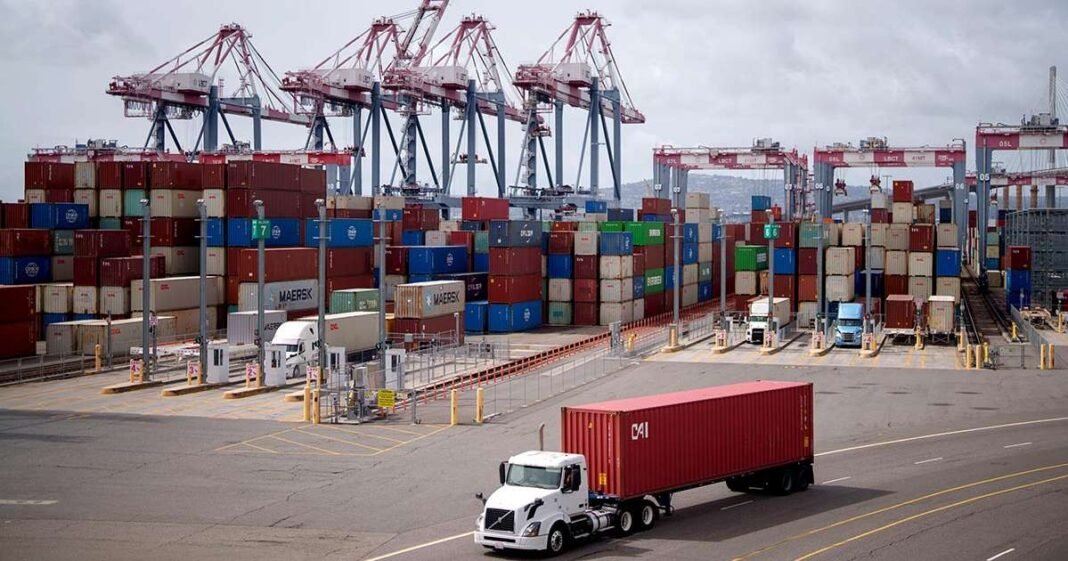

Truck at the Port of Long Beach. (Eric Thayer/Bloomberg)
[Stay on top of transportation news: Get TTNews in your inbox.]
The bulk of President Donald Trump’s global tariffs face their biggest test yet when a U.S. appeals court weighs arguments on their legality July 31, a day before higher rates against many countries are set to kick in.
The tariffs were allowed to stay in place temporarily even after the U.S. trade court in May sided with a group of Democratic-led states and small businesses that claimed Trump wrongfully invoked an emergency law to justify the levies. Now, the U.S. Court of Appeals for the Federal Circuit is set to weigh whether the tariffs are constitutional. A ruling is possible within weeks.
Trillions of dollars of global trade are embroiled in the legal fight. A loss for the government would raise questions about the validity of Trump’s recent trade deals. The administration also would be forced to contend with demands to refund tariffs that were already paid.
The cases are likely to wind up at the Supreme Court, drawing the justices into yet another fight this year over Trump’s agenda.
Tariff Legality
The states and businesses are set to argue that only Congress has authority to issue tariffs and that the levies amount to a massive illegal tax on American companies and consumers who are footing most of the bill. The Trump administration will press its case that the president has broad authority to issue tariffs under a rarely used emergency law, and that his decisions cannot be reviewed by any court.
A 10% flat global tariff has been in effect while the litigation unfolds. Trump set an Aug. 1 deadline for a new round of rate hikes on imports from countries that haven’t struck deals with the U.S., insisting that no further extensions would be granted. The contested levies could be in place for weeks or months before there’s a final resolution, creating more financial uncertainty for businesses.
U.S. trade negotiators continue to strike deals with nations eager to lower their tariffs. Trump has hailed agreements with Japan and the European Union in the past week, following recent deals with nations including the Philippines and Vietnam.
To all of my great lawyers who have fought so hard to save our Country, good luck in America’s big case today. If our Country was not able to protect itself by using TARIFFS AGAINST TARIFFS, WE WOULD BE “DEAD,” WITH NO CHANCE OF SURVIVAL OR SUCCESS. Thank you for your attention…
— Trump Truth Social Posts On X (@TrumpTruthOnX) July 31, 2025
Trump, in a post July 31 on his Truth Social platform, wished his lawyers good luck “in America’s big case today.”
“If our Country was not able to protect itself by using TARIFFS AGAINST TARIFFS, WE WOULD BE ‘DEAD,’ WITH NO CHANCE OF SURVIVAL OR SUCCESS,” he said. “Thank you for your attention to this matter!”
National Emergency
The appeals court will hold the July 31 hearing with its entire slate of 11 active judges instead of a typical three-judge panel, meaning the ruling can immediately be appealed to the Supreme Court. Three of the judges were appointed by Republican presidents and eight by Democrats.
President Donald Trump announces his “Liberation Day” tariffs on April 2 in the Rose Garden at the White House in Washington. (Mark Schiefelbein/Associated Press)
Trump issued a series of executive orders to announce his tariffs using the International Emergency Economic Powers Act, a law that grants the president authority over a variety of financial transactions on an emergency basis. The states and businesses argue Trump’s use of IEEPA is illegal because the law doesn’t mention tariffs and is typically used to levy sanctions and asset freezes during national emergencies.
Tim Haynes of Penske Transportation Solutions discusses how AI is being applied to fleet management, from predictive maintenance to route optimization. Tune in above or by going to RoadSigns.ttnews.com.
In February, Trump used the law to impose tariffs on China, Canada and Mexico, arguing that the flow of the drug fentanyl and illegal immigration into the US constituted a national emergency. The president then declared another national emergency over the persistent U.S. trade deficit and invoked IEEPA to issue duties in April against virtually all U.S. trading partners, his so-called “Liberation Day” tariffs.
The Trump administration said in a brief with the appeals court that Trump is exercising his tariff authority “consistent with his obligations under the Constitution.” The levies, the government argues, are “appropriate to address what he has determined are grave threats to the United States’s national security and economy.”
The states and businesses argue that trade deficits are a persistent part of the U.S. economy and therefore not an emergency, and that the fentanyl-related tariffs are a dressed-up negotiating tactic rather than a legitimate effort to stem the flow of drugs.
“If he’s using unconstitutional powers to implement tariffs, those will be struck down,” said Oregon Attorney General Dan Rayfield, whose office is leading the multistate suit.
Trump has also imposed tariffs on specific sectors like autos and steel under an authority that allows him to do so on national security grounds — so-called 232 cases that trade lawyers consider to have a stronger legal foundation than the IEEPA duties.
At least 11 lawsuits have been filed this year over Trump’s tariff policies. Most are on hold until the Federal Circuit — and potentially the Supreme Court — weighs in.
Earlier in the week, the U.S. trade court rejected a request to reinstate a tariff exemption that Trump got rid of for low-value goods from China, citing the fact that the cases before the Federal Circuit cover the same ground. Trump on July 30 signed a new executive order ending the tariff exemption for low-value imports worldwide — a move expected to invite even more legal challenges.

