
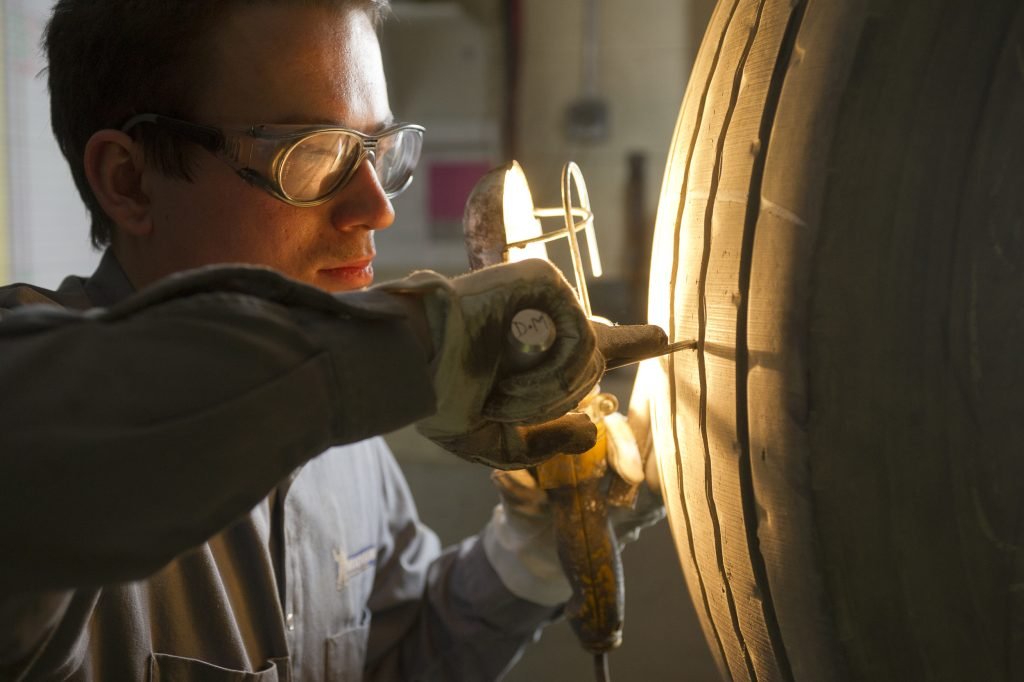

The ‘detecting’ of truck tires, where used tires get a second (or third) life with a new tread, is on the rise. This technique has a very positive effect on the Total Cost of Ownership and helps transport companies to reduce their ecological footprint. The large tire brands also compete with cheap competitors. And they specialize mainly in warm investigation.
With all the big brands, re -profiling is a growing activity. “Our investigation is an essential part of our Total Mobility strategy,” says Goodyear. “It helps fleets to extend the lifespan of tires, reduce waste and reduce operational costs.” At Continental, too, Rechaperage is an integral part of the ‘Contilifecycle’ strategy. “We reuse up to 70% of the original band,” says Continental. Hankook is on the same wavelength and invests to keep track of the growing demand. “Although we still have to inform the customer about the benefits of ‘detecting’. In the Netherlands, we therefore actively participate in the ‘DuurzameBanden.nl’ project.”
TCO counts, not the price
Cheap tires are often seen as an alternative for ties with a renewed tread, but according to the Premium brands, that posture should gradually change. “The Fleet owners increasingly acknowledge that premium tires in combination with detecting and re-profiling yield a better total cost of ownership,” says Goodyear. Continental emphasizes that cheap tires rarely offer sustainable or qualitative benefits. “Renewed tires of a quality brand, such as ours, simply perform better.” Hankook formulates it in this way: “Anyone who only looks at the price loses the TCO. Loses eyes. Today renewed tires are a real competitor for both cheap and quality ties.”
Only warm investigation
In Belgium, the brands usually offer a warm investigation (‘Moldcure’), with a new tread under high temperature and pressure on the carcass is ‘vulcanized’. Hankook does this in its own Reifen Müller factory in Hammelburg, Germany, Michelin has its own factory in Clermont-Ferrand, Goodyear has its own installations in Wittlich in Germany and the French Riom and Continental produces in Hannover (Germany) and Ivybridge (United Kingdom).
What is the cost price and lifetime of these renewed tires? At Michelin one speaks of 60 % of the price of a new band. At Hankook you pay 75% to 80% compared to a new one, and you get a lifespan that can approach up to 100% of the original band. Continental speaks of a price advantage of up to 25% and a comparable lifespan. Goodyear provides a general saving of 10%, and you could even ride it up to 150% longer. The impact of the (limited) costs for the cut -off of the profiles are not included in this.
Carcasses
The handling of carcasses of the tires differs per manufacturer. At Goodyear the customer can choose whether he will get his own carcasses back, or makes a choice for equal copies from the ‘Karkassen-Stock’. The process is made transparent and traceable via the ‘Ecasing’ app. Continental also works with a ‘Casing Pool’: the customer does not necessarily recover his own carcass, but a similar copy with the same quality guarantee. Hankook does not give the customer his own carcasses back.
The re -profiling of tires is possible with all brands, provided that the state of the carcass allows this. This method can yield extra kilometers at a relatively low cost.
Up to three times
Can you only have the tread of your tires renewed once? No, some tires can get a detect two or even three times, depending on the application and condition of the carcass. “In heavy working conditions, such as site transport for large buildings, one detectation is sometimes the maximum,” they found at Continental.
With the Remix 2, Michelin extends the lifetime of a truck tire by 375%. The Michelin Remix 2 comprises two warm tread innovations and three re -profiling. These renewed tires are made with the same molds and rubber compositions as new and cost on average 60% of the price for a new tire. According to Michelin, 9 out of 10 truck tires get several lives and customers save 33% per kilometer.
The Remix 2 is available for the Michelin X Multi-Gamma. With the Remix 2 a band gets several lives: new, re -profiling, warm tread renewal (remix), re -profiling, remix 2 and re -profiling. Remix 2 also contributes to sustainability. Each renewal saves 50 kg of raw materials, with only 20 kg of new material – a saving of 70% compared to the production of a new tire. In addition, up to 115 kg of CO₂ emissions is avoided per renewed band. The renewal of six tires on a three -axle trailer prevents approximately 300 kg of waste. According to Michelin, Remix also provides four times more jobs in Europe compared to buying new tires that are being introduced.
The French manufacturer already started detecting in 1923 and has more than a century of experience with this technique. Yet not all carriers are convinced, we hear in Clermont-Ferrand. There is mainly fear of blind tires. A study by TÜV Süd shows that there is no increased risk if the re -profiling has been carried out correctly. The technology of tread renewal is also often used in aircraft tires. (Erik Roosens)

