
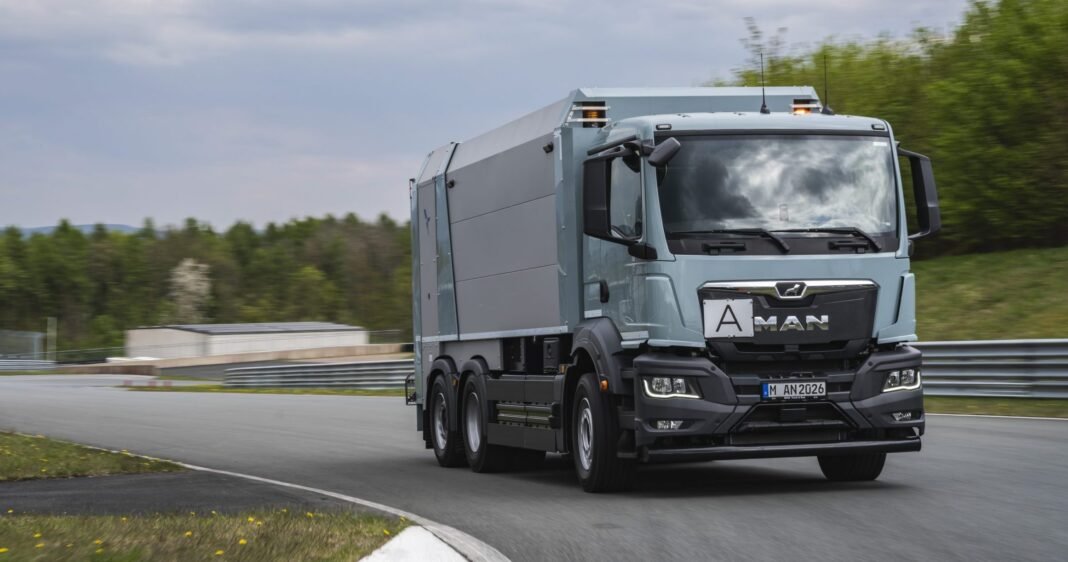

Electric mobility is transforming the municipal sector, with MAN Truck & Bus leading the transition towards cleaner public services across Europe. The company now offers a broad range of electrified vehicle solutions for cities and local authorities, including waste collection trucks, skip loaders, flatbed vehicles with loading cranes, tanker trucks and swap-body vehicles. These electric solutions are helping municipalities deliver essential services with zero local emissions, from refuse collection and winter gritting to specialist emergency and fire brigade operations.
Every year, MAN sells around 4,000 trucks for municipal and fire brigade applications. The company is particularly dominant in the fire brigade sector, where it holds around 40 per cent market share across key European markets including Germany, France, United Kingdom, Austria and Italy.
Image: MAN Truck and Bus
A standout example of electric municipal mobility can be found in the Upper Styrian town of Judenburg. Since late 2025, the town has operated a fully electric MAN rear-loading waste collection vehicle as part of its sustainability strategy. Waste collection is particularly energy-intensive due to constant stop-start driving and continuous operation of onboard systems. Despite these demanding conditions, the electric vehicle achieves a real-world range of up to 120 kilometres per route, with peak performance reaching 180 kilometres while servicing as many as 800 bins. Energy consumption typically ranges between 1.6 and 2 kWh per kilometre, depending on terrain and load weight.
Electric municipal fleets are also becoming increasingly common elsewhere in Austria. The City of Vienna now operates a growing number of electric waste collection vehicles, skip loaders and tipper hydraulic trucks across a variety of operational profiles. Meanwhile, Österreichische Post AG has expanded its use of MAN eTGS electric trucks beyond Vienna into the regions of Styria and Tyrol.
Municipal applications are particularly well suited to electric drivetrains because routes are predictable and involve frequent stop-start operation. MAN’s high-voltage batteries, developed specifically for commercial vehicles and manufactured in Nuremberg, are designed for durability, long service life and high cycle stability under demanding daily conditions.
To support a wide variety of public service applications, MAN works with between 30 and 40 specialist bodywork manufacturers depending on market requirements. This collaboration enables fully electric solutions for refuse collection, winter maintenance and specialist municipal vehicles. High-voltage interfaces and electric power take-offs can deliver up to 90 kW of direct current power, allowing complex body systems to operate entirely electrically.
Image: MAN Truck and Bus
The growth of zero-emission municipal transport is being accelerated by supportive regulation and procurement policies. The EU Clean Vehicles Directive provides public authorities with clear procurement targets for clean vehicles across member states including Spain and Netherlands. From 2026, the directive will require significantly higher quotas for clean heavy goods vehicles and buses, creating greater certainty for manufacturers, infrastructure providers and local authorities.
However, widespread adoption depends on close cooperation between vehicle manufacturers, bodybuilders and charging infrastructure providers. Public sector procurement is expected to play a critical role in accelerating economies of scale and strengthening European supply chains.
“Electric mobility in the municipal sector is no longer a pilot project but a practical solution for everyday use,” says Friedrich Baumann, Executive Board Member for Sales and Customer Solutions at MAN Truck & Bus SE. “Examples such as Judenburg and Vienna clearly demonstrate: it works! And not only technically but also operationally and economically. Funding programmes make a crucial contribution to triggering investment and bringing innovation to wider deployment.”
For cities and local authorities, the advantages of electric municipal vehicles extend beyond sustainability. Zero-emission fleets help authorities meet climate targets while reducing long-term operating costs through lower maintenance requirements and cheaper energy use. Quiet electric drivetrains also reduce noise pollution, enabling more flexible operating hours in residential areas.
In Judenburg, these benefits are already being realised in practice. The town’s electric waste collection vehicle is powered entirely by locally generated renewable energy from hydropower and photovoltaics, reducing costs while increasing energy independence for daily municipal operations.

