
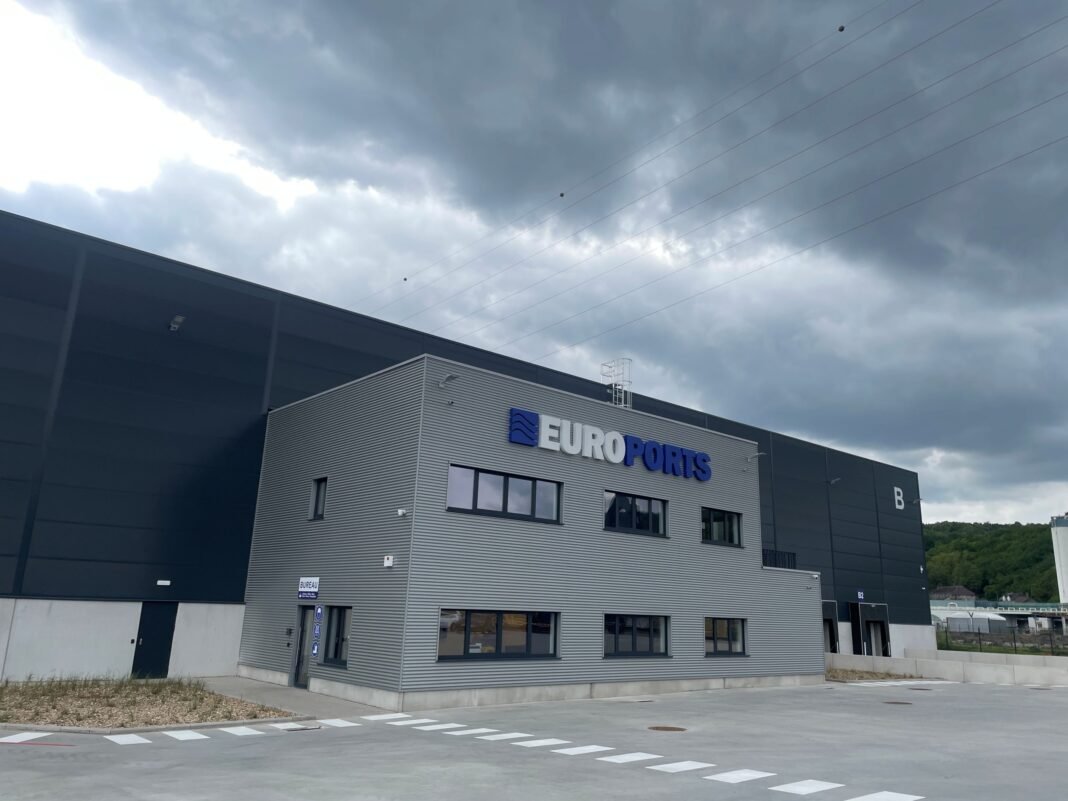

Euroports Inland Terminals has put into use the first phase of its new multimodal terminal in Engis, on the banks of the Meuse: two warehouses with a total surface area of 15,000 m² for customers active in different sectors of the bulk. The procedures for the start of the second phase of the project will be initiated at the end of this week.
The 3R-Port hub is located on a former industrial site (where the CEGRAM factory produced graphite electrodes until 1994), which was purchased by the Eloy group from Sprimont in 2022 and completely renovated. Euroports occupies a third of this 10 hectare site, while on another part of the site a factory for the production of hydrogen via electrolysis by Virya Energy (Colruyt group) is being considered.
Terminal 3R Port Engis currently consists of two warehouses. The first, equipped with six warehouses, is intended for the industrial group Lhoist, while the second, which is designed in a more classic way, will mainly work for Nyrstar and Hydrometal. The terminal has a jetty on the Maas, but is not yet trimodal. Discussions are underway with Infrabel to build a railway line there, which, according to Stéphane Jaumot (Managing Director of Euroports Inland Terminals), is technically very feasible, as there is already an industrial branch a few tens of meters from the site.
The terminal is Seveso certified, which means that both dangerous and non-dangerous goods can be processed within one and the same installation. The scope of work mainly includes heavy metals intended for the recycling and metal industries, minerals such as lime and dolomite, as well as bulk and packaged goods. These features have been taken into account in the design, in particular through a highly advanced system for collecting and storing run-off water, which should prevent environmental damage in the event of an incident involving a product. The Eloy group’s expertise in the field of water purification techniques has proven to be invaluable. In terms of energy, the warehouses are covered with solar panels that can produce up to 450 MWh per year, and a 400 kWh storage battery allows intelligent energy management.
As Stéphane Jaumot explains in the interview he gave us, this is only the first phase of a trilogy: the procedures for obtaining the combined permit will be launched at the end of this week for phase 2, which includes a warehouse for the storage of road salt on behalf of K+S; Phase 3 includes the construction of a fourth warehouse for other industrial companies in the region. This will strengthen the position of Euroports Inland Terminals, which already processes approximately 5 million tonnes of goods per year at 10 locations, representing 8% of the total volume of goods handled by Euroports worldwide, with a predominantly maritime focus.

