
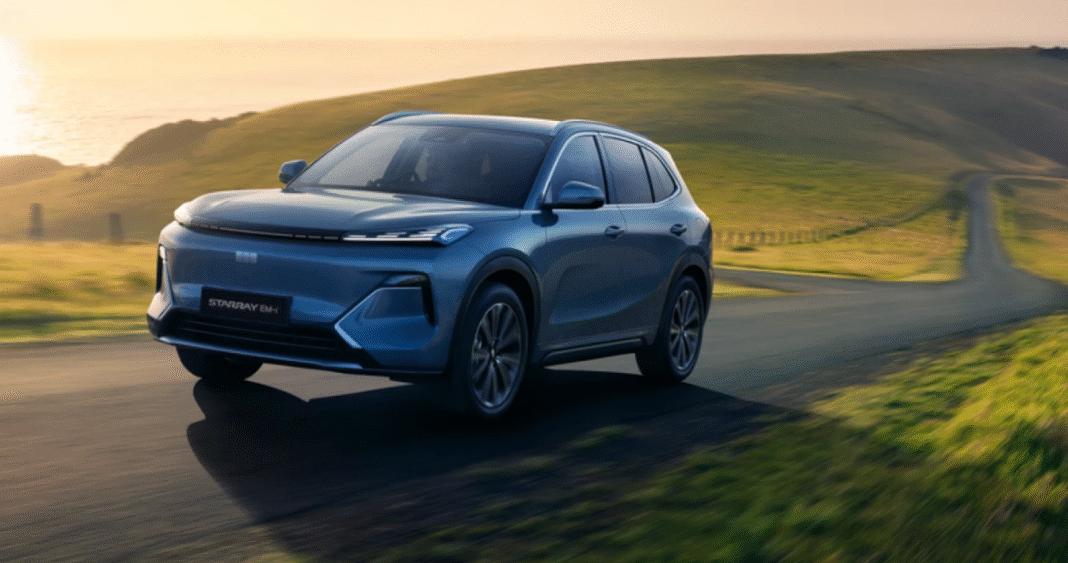

A Week with Geely’s Plug-in Hybrid Stablemate to the EX5, reviewed by Ian Campbell.
First Impressions
Last month I gave you my verdict on the all-electric Geely EX5 Max. This time round, the keys for the test fleet had a different fob attached to them — the Geely Starray 1.5 EM-i Max, the brand’s plug-in hybrid offering that joins its EV sibling on UK forecourts. Same Geely family, different recipe. After a week of mixed driving across Lancashire and beyond, I came away genuinely impressed. This is a properly comfortable car.
Let’s deal with the basics first. The Starray range starts at £29,990 for the Pro and tops out at £34,990 for the Ultra; my Max test car sits in the middle at £32,690. For that you get a 1.5-litre petrol engine paired with an electric motor and an 18.4kWh LFP battery, giving an official 51 miles of electric-only range. Combined power is 258bhp and 0–62mph comes up in 8.0 seconds. The Max trim adds a panoramic sunroof, head-up display, ventilated driver’s seat with memory, heated steering wheel, powered tailgate, wireless phone charging and the same 16-speaker, 1,000-watt Flyme audio system fitted to the EX5 Max. There’s very little you’d feel was missing from this car day to day.
If the EX5 is built for fleets ready to take the EV plunge, the Starray is here for everyone who isn’t. Drivers without home charging, drivers who do irregular long runs, drivers who simply aren’t ready to go full battery yet — this is the car for them. And I suspect that’s a lot of you.
Image: Geely
Design and Interior
Honest answer first — if you parked the EX5 and the Starray side by side and asked me to spot the differences from twenty paces, I’d struggle. The Starray gets its own front fascia (with LED running lights forming a pair of “eyebrows” above the headlights) and slightly different rear styling, but underneath the skin and over the top of it the two cars are essentially twins. Same mid-size SUV body, same proportions, same quietly modern look that won’t turn heads but won’t offend anyone either. For fleet use, that’s a feature, not a bug.
Step inside, though, and one thing immediately stood out to me: the driving position feels noticeably higher than in the EX5, could just be me. Whether it’s the seat geometry or just my perception, the Starray gives you a more commanding view forward and a more traditional SUV feel behind the wheel. On Lancashire’s narrower B-roads where you’re constantly weighing up oncoming traffic, that elevated view is a genuine practical advantage — and it’s comfortable too. Long stretches in the seat never gave me the back ache that a long day in some company cars seems to.
The cabin itself is the same handsome affair I praised in the EX5. The 15.4-inch central touchscreen, the 10.2-inch driver display, the synthetic-leather upholstery, the thoughtful storage — it’s all here. On the Max trim you also get the panoramic sunroof, the heated and ventilated front seats, the head-up display and the 16-speaker audio system. Boot space is 528 litres — a useful 67 litres more than the EX5 thanks to a different floor arrangement — and rear legroom remains very good. I had four six-footers in this car for a thirty-mile run and there wasn’t a complaint.
The wife test, for the record, was again passed without drama. Centre console swallowed the handbag whole, she found the driving position natural, and the chimes once again didn’t bother her in the slightest.In fact she insisted taking it on an airport run rather than her Tesla and that got me surprised.
On the Road
Power comes from a combined 258bhp setup — a 1.5-litre four-cylinder petrol engine producing 98bhp paired with a 215bhp electric motor driving the front wheels through a single-speed E-DHT gearbox. Around town with the battery topped up the Starray is genuinely lovely to drive. Quiet, smooth, and almost indistinguishable from the EX5 in EV mode. This is where most fleet drivers will spend most of their time, and it’s where the Starray shines.
The same softly tuned suspension carries over from the EX5, which means the same composed ride over the moonscape that passes for a British road surface these days. There’s a bit of body lean if you push on, but body control is fine for the way most fleet drivers will use this car. It’s not asking to be hustled down a B-road; it’s asking to waft you to your next meeting in comfort. After a long day on the road, that matters more than anyone wants to admit.
Where the Starray loses a few marks against the EX5 is when the petrol engine wakes up. The transition from EV running to hybrid mode isn’t always seamless, and when you ask for genuine acceleration the engine can sound a touch coarse. Autocar were also critical of the petrol unit under load and the slightly laggy power delivery, and I’d echo that. Keep the battery topped up and the car is brilliant; let it run flat and you become acutely aware that the petrol engine is doing the heavy lifting through what is a fairly modest 1.5-litre unit. Plan your charging accordingly.
Image: Geely
Battery, Range and Charging
The Max trim shares its 18.4kWh LFP battery with the entry Pro — the longer-range 29.8kWh pack is reserved for the Ultra. Geely quotes 51 miles of electric-only range; in real-world driving I saw a comfortable 40–45 miles on a full charge with a mix of urban and dual-carriageway running. Parkers reckon 45 miles is achievable in normal driving and that lines up almost exactly with my experience.
And here’s the thing — for the typical fleet driver doing thirty to forty miles a day to and from the office, that’s the whole game. Plug in at home overnight, drive the commute on electrons all week, and only call on the petrol engine when you’re heading to a meeting in Birmingham or back up the M6 to Glasgow. Run like that, the official 117mpg WLTP figure starts to look believable. Run it on petrol alone with the battery flat and you’ll see closer to 50mpg — still respectable for a car of this size and weight. Cost-effective is the right word for it.
Charging is straightforward. AC charging through a 7kW home wallbox takes around three hours from a quarter to full, perfectly suited to overnight top-ups. DC rapid charging on the smaller-battery Pro and Max is capped at 30kW, which is enough for a 30–80% top-up in about 20 minutes if you’re caught short — not class-leading, but adequate. The faster 60kW DC rate is reserved for the Ultra trim, which is a slight mark against the Max if you do a lot of unscheduled long runs.
The Niggles
Same complaints as last month, I’m afraid. The driver alerts and lane-keeping nags are still over-zealous, and they still don’t remember your settings between ignition cycles. Geely tells us over-the-air updates are coming and I genuinely hope this is one of the first things they tackle, because it’s the single thing most likely to put a fleet driver off.
The touchscreen-for-everything interface is the same as the EX5 — most secondary functions buried in menus, with only a handful of physical buttons (a volume knob being the welcome exception). Add to that the rough transition from EV to engine running, and you’ve got a couple of areas Geely could absolutely sharpen up before the next refresh. None of these are deal-breakers, but they’re worth flagging if you’re putting drivers in this car day after day.
Collision Mitigation Support. Image: Geely
Safety and Warranty
The Starray earned a full five-star Euro NCAP rating in 2025, which is exactly what fleet managers want to see. The full active safety suite is here as standard: adaptive cruise, lane assist, blind-spot monitoring, autonomous emergency braking, traffic sign recognition, the lot.
Warranty is the same headline-grabber as the EX5 — eight years and 125,000 miles of cover including the battery, two years of free servicing, four years of complimentary breakdown cover, and a two-year connected services subscription. For fleet operators chewing through whole-life cost spreadsheets, that’s hard to argue with.
The Fleet Case
Now we’re at the bit that matters. The Starray Max sits in the 9% Benefit-in-Kind band for the current tax year, rising to 10% from April 2026. A 20% taxpayer is therefore looking at around £54 a month in BiK on this car, or roughly £650 a year. Compare that with a petrol-only equivalent in this segment and the saving is substantial — even if it can’t match the EX5’s 2% EV rate.
Crucially, with a list price of £32,690 the Starray Max sits well below the £40,000 Expensive Car Supplement threshold, so you avoid the supplementary annual road tax that catches out so many “nearly there” company cars. First-year VED is £130, dropping to the £195 standard rate from year two.
Further details on the Geely Starray can be found on Whole Life Cost
Geely also throws in eight years of warranty, four years of free breakdown cover and two years of free servicing on top, which sweetens the running cost picture further. Business contract hire deals are still settling but the entry Pro is being advertised from around £260 a month with typical terms; expect the Max to come in at a premium of perhaps £30–50 a month over that depending on contract length and miles.
Now, on price — and this is the bit I’ve been chewing over all week — the Max sits at the higher end of the Chinese PHEV pack. The BYD Sealion 5 starts at £29,995 (though it’s in a much higher 14% BiK band and has a smaller boot), the Chery Tiggo 7 is similarly priced at £29,995 with a matching 10% BiK, and the Jaecoo 7 PHEV undercuts the Starray Max too. The closest direct rival on price and equipment is the MG HS PHEV at £32,245 — essentially in line with the Starray, give or take a few hundred pounds. Where the Starray opens up real distance is against the European mainstream: the Kia Sportage PHEV starts at £40,000-plus, the Ford Kuga PHEV similar, and a Hyundai Tucson PHEV will set you back well north of £38,000. So yes, the Max is more expensive than the cheapest Chinese rivals, but it’s materially cheaper than the established names — and the warranty package, BiK position, lofty driving position, build quality and 528-litre boot all earn it serious points back.
EX5 vs Starray: Which Is Right for Your Fleet?
This is the question I’ve been chewing over all week, and the honest answer is that the two cars suit different drivers.
If your driver has a driveway with a wallbox, predictable journeys mostly under 200 miles, and access to public charging on the rare days they push further, the EX5 Max is the better proposition. With the £3,750 Geely grant the EX5 Max comes in at £33,240 — about £550 more than the Starray Max. But the EX5 sits at just 2% BiK against the Starray Max’s 10% (from April), which means a 20% taxpayer pays around £11 a month against £54. Over a four-year cycle that’s roughly £2,000 in the EX5’s favour on tax alone, before you even start counting fuel savings.
If your driver is on the road a lot, doesn’t have reliable home charging, or covers irregular long-distance trips where range anxiety is a real worry, the Starray Max wins comfortably. The 51-mile EV range covers the daily commute on electrons; the petrol backup means you never have to plan a journey around a charger network. For fleets that mix urban and motorway use, or for drivers transitioning from diesel without taking the full EV plunge, this is a genuinely compelling stepping stone — and that 50mpg-on-petrol-only figure means you’re not punished if a charge gets missed.
The bigger picture is that Geely now offers fleet decision-makers a coherent two-car line-up that covers most of the modern fleet brief at a price the established names still can’t match. That’s worth paying attention to, even if your fleet sticks with German metal for now.
The Verdict
The Geely Starray 1.5 EM-i Max is not a perfect car. The petrol engine is a touch coarse when it gets involved, the ADAS systems remain over-zealous, and the touchscreen-for-everything approach will frustrate the same drivers who didn’t get on with it in the EX5. The price point is real too — the Max sits at the higher end of the Chinese PHEV bracket and you can save money buying a BYD Sealion 5 or Chery Tiggo 7 if pure cash price is the priority.
But you have to weigh that against what you actually drive away with: a comfortable, well-equipped, properly spacious family SUV with an EV range that covers most commutes, the security of petrol backup for the longer trips, eight years of warranty, and a cabin that’s genuinely pleasant to spend time in. The driving position alone is worth the test drive — it’s loftier and more comfortable than the EX5, which surprised me. For the right driver, that’s a winning combination.
If you’re running a fleet where driver charging access is patchy or unpredictable, or you’ve got staff who simply aren’t ready to go full EV yet, you should be calling Geely’s fleet team about the Starray. If your drivers can plug in reliably, stick with the EX5 for the BiK saving alone. Either way, this is a brand that has earned its place in the conversation.

