

During a webinar organized at the end of January for Green Deal members, Sibelga – the operator of the electricity and gas distribution network in the Brussels-Capital Region – drew attention to a crucial challenge in the transition to electromobility: the correct sizing of charging infrastructures. An essential condition for efficient and sustainable electrification of vehicle fleets.
As electric vehicle fleets grow, the charging issue becomes increasingly central. Too often reduced to a simple matter of the number of charging points, it actually requires much broader thinking about usage profiles, user behavior and the actual power available on a site. Alain Guney, responsible for charging infrastructure projects for the government at Sibelga, delivered exactly that message during this webinar.
“Sizing infrastructure doesn’t simply mean adding kilowatts. You need to understand how vehicles drive, when they charge and what restrictions apply to the site,” he explained. With this global approach you avoid technical choices that seem logical on paper, but quickly become problematic in practice. Correct dimensioning must therefore be based on concrete data: daily mileage, vehicle standstill times, loading windows and operational priorities.
Power, flexibility and the risk of wrong choices
Undersizing can quickly put a brake on daily operations, resulting in complex rotations, heavy planning and tensions between users. Conversely, oversizing leads to unnecessary investments in expensive and rarely used installations, while the costs for the contracted power also increase.
To illustrate his point, Alain Guney presented a concrete example of a mixed fleet with ten city cars and two vans, which showed that a purely energetic approach can lead to operationally unrealistic solutions.
“On paper, two charging points may be sufficient, but in practice that is not comfortable,” he emphasized. According to him, the right compromise often lies in more charging points, but with a controlled capacity, to ensure continuity of service and a smooth user experience.
Asset management is emerging as a crucial lever. Fixed control, dynamic control or advanced systems such as an Energy Management System (EMS): each solution corresponds to a different maturity level. In particular, dynamic control makes it possible to adapt charging in real time to the actual consumption of the site, prioritizing critical applications and making optimal use of available power without exceeding contractual limits.
When charging and solar energy come together
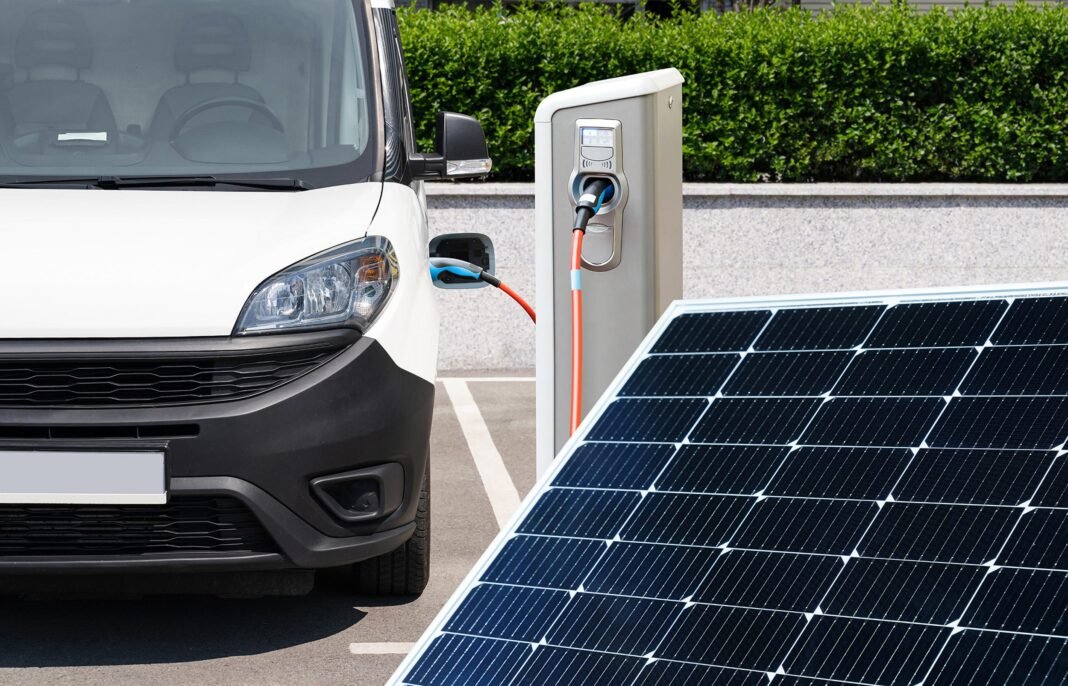
The integration of local electricity production, for example via solar panels, further increases the importance of intelligent management. Without appropriate control, a large part of the energy generated is lost due to a lack of coordination between production peaks and charging moments.
“We often see vehicles that remain plugged in all day, yet they are fully charged in less than two hours,” Alain Guney noted, calling it true ‘photovoltaic waste’. This mismatch not only leads to lower self-consumption, but also to unnecessary grid consumption, especially at the start of the day.
The most advanced EMSs, sometimes linked to artificial intelligence, make it possible to anticipate such situations. By combining data about solar production, user habits and weather forecasts, they automatically adjust the charging capacity. “An EMS is no longer just a technical tool, but a strategic partner for energy efficiency,” he concluded, emphasizing that correct sizing determines the economic and environmental sustainability of charging infrastructure projects.
Electric commercial vehicles: the Sibelga route
At Sibelga, the electrification of commercial vehicles is part of a structured and gradual approach, which started in 2021 with a thorough analysis of mobility needs. “It was essential to understand how our technicians drive, with what type of vehicles and with what operational constraints,” recalled Grégory Navet, head of mobility solutions. After test phases and a detailed mapping of the usage profiles, Sibelga launched several purchasing waves, ranging from compact commercial vehicles to heavier vans. In 2024, all new vehicles with driving license B became fully electric, while the first electric heavy-duty vehicles were ordered in 2025. Today, 25% of the company’s 450 commercial vehicles are fully electric, supported by more than 130 charging points on sites and numerous charging stations at employees’ homes. “The change was realized together with the teams, thanks to feedback from the field and an internal role model,” emphasizes Grégory Navet. This approach has now made electric driving the norm instead of the exception.

