

FuelMarble UK has announced the launch of its fuel-saving technology for UK fleet operators, haulage companies and commercial vehicle managers seeking to reduce diesel costs without replacing vehicles or modifying engines. As fuel prices remain volatile and margins tighten across the transport sector, the solution is positioned as a practical way to improve efficiency within existing internal combustion engine (ICE) fleets.
Designed as a one-time installation, FuelMarble targets fuel inefficiency at the combustion level — an area often untouched by traditional optimisation tools such as telematics, route planning and driver training. By focusing on engine thermal performance, the technology aims to unlock efficiency gains that conventional fleet management strategies cannot achieve alone.
How FuelMarble Works
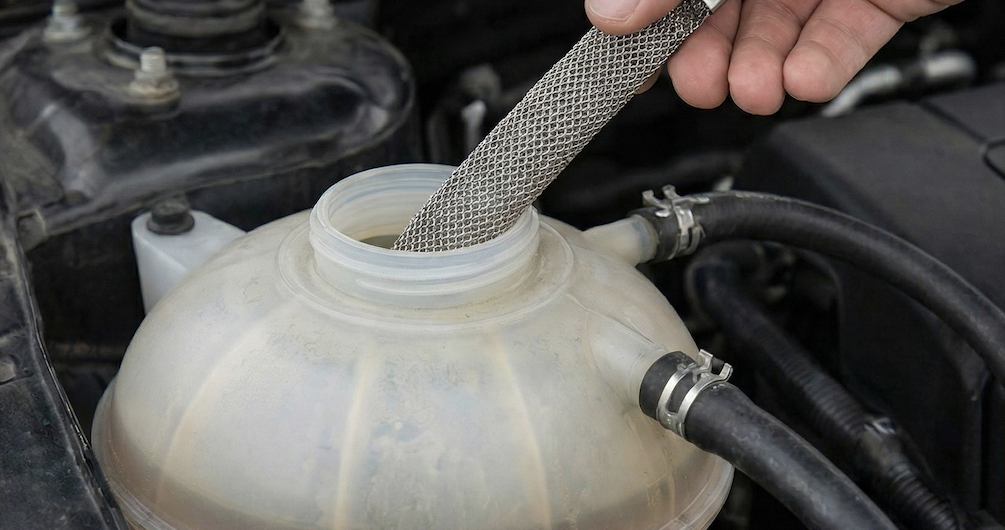
FuelMarble is a precision-engineered functional glass mineral device that installs directly into a vehicle’s coolant reservoir in under 60 seconds. It does not interact with the fuel system or engine components and requires no ongoing maintenance, power source or chemical input.
Originally developed at the Kurume Institute of Technology in Japan under Professor Watanabe Takeshi, the device alters the physical behaviour of coolant within the engine. Specifically, it reduces the coolant’s surface contact angle from 62 degrees to just 4 degrees, improving how effectively the liquid interacts with engine surfaces.
In a standard cooling system, a thin insulating vapour layer — known as the thermal boundary layer — forms between the coolant and engine metal. This layer reduces heat transfer efficiency, allowing engine temperatures to rise unevenly. FuelMarble eliminates this barrier, enabling more consistent contact between coolant and engine surfaces.
As a result, cylinder head temperatures are stabilised by between 8°C and 12°C. This improved thermal regulation helps recover approximately five percentage points of combustion energy that would otherwise be lost as waste heat, enhancing overall engine efficiency.
Verified Performance and Real-World Results
FuelMarble’s performance has been independently validated through more than 20 real-world tests conducted across Japan, Indonesia and China. These trials used controlled fill-to-fill methodologies, comparing fuel consumption before and after installation under consistent driving conditions.
One of the most recent documented tests took place in Jakarta, Indonesia, between 25 January and 25 March 2023. The trial involved a 2012 Honda Freed operating in daily urban traffic. Conducted using the same driver and routes throughout, the study included a 30-day pre-installation baseline followed by 60 days of post-installation monitoring. The test was independently witnessed by engineer Steve Rion.
Fuel efficiency improved from an average of 16.83 km/L before installation to 20.49 km/L afterwards, representing a gain of 21.75 per cent. Emissions testing recorded carbon monoxide (CO) and hydrocarbons (HC) at 0 ppm and 0 per cent across both test periods.
Across all documented trials, FuelMarble has demonstrated typical real-world fuel efficiency improvements ranging from 7 to 15 per cent, with some vehicles achieving gains exceeding 20 per cent depending on engine type and operating conditions. Emissions reductions have also been significant, with testing under Japanese government-standard protocols (TRIAS 71-2001) showing decreases of up to 93 per cent in carbon monoxide and up to 98 per cent in hydrocarbons and nitrogen oxides.
Addressing Cost and Emissions Pressures
With UK fleet operators under increasing pressure to reduce both costs and emissions, solutions that do not require major capital investment are gaining attention. Electrification remains a long-term goal for many businesses, but budget constraints and infrastructure limitations mean that widespread adoption is still some way off.
Avery Ching, Director of FuelMarble UK, said: “Fleet operators are being asked to reduce emissions and cut costs simultaneously, while the capital budget for fleet electrification isn’t yet available at scale. FuelMarble addresses the combustion efficiency problem that no other fleet tool touches — and does it permanently, from the vehicle you’re already running.”
By improving combustion efficiency within existing diesel engines, FuelMarble offers a potential bridge solution for operators seeking immediate savings while planning longer-term transitions to zero-emission fleets.
Regulatory Clearance and Market Track Record
FuelMarble is notable for being the only mineral coolant device to receive clearance from the Japan Fair Trade Commission following a 2008 investigation into fuel-saving device claims. Of the 20 products reviewed during that process, 19 were issued cease-and-desist orders due to unsubstantiated performance claims.
FuelMarble’s data was accepted as credible, allowing it to remain on the market. The technology has been in continuous commercial use since 2002, with more than 180,000 units deployed globally.
As UK fleet operators look for practical ways to manage rising costs and environmental obligations, FuelMarble’s entry into the market offers a new approach focused on improving efficiency from within the engine itself — without the need for vehicle replacement or complex retrofitting.

