
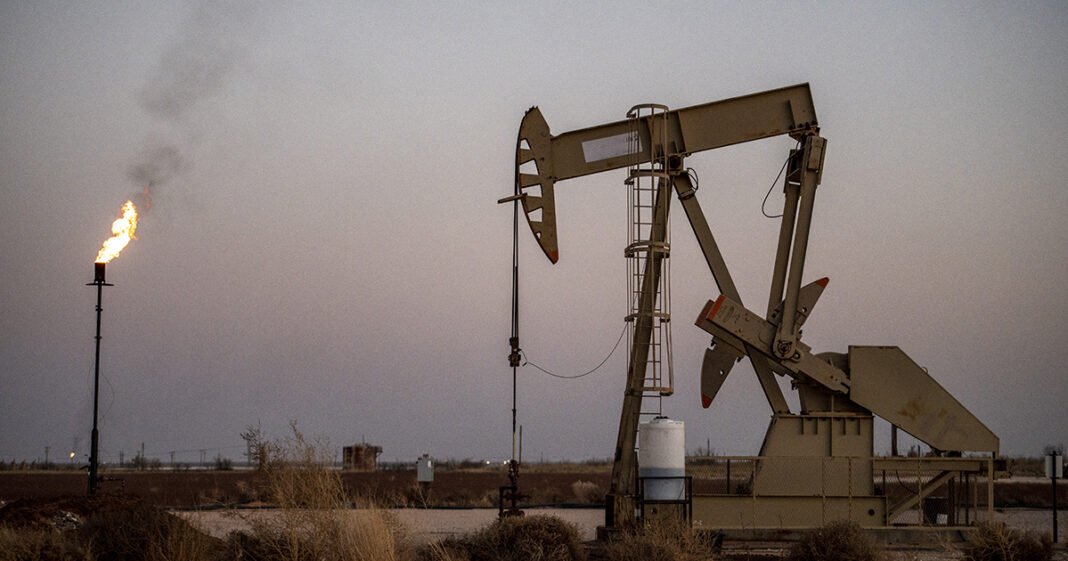

An oil pump jack in Midland, Texas. (Sergio Flores/Bloomberg)
March 26, 2026 2:38 PM, EDT
Almost a month into the war in Iran, oil traders reeling from massive market swings are pulling back as conflicting messaging from Washington and Tehran keeps prices gyrating.
Four of the six largest swings ever seen in international oil benchmark Brent futures have come since the war started at the end of February. Now, as traders struggle to adjust their exposure and protect their positions, evidence is growing that liquidity is thinning, which threatens to worsen the violent moves.
The slowdown is already evident. Total Brent futures open interest plunged to the lowest in four months earlier this month, and consultant Energy Aspects said its measure of liquidity in Brent has fallen to the lowest level since at least April 2024.
“I sense fatigue out here and less liquidity,” said Scott Shelton, an energy specialist at TP ICAP Group Plc. “Most humans have either pared back risk to adjust for VAR (value at risk) exploding or got out completely, which leaves the oil market to the algos competing on trading headlines and generating pain.”
“I am exhausted and my clients are there too as well,” he added.
The White House’s shifting tone — veering from threats of massive attacks to optimism about negotiations — has kept traders on edge as they monitor President Donald Trump’s latest pronouncements, which can come at any time, day or night, weekday or weekend.
While traders are still monitoring the news, some say trading has gone down, with many especially cautious around weekends.
When market volatility spikes, traders’ value at risk — the maximum loss that the position may see during a given period of time — can balloon. Many traders have also hit stop-loss triggers, forced to close out bets after the market reached a pre-determined level. Most of the pullback has been in the futures market and inter-month spreads, traders and brokers said.
The lack of liquidity has arisen partly because many speculative players are long, leaving few traders to buy dips in prices, according to Tim Skirrow, head of derivatives at Energy Aspects. High levels of realized volatility are also contributing to the lower liquidity, he added.
Brent’s 20-day average realized volatility has reached the highest since Russia’s invasion of Ukraine in 2022. That’s even dampened participation among some algorithmic traders notorious for amplifying price swings in regular market conditions.
“The increase in volatility is such that many traders will likely find their available risk capital or VAR is used up very quickly,” Oxford Institute for Energy Studies analysts Bassam Fattouh and Ahmed Mehdi wrote in a note. “The potential for large margin calls means that stops are unlikely to be placed too far from current values.”
While many smaller traders have been stopped out of positions or curbed activity, some larger institutional players appear to be holding on.
Traditional commodity trading advisors, also known as trend-following strategies, have sustained maximum long positions in both oil benchmarks since early March and have widened their stop-out levels to points well beyond current price ranges, according to Kpler. This allows them to hold steady and capture profits while sitting out the breakneck pace of today’s trading environment, the firm added.
The trend suggests that only relatively high-frequency strategies — primarily used by banks and market makers — are actively trading, according to Kpler. These strategies tend to focus on derivatives and, unlike trend-followers, do not typically trade in a way that accelerates price moves.
Physical Oil
To be sure, trading giants who move physical cargoes of oil are showing no signs of a pullback. While lower liquidity means traders have to cough up more to hedge their risk, they stand to make significant profits by moving supplies from the U.S. to Asia.
Fresh from TMC, ATA President Chris Spear takes a candid look at what today’s fleet maintenance trends reveal about the broader state of trucking. Tune in above or by going to RoadSigns.ttnews.com.
The U.S. has an abundance, with commercial inventories sitting at the highest levels since mid-2024, while Asian refiners are scrambling to secure crude as they lose their primary suppliers in the Middle East.
Even for the physical traders, chances for profits come with having to adjust positions rapidly.
“It’s changing so fast that you can be long one minute, and then next thing you know, something comes out and you’re short,” Gunvor Group CEO Gary Pedersen said.
Written by Devika Krishna Kumar, Mia Gindis and Alex Longley

