
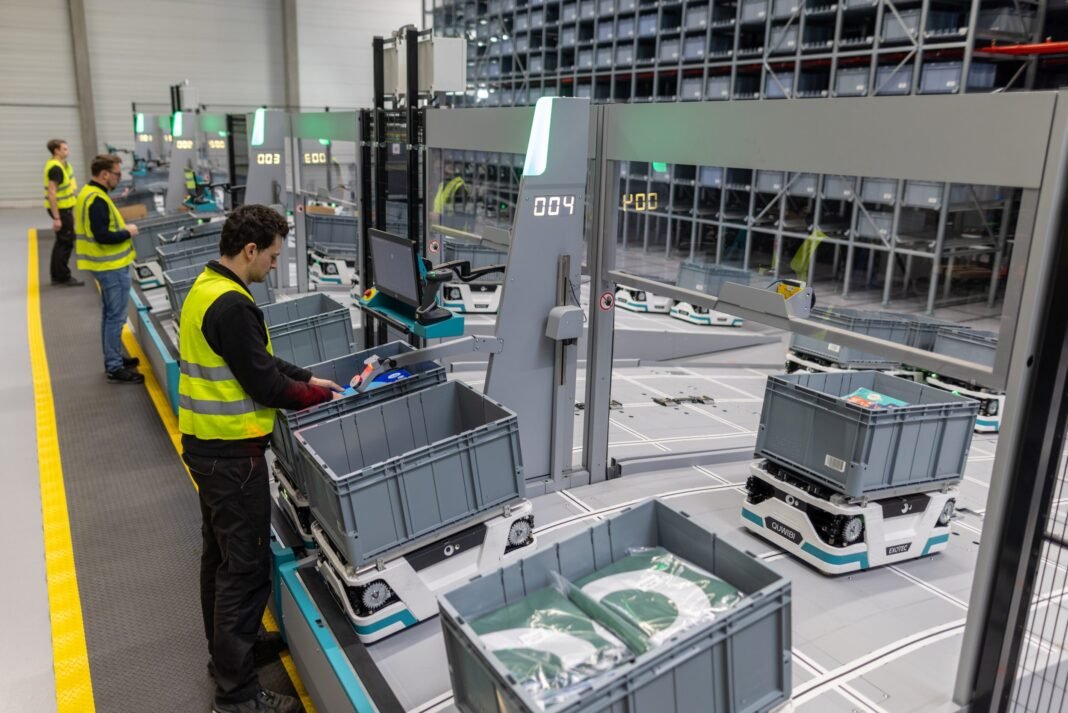

Logistics companies are barely finding employees. It helps explain why automation is becoming increasingly popular in warehouses. But does working with AVGs and other robots make work in warehouses more interesting? Or is motivation actually compromised? Two logistics experts give their opinion.
(Photo: Exotec)
Yes – Alex Van Breedam, TRI-VIZOR
Alex Van Breedam
“Yes, the work of employees who have to manage robots and automation will become much more interesting. Because we know how difficult it is to keep people who do very repetitive warehouse tasks motivated. Automation can solve that. Repetitive work can be highly automated. As a human, thanks to automation, you will mainly do more ‘exceptional’ work: tasks that rarely occur and cannot be automated. Humanoid robots, such as those from Boston Dynamics, may be technically possible, but probably not always the most efficient solution. You will not have a robot perform specific tasks or tasks that only need to be done occasionally or once a day.”
“In addition, in an automated warehouse it becomes an important task to put together and manage a team that consists of both people and machines. It is important that employees are involved in the configuration and management of the robots and cobots with which they have to work. This gives them more ownership and makes human-machine collaboration more efficient.
“Whether employees from a warehouse with only people can easily switch to a logistics environment with people and robots or AGVs? It is inevitable, but as is often the case, the generation that experiences the transition experiences the most resistance. If you start working in a warehouse where there are already robots, it feels normal. If you were in a different situation, then that transition is more difficult.”
No – Thomas De Lombaert, Hasselt University
Thomas De Lombaert
“When AGVs enter the workplace, I always see two types of impact: physical and psychosocial. Physically, automation seems like a blessing at first glance. Robots take over repetitive and taxing tasks, but in practice unexpected side effects emerge. Employees sometimes have to handle even more strain. For example, reach truck drivers develop neck complaints because they have to look up more frequently, order pickers get tired more quickly due to more intensive lifting and bending. What was intended ergonomically, can lead to complaints and failure in the long term.”
“In addition, there is the psychosocial impact. The recent study by PhD candidate Jarne Bosch, which I am co-supervising, shows that employees roughly fall into three groups in terms of acceptance of robots: enthusiastic proponents, outspoken skeptics and a large middle group without a clear opinion. It is precisely the latter group that is crucial. If task variation disappears and jobs become more monotonous, motivation decreases. That is why I advocate giving employees autonomy: let them decide how and with which robots they work, and maintain a human working environment in which robots support, not dominate.”
“So be careful with a top-down approach. Technically, people usually quickly learn to work with AGVs, but if robots are introduced without support, trust and the intended productivity gains quickly disappear. Automation is not a panacea. It only works if technology, ergonomics and human engagement are viewed together.”

