
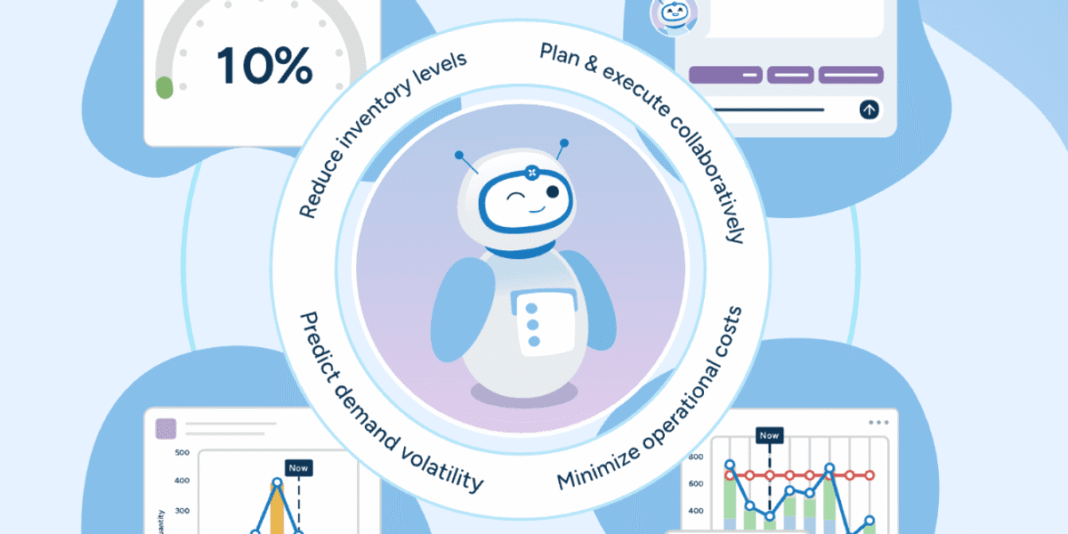

Artificial intelligence (AI) is moving from experimentation to operational decision support across supply chain planning, but only 10% of retail and manufacturing leaders say they would trust AI to make fully independent supply chain decisions, according to a study from tech vendor Relex Solutions.
Instead of allowing AI to make those decisions itself, 54% said they prefer AI to make recommendations while humans finalize decisions. That data comes from “State of Supply Chain 2026: Volatility, Trade-Offs & the Rise of AI,” a report based on a January 2026 survey of 514 retail, manufacturing, wholesale and supply chain leaders conducted by Researchscape.
Despite that skepticism, 67% of respondents to the survey said their confidence in using AI for supply chain decision-making has increased compared with last year. For example, 47% are using or planning AI-driven inventory and supply optimization and 41% are applying AI to logistics and routing.
Meanwhile, many organizations are planning for a future with more AI, with 71% planning to invest in generative and agentic AI and 60% in predictive AI over the next three to five years.
The chief reason behind those investments is that 44% of leaders cite consumer demand volatility as a top challenge over the next three years, reinforcing the need for more intelligent, responsive planning systems.
Retailers continue to feel the downstream effects of demand uncertainty, as 30% cite adapting to sudden consumer demand shifts as a major challenge, reinforcing the need for stronger demand visibility and more responsive planning processes. To address this volatility, retail leaders are increasingly turning to AI-driven forecasting, inventory optimization, and decision-support tools that allow them to respond quickly to changes in consumer behavior while protecting margins and availability.
Manufacturers cited different reasons for investing in AI, with 57% saying raw material procurement disruption is the most impacted area of their supply chain, while 34% citing regulatory and compliance pressures as a growing operational concern.
“AI is becoming part of everyday supply chain decision-making,” Madhav Durbha, group vice president of manufacturing industry strategy at Relex Solutions, said in a release. “As volatility persists, companies are investing in AI-driven forecasting, optimization, and decision support to respond faster and operate with greater confidence, even when conditions change quickly.”

