
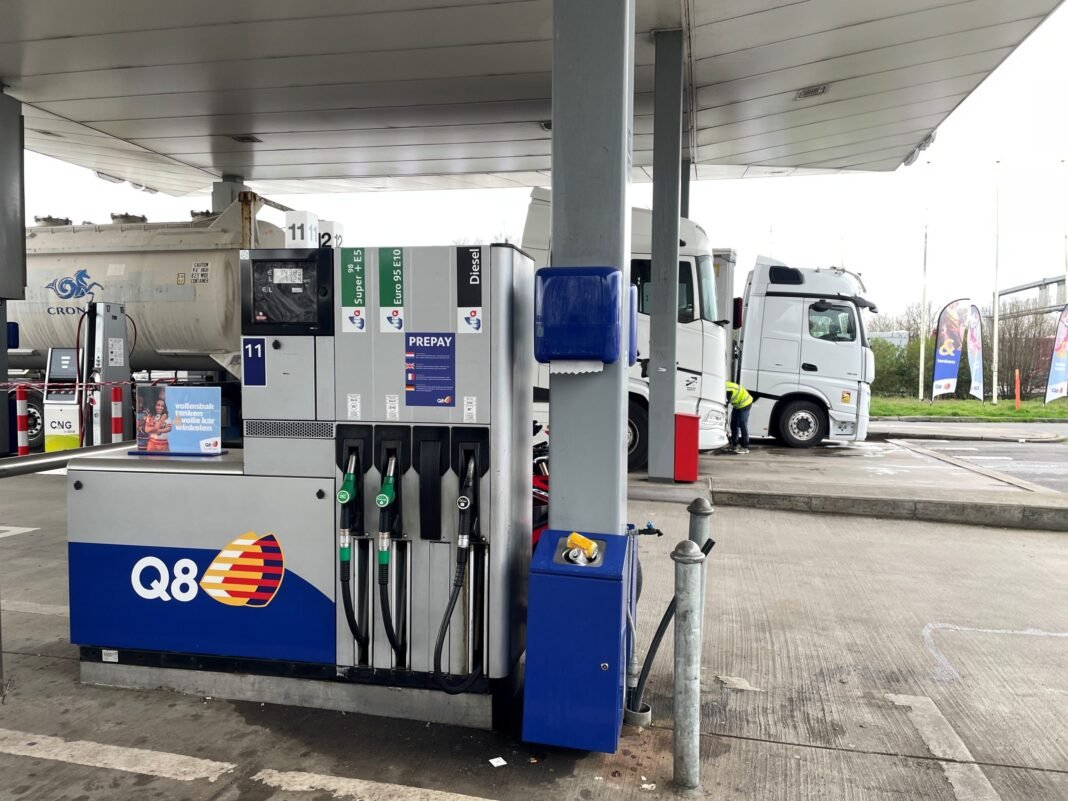

Faced with the explosive rise in diesel prices, Belgian transporters can only count on themselves. So far, no government has lifted a finger to support this sector in dire straits, much to the chagrin of those directly involved and the federations that represent them. There is therefore only one solution: faster and stricter application of the diesel clause.
Let’s first get some facts straight: since January 1, 2026, maximum prices at the pump for diesel have increased by 37%. For transporters, the increase is even more than 42%, according to the ITLB. Let us also not forget that diesel represents 14 to 19% of the cost of transport, depending on whether one is active in the courier sector, general national transport or international transport; this share is currently increasing to 20 to 25%, depending on the case. The ITLB updated its cost price indexes on March 22 and for the time being they have increased by 7.30% in domestic transport compared to January 1 and by 6.27% compared to March 1.
These figures may seem theoretical, but they translate into a much more concrete reality: each truck (based on an average consumption of 30 l/100 km and 500 kilometers per day) costs the operator an additional 90 euros per day. That is 450 euros per week, more than 1,800 euros per month and more than 20,000 euros per year. That is more than the profit margin that most transport companies in Belgium realize per vehicle. The situation is therefore untenable.
The governments are failing
The professional federations have been calling for support measures from the various levels of government for two weeks, but nothing is happening for the time being. Within the federal government, David Clarinval is the only one to raise the possibility of a reverse cliquet (i.e. a temporary reduction in excise duties), but no decision has yet been taken to that effect. In any case, the reverse cliquet would have only a limited impact for transporters, as Michael Reul (UPTR) explains: “The reverse cliquet neutralizes (fully or partially) future increases in fuel prices. This neutralization entails a reduction in the refundable part of the excise duties on professional diesel. For transporters, a possible reverse cliquet would therefore only be a plaster on a wooden leg…” However, there would be a way around this problem, as Philippe Degraef (Febetra) explains: apply the reverse cliquet, but with an exception for road hauliers, who could still get the same amount (19 cents) back for professional diesel.
The UPTR had called on the federal and regional governments to, on the one hand, increase the reimbursement of excise duties on professional diesel and, on the other hand, to postpone the planned increases in the kilometer charge. A position that is also defended by Transport and Logistics Flanders and by Febetra, but which, if it becomes reality, will only remove an additional additional cost from 1 July 2026.
Apply the diesel clause more quickly
Belgian transporters must therefore only rely on themselves and their best asset remains the diesel clause, which is applied by approximately 9 out of 10 transporters. “The problem, when fuel prices skyrocket five times in three weeks, is that the transporter has to wait until the end of the month to send his invoice. That is far too slow: the diesel clause has to be recalculated every week,” explains Vincent Gaillard (Sud-Fresh). An approach that some transporters have already managed to implement, but which conflicts with the wish of clients to also limit their transport costs, causing some to impose payment terms of… 120 days. That would be a deadly combination for carriers whose liquidity is already under pressure.

