
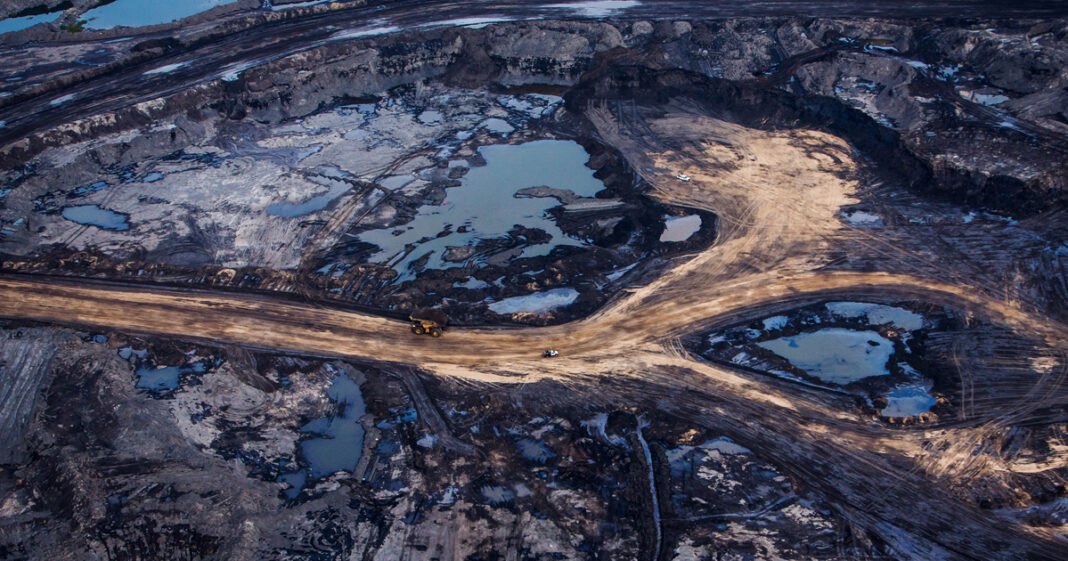

The Athabasca oil sands near Alberta, Canada. (Bloomberg)
March 20, 2026 4:08 PM, EDT
Key Takeaways:
- Canada’s pledge to add 23.6 million barrels of oil faces obstacles from seasonal maintenance cuts, limited pipeline capacity and wildfire risks.
- Analysts say producers would need to defer maintenance to boost output, yet companies have not announced changes and export pipelines remain constrained.
- New projects starting this year, including Cenovus’s West White Rose and additions at Foster Creek, could help meet the goal but will take time to ramp up.
The Canadian government’s promise to boost oil supply by 23.6 million barrels in the coming months faces significant hurdles because of the industry’s seasonal production cuts for maintenance, a scarcity of pipeline space and the looming threat of wildfires.
The International Energy Agency on March 19 confirmed that Canada’s commitment toward a global initiative to supply 400 million additional barrels would come from production increases. The country would be the third-largest contributor to the IEA’s program, with the additional crude equal to about 130,000 extra barrels a day if rolled out over six months.
But Canadian oil companies have been planning to take more than 300,000 barrels a day of production offline for maintenance in the spring and 400,000 barrels in the fall, Taylor Lee, vice president of upstream research at Rystad Energy, said at a conference in Calgary this week.
In order to get more crude out fast, they would have to put off that work, which they typically have locked in because of long planning times. Some new projects are set to begin production this year, including an offshore oil play off the coast of Newfoundland owned by Cenovus Energy Inc., but they’re not quite ready.
“Maybe in the max case scenario, you could get 200,000 barrels per day, but through deferral of maintenance,” Lee said. “These maintenance and deferral periods involve long lead times. Most of these companies have their budget set.”
So far, none of the major Alberta oil sands companies, including Cenovus, Suncor Energy Inc., Canadian Natural Resources Ltd. or Imperial Oil Ltd., have announced plans to postpone or scale back maintenance. Emails and phone calls to the companies to ask about turnaround delays were not returned.
Production in Alberta, the source of about 85% of Canada’s oil output, falls an average of 5.7% in the second quarter versus the first quarter, with May being the month when output is most often at its lowest, according to Alberta Energy Regulator data.
Federal Energy Minister Tim Hodgson announced the country’s contribution last week. The 32-member IEA made the move in a bid to address a near-total shut down of oil exports through the Strait of Hormuz, where about 20% of global crude flows.
As one of the world’s largest crude exporters, Canada holds no strategic petroleum reserve. The country produces more than 5 million barrels a day.
With West Texas Intermediate soaring to nearly $100 a barrel, companies have every incentive to run major oil sands sites at maximum production, but higher output doesn’t mean they could access export pipelines.
Hodgson. (Dhiraj Singh/Bloomberg)
Enbridge Inc. has been rationing space on its Mainline, the largest oil export conduit. While the Trans Mountain pipeline has some room, it has run at as high as 96% capacity in recent months and could exceed that as Asian buyers look for alternatives to Middle East oil.
Shipping crude by rail isn’t currently economical due to the price differences between destinations, according to Martin King, RBN Energy’s managing director of North America energy market analysis.
“There’s not really room on the pipe, and if you’re going to put it on rail, the differentials right now would have to be more attractive and they’re not attractive enough,” he said. “So it’s a little bit of a mystery from where this crude is supposed to originate and how it’s supposed to get to market.”
The Canadian Association of Petroleum Producers trade group said new pipelines would be required for meaningful new oil and gas production growth. “There is very minimal short‑term ability for Canadian producers to further increase production in response to potential supply disruptions arising from the conflict in the Middle East.”
Oil sands producers regularly plan what are called turnarounds to shut equipment and repair machinery. Turnarounds this spring include major work on Suncor’s Firebag in-situ oil sands site starting in April that will cut output by 85,000 barrels a day for the second quarter, according to the company and a local union.
Work on the Suncor Base Plant mine upgrader will reduce output of bitumen and synthetic crude by a combined 85,000 barrels a day in the same quarter. Additional downtime is planned at Cenovus’s Foster Creek site, at Suncor’s Fort Hills mine and Imperial’s Kearl mine.
Repairs on Suncor’s majority-owned Syncrude upgrader, planned for March through May, were pushed back until August due to an unrelated breakdown, Bloomberg News reported last week.
Another potential challenge are wildfires that tend to erupt in oil-producing regions of northern Alberta. Last year, three major oil sands in-situ well sites, accounting for about 350,000 barrels a day of production, were briefly shut due to a blaze near Cold Lake.
Some projects that are set to open this year could help fulfill Canada’s goal. New wells are being added to Cenovus’s Foster Creek, and International Petroleum Corp.’s Blackrod project in the oil sands will start producing crude this year.
And off the coast of Newfoundland, the Cenovus majority-owned West White Rose project is slated to open in the second quarter and ramp up to 80,000 barrels a day by decade’s end.

