
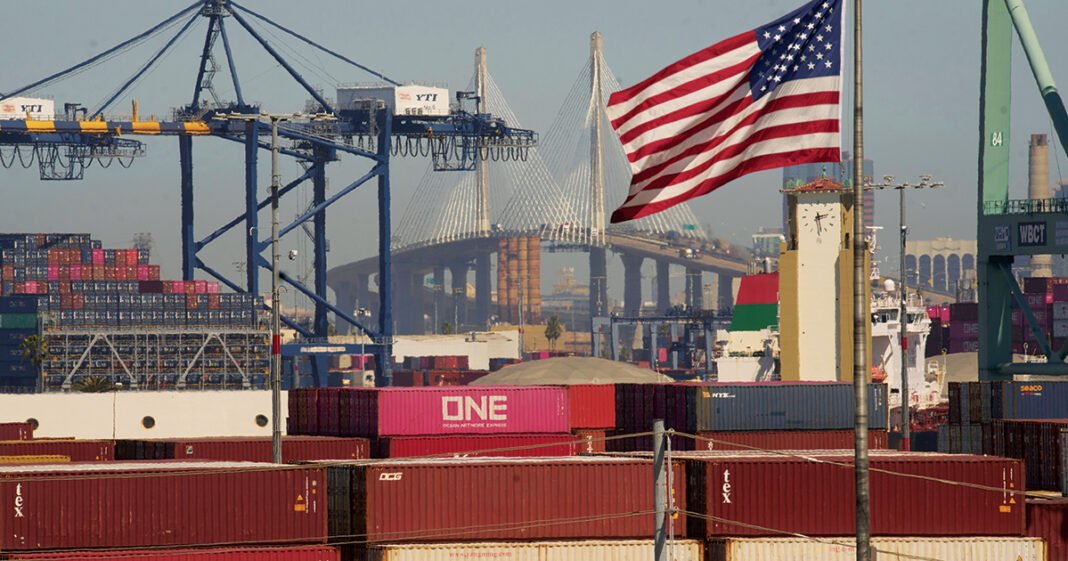

Containers stacked up at the Port of Los Angeles with the Long Beach International Gateway Bridge in the background in April. (Damian Dovarganes/Associated Press/File)
March 13, 2026 11:08 AM, EDT
The Trump administration said it’s making progress on building a web-based portal to handle refund requests for almost $170 billion in global tariffs that were overturned by the Supreme Court, though it remains unclear when exactly the system will go live.
The portal, which is about 70% complete, is part of a new system that will automatically verify and process an expected wave of refund requests before issuing payments electronically, a Customs and Border Protection official said in an affidavit March 12 with a judge overseeing thousands of lawsuits seeking refunds. No timetable was provided for completing the project.
In response, Judge Richard Eaton of the Court of International Trade issued an order saying CBP is “making satisfactory progress” in developing a system that indicates “refunds can be expedited to those importers who take the necessary steps to receive refunds electronically.”
Eaton asked for another update by March 19. The judge has previously said that “every single cent” of tariffs collected under the International Emergency Economic Powers Act, or IEEPA, must be returned.
The Supreme Court ruled last month that Trump unlawfully used IEEPA to impose so-called reciprocal tariffs on goods entering the country to address persistent U.S. trade deficits. Since then questions have swirled around when and how importers may get refunded.
In the affidavit, CBP official Brandon Lord said the system under development is called the Consolidated Administration and Processing of Entries, or CAPE. It’s intended to be largely automated once a claim is made and is being designed to issue consolidated refunds to importers, Lord said.
“CBP expects that in its first phase of development, CAPE will be able to process the majority of formal and informal entries on which IEEPA duties were paid,” Lord said.
Patrick Brennan of Cox Fleet talks about the common missteps that fleets make in planning for future maintenance and operational needs. Tune in above or by going to RoadSigns.ttnews.com.
Greg Husisian, a partner at Foley & Lardner representing companies seeking about $1 billion in refunds, said he’s concerned about a process that requires importers to opt-in, versus the government using the records it already has to calculate refunds. Small businesses in particular may not have the resources or expertise to participate, he said.
“This is at best make-work, and at worst a cynical way for the government to keep refunds,” Husisian said.
The process, if it takes effect, will impact hundreds of thousands of U.S. importers with tens of millions of IEEPA tariff payments. It’s unclear if Eaton could request or order any changes, or if the plan may face challenges from importers. Any disagreement could lead to a new wave of appeals.
Patrick Brennan of Cox Fleet talks about the common missteps that fleets make in planning for future maintenance and operational needs. Tune in above or by going to RoadSigns.ttnews.com.
The details in Lord’s March 12 affidavit add to one he provided March 6, when he said CBP was working on a process that “will be simpler and more efficient” than the current process and would potentially be ready for use in as soon as 45 days.
Joyce Adetutu, a partner at Vinson & Elkins, said in an email to Bloomberg News that the process proposed by customs officials so far would “likely streamline” things by allowing each importer to collectively seek refunds for all of the goods they brought in, as opposed to by entry.
She warned that there appeared to be a few steps where businesses could face more delays, such as if their documentation didn’t satisfy the government’s criteria or if there was disagreement about the refund amount.

