
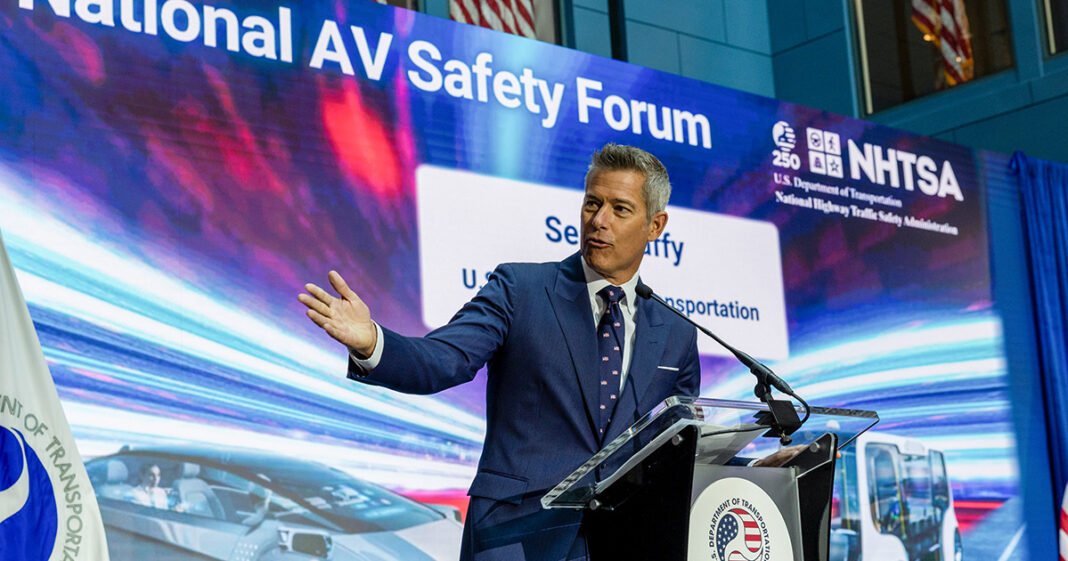

“We want to make sure that the United States leads the way on safety and on innovation,” Transportation Secretary Sean Duffy said March 10. (Alex Kent /Bloomberg)
March 11, 2026 3:09 PM, EDT
Key Takeaways:
- DOT is advancing updated safety standards and regulatory actions to support commercial‑scale autonomous‑vehicle deployment.
- Federal officials emphasize the need for consistent nationwide rules, especially for longhaul trucking operations crossing multiple jurisdictions.
- Lawmakers are revisiting stalled AV legislation as Congress prepares for the upcoming surface transportation reauthorization.
The Department of Transportation is preparing a series of autonomous-vehicle regulatory moves this year to further shape how the technology reaches commercial scale — including in the freight sector.
The actions, announced by Secretary Sean Duffy at the first-ever AV Safety Forum in Washington on March 10, are part of an ongoing effort to establish a predictable national framework for automated driving systems.
The department’s push comes as the trucking industry continues to explore automated driver‑assist systems, pilot freight corridors and longhaul autonomous truck testing.
“Here at DOT, we talk about the ‘Golden Age’ of transportation. And we think that Golden Age is about safety and the Golden Age is about innovation,” Duffy told stakeholders at the forum. “And we want to make sure that the United States leads the way on safety and on innovation.”
A consistent AV rulebook would reduce uncertainty for companies developing vehicles, such as automated commercial trucks. (Kodiak Robotics Inc. via YouTube)
While his remarks focused on robotaxis, the secretary also reminded attendees that a consistent AV rulebook would reduce uncertainty for companies developing vehicles, such as automated commercial trucks.
Duffy pointed to the ongoing work toward arriving at a robust federal AV framework. He explained the objective is for companies to be able to “develop a vehicle, deploy a vehicle, scale a vehicle” nationwide — a point that carries particular weight for longhaul trucking routes that routinely cross multiple jurisdictions.
Easing Access to Technology
The secretary also said he approved proposed updates to several safety standards to further facilitate access to the technology.
“These updates would remove unnecessary requirements for manufacturers when they make an AV,” Duffy explained. “So, if we don’t have a driver, do I need windshield wipers. Do I need something to defog my car. You might want those … but do I need them if I don’t have a driver.”
The secretary emphasized that roadway safety remains central to the agency’s decision‑making, citing the estimated 40,000 highway fatalities that occur annually. Certain levels of automation, he contends, would help reduce those numbers, depending on how the technology is deployed and regulated.
Safety, Efficiency Are Integral
For trucking, safety and efficiency are closely linked in industry discussions about the role of automation. Carriers exploring advanced driver‑assist systems have indicated they need regulatory clarity to evaluate operational models, insurance expectations and workforce impacts.
Last year, Duffy unveiled the National Highway Traffic Safety Administration’s updated AV framework. According to DOT, this aimed to “blaze a path for the safe commercial deployments of AVs while improving both safety and mobility for the American people.”
The regulatory push also intersects with congressional interest in how automation might reshape freight movement, prompting lawmakers to revisit stalled efforts to create a national AV framework.
Together, @SecDuffy and @NHTSA are unleashing innovation and empowering AV innovators to build in America! 🇺🇸 https://t.co/pcLs0EtMkM
— U.S. Department of Transportation (@USDOT) March 10, 2026
At a hearing with stakeholders last month, Senate Commerce Committee Chairman Ted Cruz (R-Texas) said the moment had arrived for Congress to adopt a national AV regulatory framework. “Autonomous vehicles, or AVs for short, are no longer theoretical,” Cruz said. “Like it or not, they are here and will be central to the future of roadways.”
On the other side of the Capitol, Rep. Bob Latta (R-Ohio) continues to call on colleagues to support his most recent version of the Safely Ensuring Lives Future Deployment and Research in Vehicle Evolution (SELF DRIVE) Act. Co-sponsored by Rep. Debbie Dingell (D-Mich.), the bipartisan legislation would establish a national safety and regulatory framework for AVs.
We must come together to advance an AV federal framework for their safe deployment and to remain at the forefront of this technology, manufacturing, and safety. AVs have the potential to make our roads safer & more accessible.
— Rep. Debbie Dingell (@RepDebDingell) February 2, 2023
“I’ve said from the start, and I’ve always said this: AVs must be as safe or safer than anything on the road today,” Latta recently told colleagues about his bill that responds to long-standing concerns about the lack of a national AV framework.
For nearly a decade, federal lawmakers have been unable to finalize bipartisan AV legislation. The upcoming surface transportation reauthorization — expected to move in committee this spring — will give Congress its next chance to examine a national framework.

