
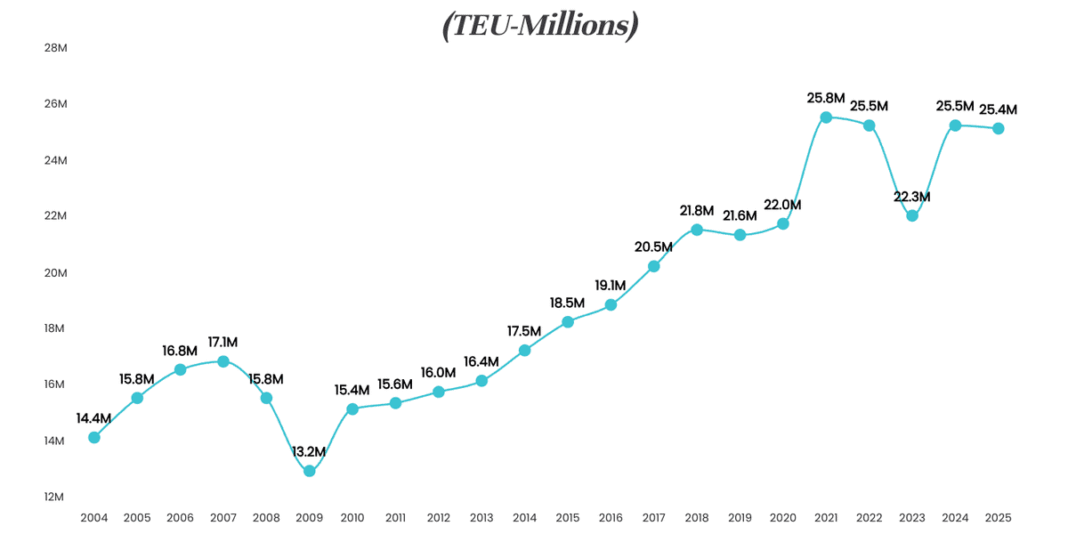

Uncertainty will continue to roil U.S. container ports, as imports are expected to remain below last year’s levels for the first half of 2026 amid ongoing tariff uncertainty, and it is too soon to gauge the impact of the conflict in Iran, according to the Global Port Tracker report released today by the National Retail Federation (NRF) and Hackett Associates.
Violence in Iran and neighboring Middle East nations has quickly hampered international trade flows in the first nine days of the new war. But it is too soon to measure the potential impacts on containerized goods reaching U.S. shores, Hackett Associates Founder Ben Hackett said.
“The immediate impact on containerized traffic to the United States is not likely to be substantial since little U.S.-bound container cargo is sourced from the region,” Hackett said. “While it is too early to measure in the monthly data, increasing oil and gasoline prices will inevitably drive structural inflation if the conflict persists. That, in turn, could squeeze consumer discretionary spending and U.S. manufacturing, and ultimately drive down import volumes in the longer term.”
But even as those impacts continue to develop, U.S. ports are already struggling with fast-changing tariff conditions, NRF Vice President for Supply Chain and Customs Policy Jonathan Gold said.
The Supreme Court last month ruled against the Trump Administration’s use of tariffs under the International Emergency Economic Powers Act (IEEPA). President Donald Trump immediately responded by announcing a temporary, 150-day 10% tariff under Section 122 of the Trade Act of 1974, and the administration later said the rate could be increased to 15%. The administration is also looking at launching a series of new Section 301 trade investigations.
“The Supreme Court has struck down IEEPA tariffs but other tariffs have already been announced and others will be coming, so uncertainty continues for retailers,” Gold said. “The need for clear and predictable trade policy remains, and long-term planning continues to be difficult for merchants and other businesses. While we agree with holding our trading partners accountable and looking for more domestic manufacturing opportunities, it needs to be understood that tariffs drive up costs for businesses and prices for consumers.”
By the numbers, ports have not yet reported numbers for February, but Global Port Tracker projected the month at 2.01 million TEU, down 1.3% year over year. March is forecast at 1.91 million TEU, down 11.2%; April at 2.03 million TEU, down 8.1%; May at 2.09 million TEU, up 7%; June at 2.1 million TEU, up 6.8%, and July at 2.2 million TEU, down 8%.
Those numbers would bring the first half of 2026 to 12.21 million TEU, down 2.5% from 12.53 million TEU during the same period in 2025. The year-over-year increases in May and June are largely because of the sharp drop-off in imports during those months last year after “Liberation Day” tariffs were announced in April 2025.
Imports during 2025 totaled 25.4 million TEU, down 0.3% from 25.5 million TEU in 2024. The report provides historical data and forecasts for the U.S. ports of Los Angeles/Long Beach, Oakland, Seattle and Tacoma on the West Coast; New York/New Jersey, Port of Virginia, Charleston, Savannah, Port Everglades, Miami and Jacksonville on the East Coast, and Houston on the Gulf Coast.

