
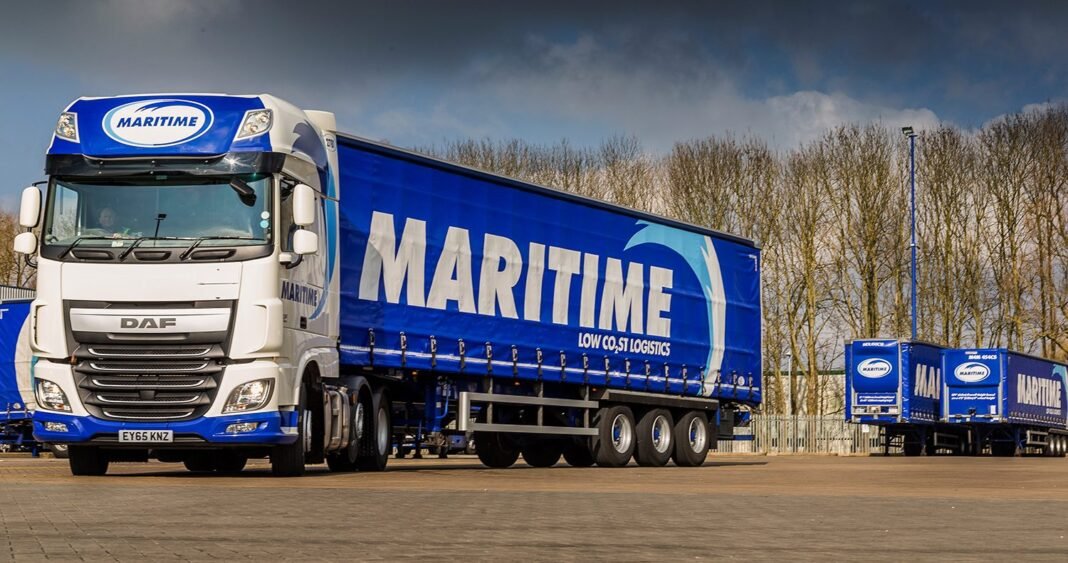

Maritime Transport, the UK’s leading provider of integrated road and rail freight logistics, is supporting an Ofgem-funded innovation project aimed at helping freight operators plan for the electrification of heavy goods vehicles (HGVs) within the constraints of the UK’s energy network.
The Future Fleet project has received funding from Ofgem and UK Research and Innovation (UKRI) through the Strategic Innovation Fund, managed in partnership with Innovate UK and led by UK Power Networks. Four innovation projects were awarded funding in this round, each focused on driving the UK’s transition to Net Zero while addressing the challenges posed by changing electricity demand and usage patterns.
Future Fleet brings together logistics operators Maritime Transport and Voltloader, megawatt charging provider Voltempo, and industry partners Energy Systems Catapult and Baringa. The project aims to define real-world freight operator profiles and pair them with tailored energy solutions, including flexible grid connections, on-site battery storage, and smart, megawatt-scale charging strategies. These insights will help identify the most cost-efficient pathways to large-scale decarbonisation of road freight.
Maritime Transport is providing operational expertise from a freight operator perspective to help develop representative fleet profiles. This insight will support the project in exploring how different energy arrangements could be deployed for electric HGVs, reflecting real operating conditions and constraints.
Future Fleet is currently in the Alpha phase of the Strategic Innovation Fund, which focuses on proving concepts through small-scale testing and validating key assumptions before scaling up. Alongside Future Fleet, the SHARED (Smart Hydrogen and Resilient Energy Decarbonisation) project has also entered the Alpha phase, while Wayl-Ease and SNUG (Smarter Network Upgrades) have progressed to the Beta phase, where solutions are demonstrated at a larger scale over extended periods.
Maritime’s involvement builds on its wider decarbonisation efforts, including participation in all three national projects under the Zero Emission HGV and Infrastructure Demonstrator (ZEHID) programme. Funded by the Department for Transport and delivered in partnership with Innovate UK, ZEHID aims to develop the data, insights, and infrastructure required to make large-scale electric road transport commercially viable across the UK.
Luca Grella, Head of Innovation at UK Power Networks, said: “We’re thrilled to see all these projects progress to their next phase. Each one pushes the boundaries of what’s possible in delivering a smarter, more resilient and low-carbon energy system. From AI-enabled, data-driven grid upgrades electrifying freight to new ways of unlocking flexibility in homes, these innovations will play a vital role in accelerating the UK’s journey to a low-carbon future.”
Tom Williams, Deputy Chief Executive Officer of Maritime Transport, added: “We’re delighted to be involved in the Future Fleet project. A lot of the discussion around eHGVs focuses on the trucks themselves, but for many operators, the bigger challenge is access to power and how quickly sites can be made ready. By contributing operational insight, we’re helping to highlight where the real constraints sit and what needs to change to encourage wider deployment.”

