
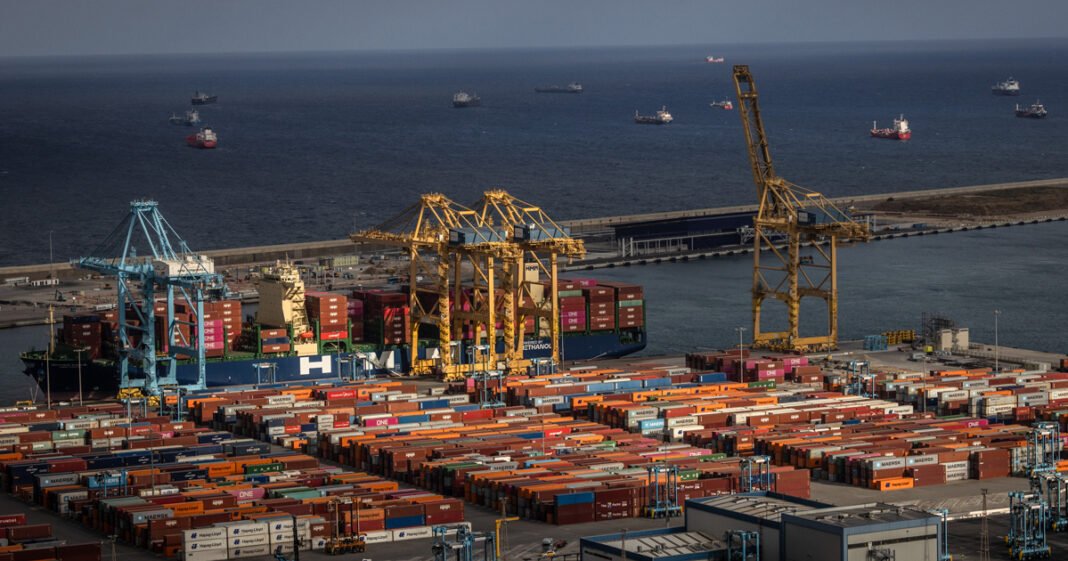

“Spain has absolutely nothing that we need other than great people,” Trump said. (Angel Garcia/Bloomberg)
March 3, 2026 1:55 PM, EST
Key Takeaways:
- President Donald Trump said Mar. 3 he told Treasury Secretary Scott Bessent to cut off all trade with Spain after it blocked U.S. access to military bases for strikes on Iran.
- The threat, which Trump suggested could include a full embargo, came as Spanish officials condemned the operation as outside international law and markets in Spain fell sharply.
- Trump and German Chancellor Friedrich Merz pressed Spain to raise NATO defense spending, while Bessent said Trump had legal authority for an embargo without indicating next steps.
U.S. President Donald Trump directed Treasury Secretary Scott Bessent to “cut off all trade with Spain” after the country denied access to its military bases for his bombing campaign against Iran.
“I told Scott to cut off all dealings with Spain,” Trump said March 3 during a meeting with German Chancellor Friedrich Merz at the White House.
Trump didn’t explain how he planned to follow through with that threat, which could prove particularly difficult since the U.S. has a trading relationship with the broader European Union. Later, he suggested he had the power to impose a full embargo on goods from the country, though didn’t indicate explicitly that he planned to do so.
“Spain has absolutely nothing that we need other than great people,” Trump said. “They have great people, but they don’t have great leadership.”
Trump’s remark came after cash equities trading in Spain closed March 3. The iShares MSCI Spain ETF was down by 5.7% as of 6:32 p.m. in Madrid, after paring an earlier decline that had reached as much as 6.8% as European stocks were pummeled by inflation concerns throughout the session.
On March 1, Spanish Prime Minister Pedro Sanchez said the U.S. and Israeli operation amounted to an “unjustified, dangerous military intervention outside international law.” The government in Madrid warned Washington it can’t use the two military bases in the country’s south to support the operation, arguing that such involvement would fall outside the treaty governing the facilities.
RELATED: EU to Suspend Planned Countertariffs on $109B of US Goods
“We want military actions always under the United Nations charter and under collective effort,” Spanish Foreign Minister Jose Manuel Albares said in an interview with Bloomberg Television March 3. “A world based on predictable rules is better than a world in which force is the only rule.”
Trump has repeatedly expressed frustration with Sanchez for rebuffing his call on NATO allies to raise defense spending to 5% of gross domestic product. Last October, the U.S. president said that Spain should receive a “trade punishment” over the disagreement.
“I could tomorrow stop — or today, even better — stop everything having to do with Spain, all business having to do with Spain, have the right to stop it, embargoes, do anything I want with it,” Trump continued. “And we may do that with Spain.”
(Bloomberg)
Bessent in the meeting affirmed his belief Trump had the legal ability to embargo Spanish goods, without saying if he would pursue that path.
The German chancellor intervened to back Trump’s call for Madrid to boost its defense spending.
“We are trying to convince Spain to catch up with the” NATO spending target, Merz said while sitting alongside Trump during his White House visit. “Spain is the only one that’s not willing to accept that, and we’re trying to convince them that this is part of our common security, that we all have to comply with these numbers.”
Trump also criticized the U.K. for blocking him from using a military base on the island of Diego Garcia to carry out strikes on Iran, saying he was “surprised” while stopping short of making a similar trade threat.
“This is not the age of Churchill. I will say, the U.K. has been very, very uncooperative with that stupid island that they have,” Trump said.
The U.S. Supreme Court last month struck down Trump’s use of an emergency-powers law to impose his so-called reciprocal tariffs around the world. He then announced a new 10% global levy, which he then threatened to increase to 15%.
Trump’s team has said tariffs will remain central to his trade policy, reiterating plans to launch a series of investigations on accelerated timelines that allow him to unilaterally impose duties — all with the goal of rebuilding the tariff regime the court ruling effectively destroyed.

