
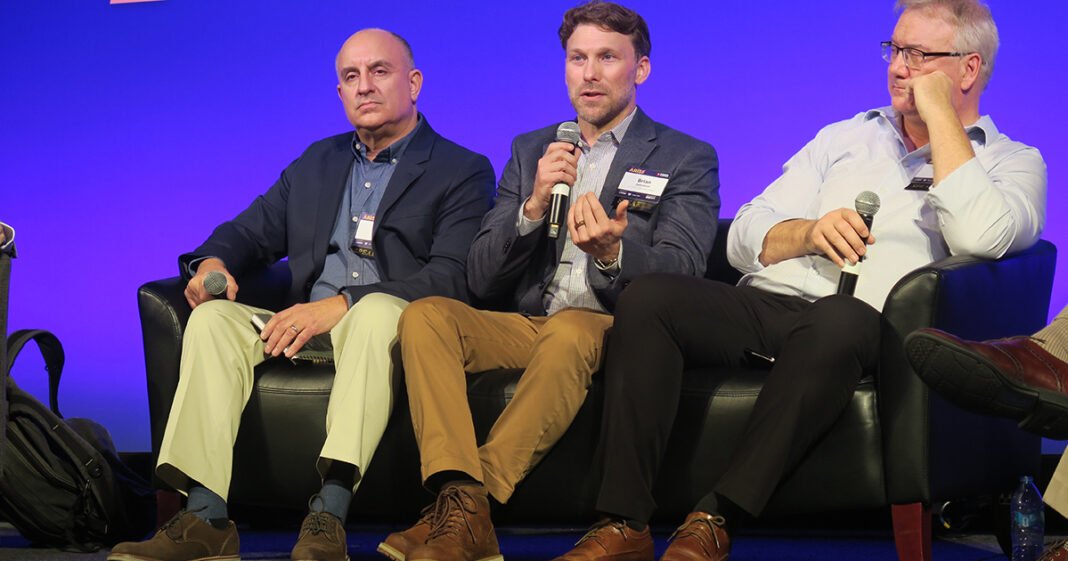

From left: Mike Franco of Tyson Foods, Brian Johnston of Conversion Interactive Agency and Paul Still of Apptoo explain how they are applying agentic AI to driver recruitment processes. (Seth Clevenger/Transport Topics)
February 27, 2026 2:43 PM, EST
Key Takeaways:
- Carriers are using AI agents to quickly and efficiently fill open positions.
- AI agents don’t make hiring decisions, but connect recruiters and candidates.
- More drivers are using AI as well.
NASHVILLE, Tenn. — As artificial intelligence transforms the way people work, it is also changing the way that trucking company recruiters connect with job seekers.
Motor carriers are beginning to implement AI agents to improve interactions with job candidates and more quickly and efficiently fill open positions with the right drivers for the role.
A panel of driver recruiting leaders outlined this shift toward agentic AI during a Feb. 26 session at the 2026 Recruitment & Retention Conference, co-hosted by Conversion Interactive Agency, Transport Topics and American Trucking Associations.
Late last year, private fleet operator Tyson Foods introduced AI agents that automate much of the initial back-and-forth with prospective drivers, and can do so around the clock. The agents do not make hiring decisions, but connect recruiters directly with promising candidates, said Mike Franco, manager of driver recruiting at the company.
When recruiters begin work in the morning, they already have about three or four calls lined up with job applicants so they can spend more time having meaningful conversations with serious candidates.
“It’s been very favorable for our recruiting team,” Franco said. “It allows them to enhance what they are doing by dealing with the drivers who are prequalified and interested with real intent.”
Cindy Songne of Joveo and Kenny Wright of Hiremaster discuss how AI agents can enhance driver recruiting results. (Seth Clevenger/Transport Topics)
Tyson Foods rolled out the AI capabilities cautiously, but in retrospect, Franco said he wishes he would have moved faster on implementation.
“We took it slow and careful,” he said. “The careful part is always good, but there’s no need to take it slowly.”
The technology has helped the company maintain a small team of six driver recruiters for its fleet of roughly 2,800 trucks.
“This has been a tremendous help to keep us lean,” Franco said.
Tyson Foods ranks No. 9 on the Transport Topics Top 100 list of the largest private carriers in North America.
Kenny Wright, president of job advertising platform HireMaster, said AI agents will continue to improve as they incorporate more data and context, such as whether a driver previously applied to a company in the past.
“It’s going to be a force multiplier, and it’s only going to get better,” he said.
Over time, AI agents will handle more time-consuming tasks so recruiters spend less effort chasing down leads or worrying about missed calls.
Serial entrepreneur and author Frankie Russo encourages driver recruiting leaders to ask more questions and embrace innovation in a rapidly changing world during his keynote at the 2026 Recruitment & Retention Conference in Nashville. (Seth Clevenger/Transport Topics)
“Our goal is to turn recruiters into closers,” Wright said. “We want to take the stuff off your plate that you hate.”
On the other side of the coin, the way that drivers search for job opportunities is changing as well, said Brian Johnston, president of driver recruiting and retention firm Conversion Interactive Agency.
A rapidly increasing number of drivers are now using AI at some point in their job searches, he said.
“This is going to happen faster and faster as 2026 rolls along into 2027,” Johnston said. “You’re going to see more drivers adopting AI.”
By tapping into the underutilized data that companies are already collecting, AI will enable recruiters to become more predictive than reactive, said Cindy Songne, vice president and global head of agency relations at Joveo, a recruitment marketing platform.
“I do not believe it’s going to replace recruiters,” she said. “I believe it’s going to make your job a whole lot easier. I believe it’s going to replace the guesswork of what you do.”
However, Songne warned that companies will need to establish proper governance for the AI tools that they adopt to safeguard sensitive data, including job candidate information.
Paul Still, CEO and co-founder of software developer Apptoo, predicted that hiring negotiations in the not-so-distant future will involve the job candidate’s own AI agent interacting with the employer’s AI agent before the candidate and recruiter speak directly.
The conference’s keynote speaker, serial entrepreneur and author Frankie Russo, encouraged driver recruiting leaders to ask more questions and embrace innovation in a rapidly changing world.
Patrick Brennan of Cox Fleet talks about the common missteps that fleets make in planning for future maintenance and operational needs. Tune in above or by going to RoadSigns.ttnews.com.
Historically, businesses that have not survived major technology shifts have tended to suffer from a failure of imagination or a lack of honesty about the need to adapt in the first place, he said.
“When the game changes, we have options: to protect what we’ve always done, to protect what’s always worked, or interrupt it,” Russo said.
It’s no longer a question of whether AI is coming, so it’s now time for businesses to adapt and innovate, he said. “If we don’t build and embrace AI, we’re the ones left behind.”

