
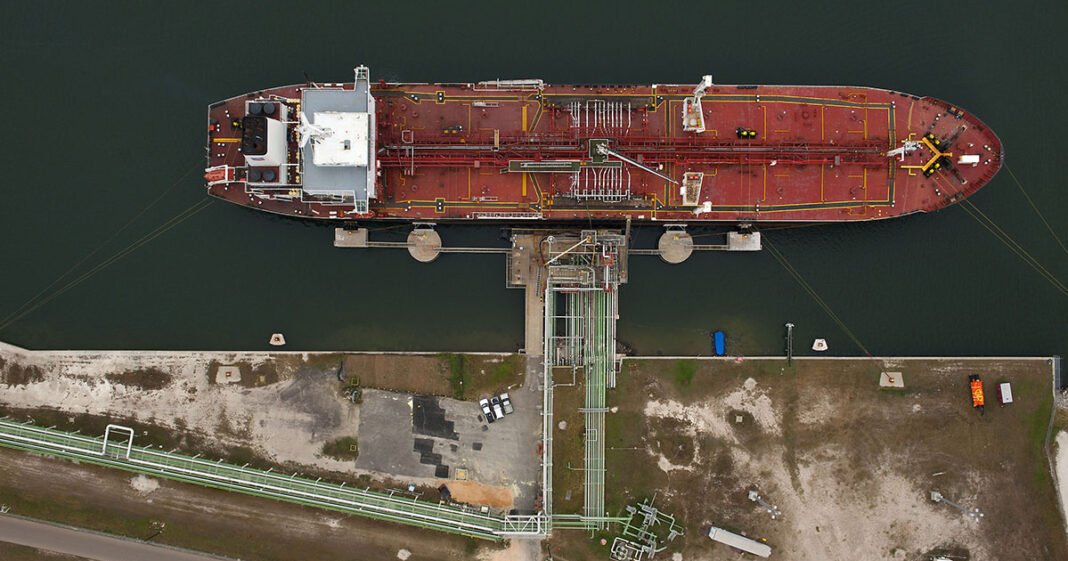

An oil tanker being loaded at the Port of Corpus Christi in Corpus Christi, Texas. (Eddie Seal/Bloomberg)
February 26, 2026 3:50 PM, EST
A shipowner’s once-in-a-generation wager on oil tankers has made it so powerful that it controls an overwhelming majority of supertankers that can collect American oil next month.
A push by South Korea’s Sinokor group — with backing from Mediterranean Shipping Co. — to scoop up very-large crude carriers has given it unprecedented control over a big share of the global fleet for immediate hire. The spree has been called “seismic” by a rival and pushed hiring costs to multiyear highs.
MSC ranks No. 9 on the Transport Topics Top 50 list of the largest global freight companies.
The scale of Sinokor’s position became more apparent this week, as it controlled almost all the VLCCs available for hire to load oil from the U.S. Gulf Coast, a major oil-exporting region. Over the next 30 days, it controls every ship that could arrive in the U.S. Gulf and isn’t currently holding a cargo, according to data from Signal Ocean, a shipping-analytics platform.
Signal’s estimates are consistent with the views of multiple other tanker-market participants, who say Sinokor has a very dominant share of available carriers in that region.
The extreme example of what’s happening there is the clearest evidence so far that Sinokor’s push is upending the tanker market, and in turn boosting earnings for shipowners. The cost of booking a supertanker from the U.S. Gulf Coast to China topped $17 million Feb. 25, the most since 2020. Having so much of the available fleet gives Sinokor more control over the rate it will charter out ships for, people involved in the market said.
“It’s not quite a ‘one stop’ yet, but alternatives are few and far in between, especially for those who prefer a ship on the water free of cargo,” said Halvor Ellefsen, a London-based director at Fearnley’s Shipbrokers UK.
Tanker earnings had already been strong due to surging oil output, a return of Venezuelan barrels to the unsanctioned fleet and geopolitical risks, such as the risk of conflict with Iran. One owner estimated recently that Sinokor controlled about 150 vessels, or close to 40% of the number of unsanctioned ships for hire globally that aren’t already committed to contracts. That has helped rates for the benchmark Middle East-to-China route surge.
When expanded to include vessels that do have a cargo on board and which could arrive in the U.S. Gulf over the next 30 days, Sinokor controls about two-thirds of the ships, according to Signal Ocean.
Sinokor Merchant Marine didn’t immediately respond to an emailed request for comment. It so far hasn’t commented on the push to buy or charter a significant number of supertankers.
Market Positions
Shipowners usually communicate the positions of their vessels to brokers and customers looking to hire tankers. Aggregated pictures of those lists are then disseminated across the market, giving a picture of how many are available for hire at any one time in a given period. As a result, broker estimates can vary as they rely on each agent’s expectations of when ships will be available.
The higher number of Sinokor vessels traveling empty in the Atlantic comes just after many of them discharged cargoes in Asia in mid-January.
There are alternatives when the VLCC fleet becomes too stretched. As rates surge, it can be cheaper for two smaller ships to carry a cargo that would be on a larger one. Earnings for vessels that haul 1 million barrels of oil have also risen in recent days.
Fees are expected to climb further. There was a booking of $18 million for a Sinokor VLCC to travel from the U.S. Gulf to China in late March, according to brokers and fixtures reports seen by Bloomberg.
“It is a fundamental shift in the ownership base,” Lois Zabrocky, CEO of supertanker owner International Seaways, said on an earnings call when asked about Sinokor’s purchases. “It’s got staying power.”

