
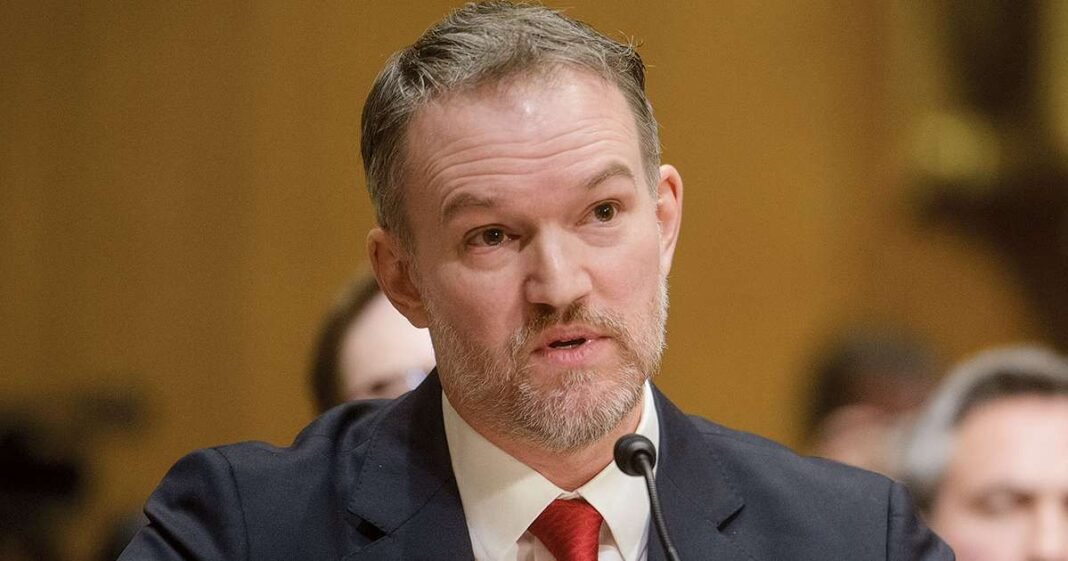

U.S. Trade Representative Jamieson Greer. (Rod Lamkey Jr./Associated Press)
February 25, 2026 3:40 PM, EST
President Donald Trump will sign a directive in the coming days raising his global tariff to 15% “where appropriate” and is seeking “continuity” with nations that struck trade deals, U.S. Trade Representative Jamieson Greer said.
“So right now, as we talked about, 10% is in place. There will be a proclamation raising it to 15% where appropriate,” Greer told Bloomberg TV on Feb. 25.
Greer sought to clarify how the administration would follow through on Trump’s threat to hike the rate to 15%, which added to U.S. trading partners’ confusion in the wake of the Supreme Court’s nixing of his so-called reciprocal duties. A 10% worldwide levy took effect Feb. 24, and in the ensuing 24 hours, the administration offered few details about how it would follow through on the president’s threat while honoring pacts with major trading partners.
When asked whether the higher charge would violate the U.S. agreement with the European Union, Greer said he would speak later on “how that might accommodate other countries.” He repeatedly suggested the changes would not result in a larger cumulative rate for certain economies with trade agreements, a positive signal for the EU, U.K. and others that faced a higher tariff burden under a blanket 15% levy.
“The point is to recreate the policy that we’ve developed over the past year, to give continuity and be able to be in a position where we can honor the deals, but also have enforcement available,” Greer said.
U.K. Business and Trade Secretary Peter Kyle said Feb. 25 that it is his “belief” that London’s trade framework “remains intact.”
“As we move forward into the coming days and we get certainty, it is certainly my hope that the 10% tariff rate will remain intact as well,” Kyle said during a news conference in Brussels.
Greer said it could take “a couple months” for the administration to re-establish Trump’s tariff regime in ways that uphold existing agreements in the wake of the court defeat. The president is imposing his baseline tariff under Section 122 of the 1974 Trade Act, which allows him to apply that duty for as many as 150 days without congressional approval.
Officials have said they plan to use that time to carry out trade investigations under other authorities, which opens the door to more permanent tariffs on products from specific countries and industries that would replace the global charge.
Similarly, Greer said the U.S. is seeking to maintain levies on Chinese goods within a range of 35% to 50%, depending on the product. Trump is expected to meet with his counterpart Xi Jinping in China in late March or early April to discuss an extension of their nations’ tariff truce.
“We expect that level to remain in place. We don’t intend to escalate beyond that. We intend to really stick to the deal that we had before,” Greer said Feb. 25 on Fox Business.
Greer said on Bloomberg that talks are ongoing over the North American trade agreement, known as USMCA, and reiterated Trump’s frustration with the deal he negotiated during his first term. He cited complaints with Mexican treatment of U.S. energy firms, Canadian dairy rules and Canadian boycotts of American liquor, as well as the risk of transshipment through both countries.
But he signaled that discussions are aimed at a pair of side deals with the countries rather than a wholesale rewrite of the agreement.
“I’m having separate negotiations with Canada and Mexico because our relationships with those countries are so different, and so I think we’ll have, over the coming year, conversations,” he said. “Maybe we’ll have separate protocols with Canada and Mexico that we tack on to USMCA; we just have to fix some of the gaps in that.”
Greer acknowledged a Bloomberg News report that Trump has privately mused about quitting the pact altogether but downplayed the significance of the remarks.
“It’s not a secret,” Greer said. “The president has been really clear this year that he’s concerned with the performance of USMCA; he doesn’t feel that we should just rubber stamp this agreement.”
Written by Hadriana Lowenkron, Jonathan Ferro, Annmarie Hordern and Lisa Abramowicz

