
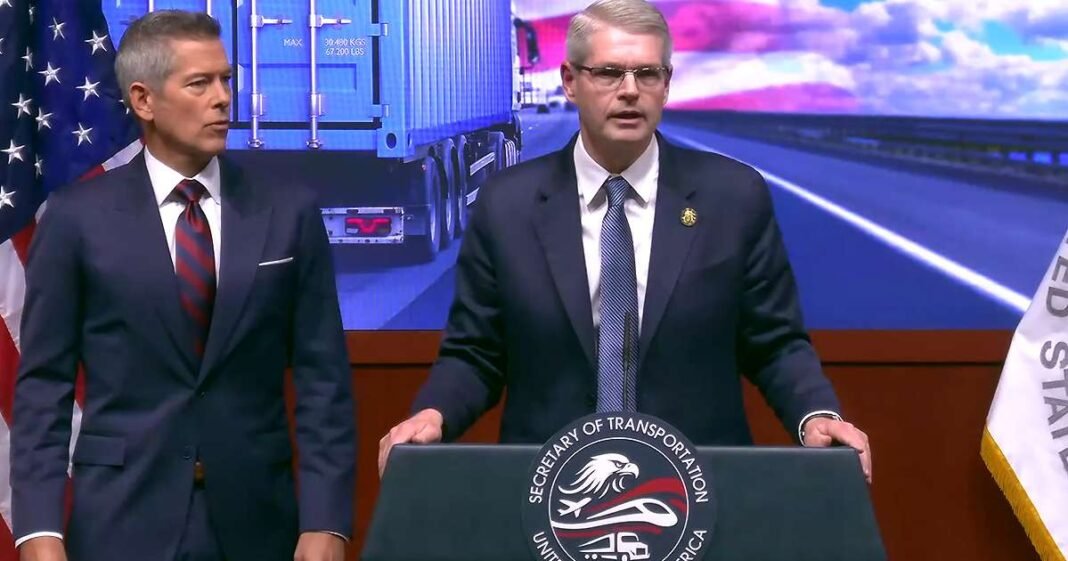

FMCSA Administrator Derek Barrs (right) and Transportation Secretary Sean Duffy discuss measures DOT is taking to enhance safety on the highways. (U.S. Department of Transportation via X)
February 24, 2026 11:29 AM, EST
Key Takeaways:
- FMCSA’s nationwide sting uncovered more than 550 CDL training providers violating federal safety standards.
- Violations included fake addresses unqualified instructors and missing hazmat training.
- FMCSA plans new rulemaking to end self‑certification and tighten oversight of entry‑level driver training schools.
The federal sting against sham truck driver training operations identified sites ranging from community colleges to churches among the 550 found violating safety standards.
Federal Motor Carrier Safety Administrator Derek Barrs reaffirmed his commitment Feb. 20 to conduct sporadic stings to uncover noncompliant commercial driver license training providers for removal in the FMCSA Training Provider Registry.
Barrs said FMCSA will continue to work with state law enforcement officers to bust CDL training programs and sham providers to ensure potential drivers meet safety. He referred to a recent action in which FMCSA mobilized 300 investigators across 50 states to conduct more than 1,400 sting operations.
“We found that over 550 of those driver training schools were cutting corners,” Barrs said.
Join @SecDuffy and @FMCSA Administrator Barrs for a press conference on the Department’s ongoing efforts in making American roads safe again! https://t.co/OJAPQ0iean
— U.S. Department of Transportation (@USDOT) February 20, 2026
Violations included schools using fake addresses, lacking qualified instructors and failing hazardous-materials training requirements. The sting resulted in 109 training providers voluntarily removing themselves from the TPR.
A Transport Topics analysis of the 450 training providers now facing proposed TPR removal showed FMCSA investigators appeared at a variety of facilities besides private training schools.
“Providers must notify current driver-trainees and driver-trainees scheduled for future training of the proposed removal,” FMCSA noted in the TPR.
Subject to Revocation
California has the most training providers likely to see their TPR approval revoked by FMCSA. The state had 31 providers with apparent safety deficiencies. Three cities — Ontario, Palo Alto and Santa Barbara — face removal along with two unified school districts, Hacienda La Puente and San Jose. A federal field office of the Bureau of Land Management in Applegate also made the list.
Illinois had the second-highest number of providers targeted for removal. These included several school districts, high schools, the city of Sandwich, three villages (Milan, Northbrook and Roxana) as well as the South Stickney Sanitary District. The latter handles 9,300 individual residential and commercial customer water accounts and maintains sewers.
Illinois could lose federal funding if they don’t fix their non-domiciled CDL issuing process.
“This is about safety — making sure all licenses are issued properly and that we have the best qualified drivers on our roadways,” – FMCSA Administrator Derek Barrs on Fox Chicago 32 pic.twitter.com/35okBEFAon
— FMCSA (@FMCSA) February 20, 2026
Texas ranked third with 25 proposed removals. The state had several independent school districts subject to federal removal: Alice, Amarillo, Bullard, Burnet Consolidated, Galena Park, Gregory Portland, Princeton and Sanford-Fritch.
Making the list are:
- City of Dallas
- Collin County Public Works in McKinney
- Grimes County Road and Bridge Department in Anderson
Among the CDL trainers proposed for removal were TruckGod CDL Training in Grand Prairie and Moham Truck Driver Training in Dallas. Others included M R Davison Logistics in Houston, Hamdan’s Family Trucking of Converse, Garrido Carriers of Brownsville and Arnold Oil Co. Fuels of San Antonio.
The states having 10 to 15 training providers proposed to lose federal approval were Alabama, Florida, Georgia, Indiana, Kansas, Kentucky, North Carolina, Maine, Michigan, Missouri, Ohio, Oregon and Utah.
The Alabama State Port Authority in Mobile made the list as well as the city of Oxford Public Works Department, Utilities Board City of Daphne, Marion County Board of Education and Lawrence County Solid Waste.
In Kansas, FMCSA investigators found 14 providers with problematic training that resulted in proposed revocation. The public entities included the cities of Leavenworth and Norton as well as the Clay County Highway Department along with several school districts.
Community colleges also were subject to the FMCSA CDL training investigation. Two with TPR proposed removals are:
- Shasta-Tehama-Trinity Joint Community College District in Redding, Calif.
- Mississippi Delta Community College’s Capps Technology Center in Indianola.
A Mississippi nonprofit called the Dependable Source Corp. Center for Community & Workforce Development in Jackson also is listed by FMCSA for proposed removal.
Churches also were subject to the FMCSA CDL training raid. Those subject to TPR removal include Harvest Church in Alabama and Shelby Road Baptist Church in Michigan, as well as Central Valley Baptist Church and Lancaster Baptist Church, both in California.
“We mobilized hundreds of investigators to visit these schools in person to ensure strict compliance with federal safety standards,” Barrs said. “If a school isn’t using the right vehicles or if their instructors aren’t qualified, they have no business training the next generation of truckers or school bus drivers.”
Tougher Training Regulations
New FMCSA rulemaking initiatives are on the horizon for CDL training, according to a recent joint announcement by Barrs and Transportation Secretary Sean Duffy.
Both noted they will continue to crack down on entry-level driver training schools by ending the current self-certification model and enhance procedures to suspend or revoke federal approval for noncompliant carriers or schools.

