
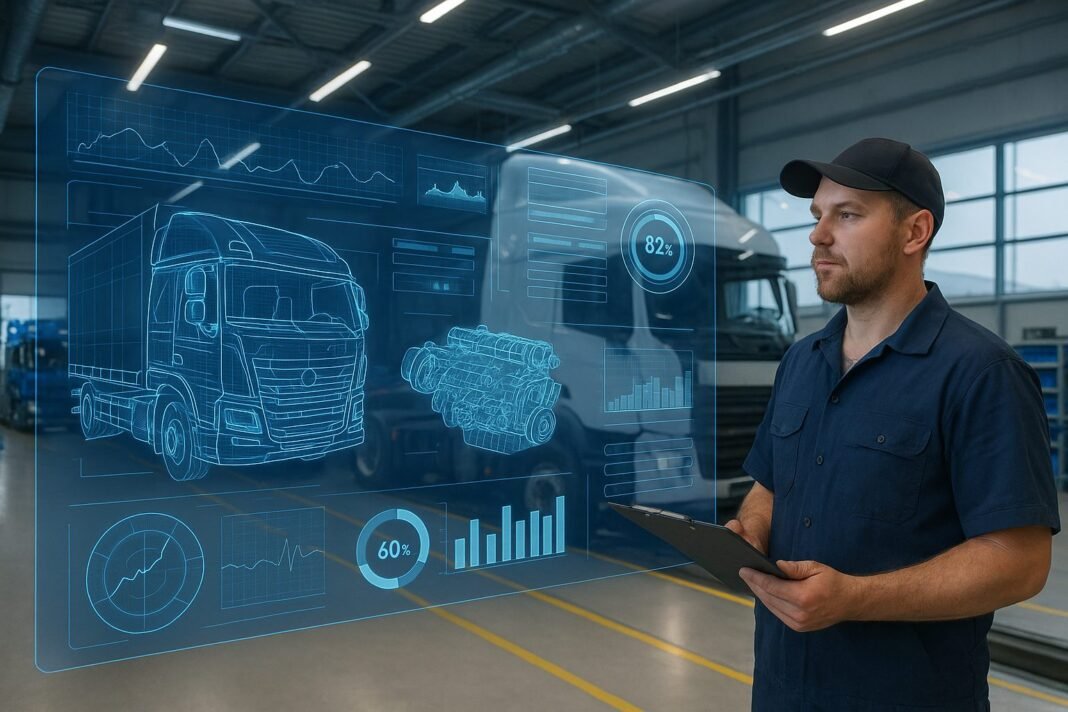

ChatGPT is just the tip of the iceberg that is artificial intelligence. For transport companies, the future lies with ‘agents’ who are able to manage specific tasks independently. That is the most important message from Franck Leveque, expert in telematics and consultant in mobility.
Franck Leveque has been active in the world of telematics for more than 25 years, first at Frost & Sullivan and then at Bridgestone Mobility Solutions. Today he is an independent mobility consultant and therefore ideally placed to help us explain the effect of artificial intelligence on road transport.
As Mr. Jourdain spoke prose…
Has AI arrived in 2022?
Franck Leveque: Of course not. Artificial intelligence emerged in the research world as early as the 1950s. In the 80s and 90s we had ‘narrow AI’, that is, self-learning but highly specialized systems. The robot that defeated Kasparov in a chess match, that was also AI. Then, in the 2000s, machine learning and neural networks emerged, leading to deep learning. And only after 2020, the so-called language models (LLMs) appeared, which became popular thanks to conversational assistants. In other words, we’ve been using AI for decades without realizing it.
What exactly is AI?
F. Leveque: It is not a solution, but an instrument to develop solutions. A smart algorithmic engine, if you will.
You say generative AI isn’t the most exciting thing…
F. Leveque: Generative AI is especially efficient for automating repetitive tasks. Think of a customer service that has to handle hundreds of emails or phone calls every day with the same questions. But the most exciting is the so-called ‘agentic AI’. In doing so, you develop an ‘agent’ who functions as a member of your staff. You need to give him access to the right databases and train him to perform very specific tasks.
New colleague needs to be trained
Does an AI agent replace an employee?
F. Leveque: No. The goal is not 100% autonomy. An AI agent can take over repetitive or monotonous tasks, but you should not entrust it with a complete assignment. Think of him as a new colleague who has just come out of school or university, to whom you have to teach the trade and whose work you have to check.
Who is able to develop their own agents?
F. Leveque: A few weeks ago, ChatGPT launched a tool with which you can build agents yourself, but we are not there yet in a professional context. Very large transportation companies can develop their own AI agents with the help of specialized consultancies. SMEs are more likely to work with slightly less specialized agents, developed by independent providers. One important point: an AI agent is purely code. You can launch it when it’s only 80% ready. It is not hardware, you can quickly adjust and improve the code.
There is also a lot of talk about video integration…
F. Leveque: Yes, you can do a lot with cameras, which are everywhere today. For example: detecting a hole in the road surface and automatically passing it on to the road manager, who, thanks to AI, can determine how urgent the repair is. But video can also be useful in a transport company: classically this involves systems that detect fatigue or drowsiness in the cabin, but also cameras that film the interior of the loading space.
Today they are mainly used to prevent intruders and theft…
F. Leveque: They can do much more. By analyzing the free floor space in real time, an AI agent can better combine transport orders and thus reduce the number of empty kilometers.
What will be the next step?
F. Leveque: The holy grail is ‘predictive maintenance’. For example, TIP Europe is financing a ‘scale-up’ that is developing a tool with which you can automatically book appointments at any garage. In addition, there are applications that collect DTCs – error codes from connected vehicles. Simply forwarding those codes is of no use. Rather, use an AI agent that filters them and determines priorities for the entire fleet. And I repeat: there will always be a need for a human to monitor. Human in the Loop!
The example of Moderna
According to Franck Leveque, very few organizations are ready to really develop AI. He refers to Moderna: in 2020, without physical contact with the Covid-19 virus, the company developed a vaccine based on the DNA sequence alone in 63 days. According to Leveque, this is the perfect example of an organization that is ripe for AI.

