
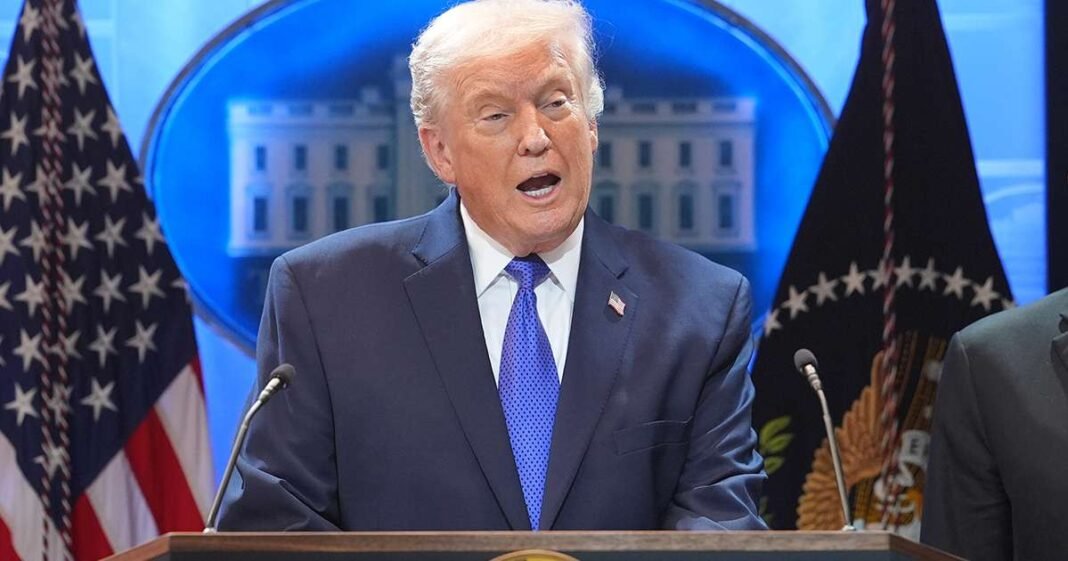

President Donald Trump addresses the tariff decision during a press briefing at the White House on Feb. 20. (Evan Vucci/AP)
February 20, 2026 1:30 PM, EST
Key Takeaways:
- The Supreme Court offered a firm rebuke of the president’s use of emergency powers to implement tariffs.
- The ruling stemmed from challenges brought by small business that claimed they had been harmed by the tariffs.
- The Tax Foundation estimated that the IEEPA tariffs alone would have shrunk the size of the economy by 0.4%.
The U.S. Supreme Court in its 6-3 majority ruling overturning President Donald Trump’s use of emergency powers to implement tariffs offered a firm indictment of the president’s actions.
“The framers did not vest any part of the taxing power in the executive branch,” the Feb. 20 decision stated. “The government thus concedes that the president enjoys no inherent authority to impose tariffs during peacetime.”
The majority stated that the constitutional power to impose taxes clearly resides with the U.S. Congress, and that includes tariffs. What they didn’t address was the lingering question of whether companies could get refunded for what has already been collected from tariffs. The U.S. Treasury had collected over $133 billion from those tariffs as of December.
Trump used the International Emergency Economic Powers Act — which affords presidents the power to regulate commerce during national emergencies — to justify many of his tariffs, making the case that trade relationships with other countries he viewed as unfair constituted a national emergency.
The court ruling stemmed from two consolidated challenges brought by small businesses that claimed they had been negatively impacted by the tariffs. As the court noted, the IEEPA does not explicitly mention tariffs.
“The good news is that there are methods, practices, statutes and authorities as recognized by the entire court… that are even stronger than the IEEPA tariffs available to me as President of the United States.” – President Donald J. Trump 🇺🇸 pic.twitter.com/v2juxmYHiR
— The White House (@WhiteHouse) February 20, 2026
The White House has maintained that tariffs increase tax revenue, encourage consumers to buy domestic goods and boost business investment in stateside manufacturing. But critics have expressed concern that tariffs ultimately raise costs on household and create a drag on long-term economic growth.
The Tax Foundation estimated that the IEEPA tariffs alone would have shrunk the size of the U.S. economy by 0.4% and reduced employment by more than 428,000 full-time equivalent jobs if left in place through 2034. This estimate did not include the effects of tariff retaliation from trading partners.
J.P. Morgan Asset Management estimated that the average statutory tariff rate the U.S. will maintain post-ruling will drop to 10.4% from the current 16.1% level.
The Tax Policy Center had previously estimated that the court overturning the IEEPA tariffs would reduce taxes on households by $1.4 trillion over 10 years, and result in average savings of $1,200 in 2026.
Trump’s initial round of tariffs under IEEPA were enacted Feb. 1 against Canada, China and Mexico.

