
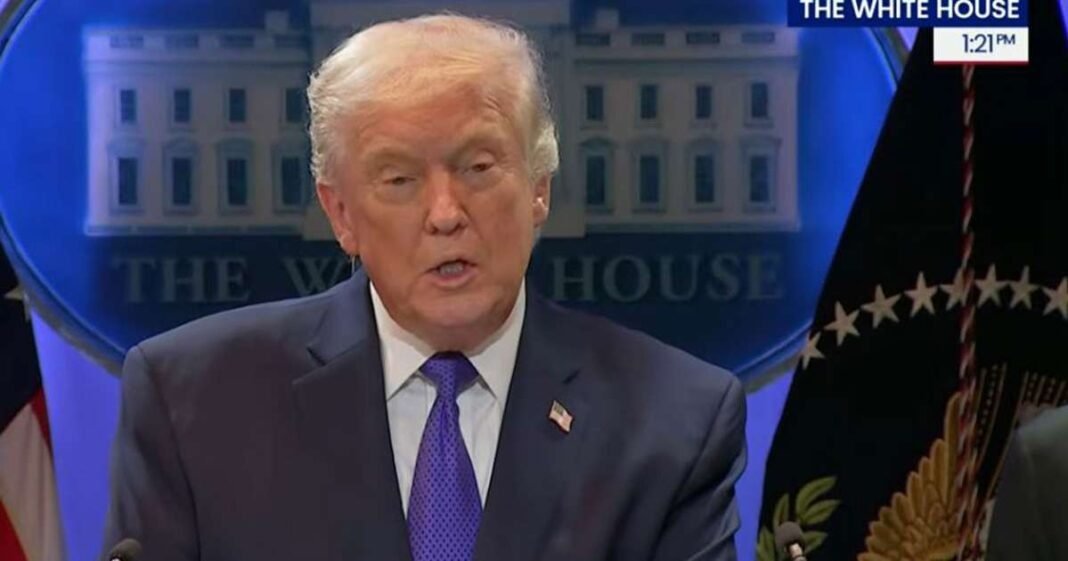

President Donald Trump vowed to forge ahead with tariffs despite complaints from opponents who say they have undercut longtime trade partnerships and increased costs for Americans. (C-SPAN via YouTube)
February 20, 2026 4:25 PM, EST
Key Takeaways:
- The Supreme Court struck down President Donald Trump’s global tariffs, prompting him to announce a new plan for a 10% flat duty under Section 122 of the Trade Act of 1974.
- The ruling weakened Trump’s tariff strategy as he argued the duties had boosted U.S. investment, with Bloomberg Economics estimating the new global rate could shift the average effective tariff to between 11.4% and 16.5%.
- Trump said he would maintain existing Section 301 and Section 232 tariffs, launch new trade investigations and move to implement the 10% baseline tariff within three days.
President Donald Trump rushed to salvage his signature tariffs after the Supreme Court struck down his global duties, pledging he would use different tools to work around the ruling and preserve import taxes he has cast as essential to his economic and foreign policy.
The president said Feb. 20 that he planned to impose a flat 10% levy on foreign goods in the coming days and that he would order a raft of trade investigations that should allow him to enact more permanent tariffs.
In a defiant and angry White House news conference hours after the decision, Trump vowed to forge ahead with his approach despite complaints from opponents who say it has undercut longtime trade partnerships and increased costs for Americans. The president has credited his tariff regime for driving substantial investments in the U.S. and preventing foreign conflicts.
Still, Trump’s evident frustration underscored the immense logistical and legal challenges he now faces. It also offered a tacit acknowledgment that his hand had been weakened, even as he vowed to continue pursuing trade deals and implementing existing pacts.
“The Supreme Court did not overrule tariffs, they merely overruled a particular use of IEEPA tariffs,” Trump told reporters, referencing the emergency authorities that the high court found illegal. “Now I’m going to go in a different direction, probably the direction that I should have gone the first time.”
MORE: High Court Sends Clear Signal on Emergency Powers
Trump said he would pursue the baseline duty under Section 122 of the Trade Act of 1974, which grants the president unilateral ability to impose tariffs. But the untested legal provision puts a 150-day limit on how long the duties can remain in place. Trump said he expected the new baseline rate to go into effect “three days from now.”
Bond yields pared an earlier advance, and stocks extended gains after Trump announced the plan for a 10% duty, which fell short of the maximum 15% charge he could have enacted for the next five months.
Trump also said existing tariffs under Section 301 and Section 232 would remain in place and vowed to launch additional investigations. The president has previously used those measures to levy Chinese exports, automobiles and metals. He suggested that those investigations could be carried out while the 10% baseline was in place and eventually replace the flat rate — though he declined to rule out whether he might also seek an extension of the Section 122 levies. Trump said he was eyeing tariffs on foreign cars ranging from 15% to 30%.
The president’s plan to impose a 10% global duty could lift the average U.S. effective tariff rate to 16.5% from 13.6%, or lower it to 11.4% if current exemptions are maintained, Bloomberg Economics estimated.
Trump opened his remarks by delivering a broadside against the Supreme Court, saying he was “ashamed of certain members” and that some of the justices were “frankly a disgrace to our nation.”

