
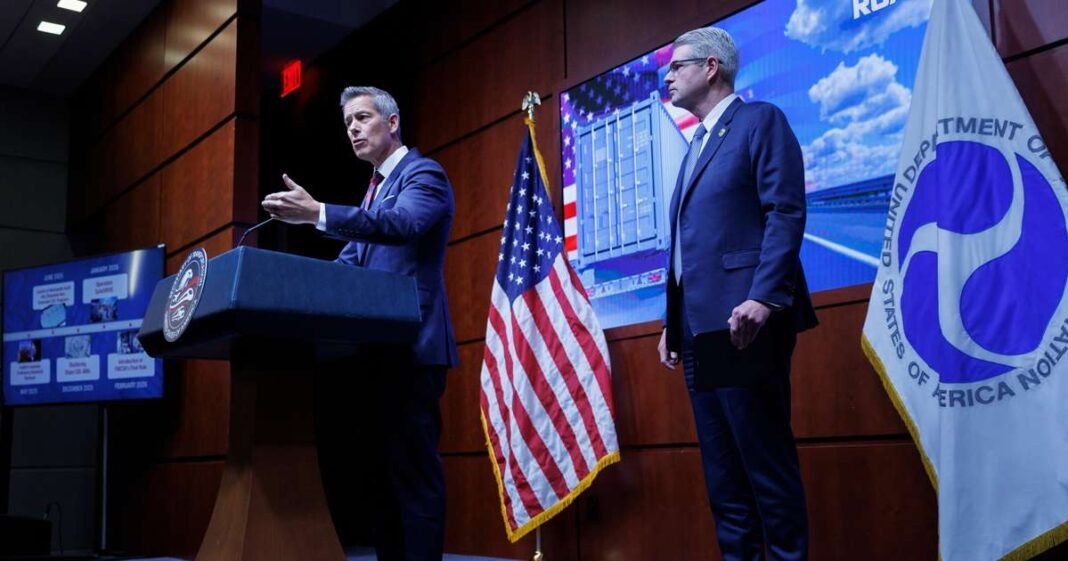

Duffy speaks beside Barrs during the Feb. 20 news conference. (Tom Brenner/Associated Press)
February 20, 2026 6:15 PM, EST
Key Takeaways:
- Transportation Secretary Sean Duffy announced new federal rules to curb fraud in trucking, including stricter CDL testing and revamped carrier registration.
- Officials said the changes aim to address long-standing oversight gaps that allowed unsafe drivers, fraudulent brokers and chameleon carriers to persist.
- DOT plans further investigations and system overhauls, with states expected to help enforce license revocations and verify carrier identities.
WASHINGTON — U.S. Transportation Secretary Sean Duffy on Feb. 20 announced federal regulatory proposals aimed at toughening enforcement of so-called chameleon carriers as well as driver training programs that do not comply with federal standards.
Speaking alongside Federal Motor Carrier Safety Administrator Derek Barrs, Duffy outlined forthcoming rulemakings intended to tighten oversight on both fronts and remove bad actors from the industry.
Duffy said the efforts aim to modernize and strengthen federal systems used to verify motor carrier identity, ownership and compliance — a direct response to chameleon carriers that repeatedly shut down and reopen under new DOT numbers to evade enforcement.
Federal officials intend to end the current self‑certification model for entry‑level driver training schools, a framework Duffy said has enabled noncompliant programs to operate with minimal scrutiny.
RELATED: Bluetooth CDL Cheating Schemes Draw Federal Action
“These efforts are about restoring integrity and safety,” Duffy said. “When we get on the road, we should expect that we should be safe and that those who drive those 80,000-pound big rigs are well trained, they are well qualified and they’re going to be safe.”
The new rulemakings, jointly described by Duffy and Barrs, include:
- Ending self‑certification for entry‑level driver training schools.
- Revamping Motus, the federal motor carrier registration system, into a rigorous verification and identity‑matching platform.
- Enhancing procedures for suspending or revoking federal approval for noncompliant carriers or schools.
- Requiring state motor vehicle departments to conduct all CDL testing.
- Adding qualification and testing requirements for brokers during registration.
“Once you start to pay attention, you see that all of these bad things have been happening and the consequence of that is that Americans get hurt,” Duffy said.
(U.S. Department of Transportation via YouTube)
Chameleon carrier schemes are a recurring focus for Duffy and Barrs, who said they intend to sharply limit the ability of companies to obscure ownership or repeatedly obtain new DOT numbers.
“We’re going to have way more stringent regulations for our carriers,” Duffy said. “One individual can get 100 different DOT numbers. We want to make sure that the DOT number is connected to an actual individual.”
Barrs added, “We have people that are going to be investigating this. We’re going to put you out of service and we’re going to do it quickly as we can within the rules we have and the tools in our toolbox.”
DOT plans to sharpen verification of a carrier’s principal place of business — ensuring companies maintain physical addresses rather than P.O. boxes or mailbox services. Barrs said AI tools and system overhauls will support identity verification so regulators “actually will know who they are, what they are,” and what the company’s name represents when carriers enter the system.
Duffy emphasized states’ role with enforcement; states will be responsible for revoking or disqualifying CDL holders when required under federal rules.
Also central to the proposal is a requirement that all CDL testing be conducted in English.

