
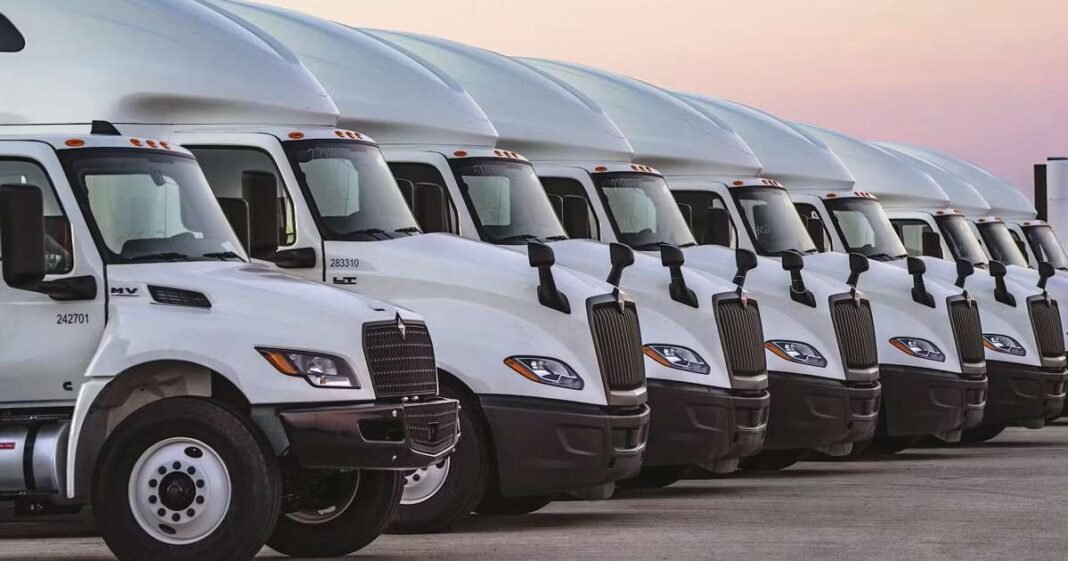

International sales dropped 33.5% to 1,695 units from 2,547. (International)
February 19, 2026 2:00 PM, EST
Key Takeaways:
- U.S. Class 8 retail sales fell 24% in January to 12,287 trucks, extending a late‑2025 slowdown despite recent gains in orders.
- Analysts said the drop exceeded normal seasonal patterns, citing soft freight demand, low rates and reduced production that pushed inventories toward tighter levels.
- Industry leaders expect sales to stabilize as stronger orders, improving spot rates and new truck models support a gradual market recovery through 2026.
U.S. Class 8 retail sales started the year down from the previous year, but there is some hope after recent order activity.
Omdia Automotive data showed sales in January decreased 24% to 12,287 units from 16,175 the previous year. Sales figures trended below the previous year throughout late 2025. Sales were also down 39.3% sequentially from the 20,225 units reported in December.
“I thought it was a little bit disappointing,” ACT Research Vice President Steve Tam said. “We do typically see about a 35% drop in sales from December to sales in January. That’s just the big hangover.”
The typical year‑end push inflates December totals, making a sharp January drop unsurprising, though Tam noted this year’s decline was larger than seasonal norms. He had expected firmer results following recent gains in truck orders and strengthening spot market rates.
“Perhaps that’s naive to think that people can react that quickly,” Tam said. “So maybe February will bode a little bit better than it typically does.”
Tam added that January‑to‑February sales usually dip 3% to 4%. He said holding steady or posting a slight improvement would be a positive sign.
He recalled that truck manufacturers cut production midway through 2025 before reversing course late in the year, adding nearly 10,000 build slots in the final weeks.
“Well, we assumed if they were going to produce them now, and that would’ve been November and December, and that they would’ve sold them in January, and yet here we are,” Tam said.
Omdia data showed sales declined for all seven major truck makers. Freightliner, a brand of Daimler Truck North America, claimed the largest market share with 4,314 trucks sold, at 35.1% of all sales, though that total was down 34.1% from 6,544 the prior year. Western Star sales, another DTNA brand, saw sales fall 10% to 795 from 883.
Freightliner claimed the largest market share at 35.1% of all sales. (Premier Truck Group)
“In general, it’s not surprising, but it was a very low number,” said Eric Starks, the chairman for FTR Transportation Intelligence. “Clearly December was a last-minute push for people to take delivery of equipment […]. So, it’s kind of getting back to reality. But it was a pretty low number in totality.”
FTR data showed that North American Class 8 preliminary net orders increased 27% year over year to 32,500 units in January. This marked the second consecutive month showing an increase, with December orders rising 21% to 42,200 units. Starks said sustained order strength will be needed to turn the increases into higher retail sales.
“The million-dollar question is, will this start to stabilize or improve,” Starks said. “At minimum it’s going to stabilize, and then we should start seeing some improvement.”
Starks said strong December and January orders pushed up backlogs. He also noted that inventories are declining toward more appropriate levels in the U.S., and that — excluding the early pandemic period — recent production rates were the lowest since December 2010.
This suggested to him that manufacturers will not be able to replenish inventories quickly. “You have to assume that if an order is coming in, that it’s likely to lead to a sale,” Starks said. “However, that’s not always the case, because sometimes you have dealer ordering.”
Starks said order activity is likely coming from fleets rather than dealers, given that inventories remain elevated on lots.
International sales dropped 33.5% to 1,695 units from 2,547. Peterbilt Motors Co. sales declined 7.7% to 1,918 units from 2,077. Kenworth Truck Co. sales slipped 3.3% to 1,798 units from 1,860. Mack Trucks sales decreased 17.1% to 947 units from 1,143 last year. Volvo Trucks North America sales declined 27.5% to 810 units from 1,117.
Volvo Trucks North America sold 810 units. (Volvo Trucks North America)
“Industry retail sales in the U.S. and Canada totaled 13,781 units in January, one of the lowest months we’ve seen since May 2020 during the COVID pandemic,” said Magnus Koeck, vice president of strategy, marketing and brand management at Volvo Trucks North America. “January is consistently one of the softest months of the year, but these numbers are significantly lower than we are used to.”
Koeck said carriers are still operating in a difficult environment marked by soft freight demand, low rates and continued pressure on profitability. Those conditions, he added, are keeping retail activity muted for now.
He expects the first quarter to remain relatively slow but anticipates gradual improvement through 2026.
“With the second half of the year likely to be stronger, Volvo Trucks is in a solid position,” Koeck said. “Our new Volvo VNL and the regional‑haul Volvo VNR, which just went into production this February, help our customers improve fuel efficiency, uptime, overall operating costs and total cost of ownership.”
Other truck makers echoed that the market remains soft but noted some early signs of stability.
“January retails reflected the continued softness we’ve anticipated as the market works through this cycle, with load demand remaining negative year over year and fleets staying measured in their capital commitments,” said Jonathan Randall, president of Mack Trucks North America. “That said, we’re seeing some encouraging signals.”
Randall cited improving spot rates, a rebalancing market and strong January order activity as positive indicators.
“That should support fleet profitability in the months ahead,” Randall said. “A sustained recovery will still depend on stronger economic growth in the freight-generating sectors that drive our customers’ businesses.”

