
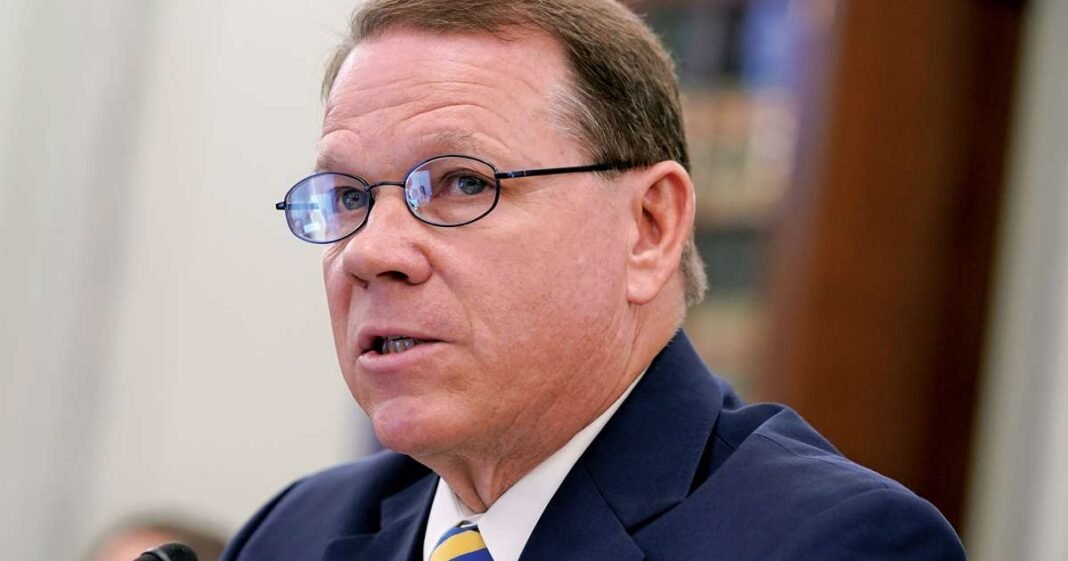

Graves is the Transportation and Infrastructure Committee chairman. (Mariam Zuhaib/Associated Press)
February 18, 2026 4:28 PM, EST
Key Takeaways:
- The House will resume work on the Water Resources Development Act on Feb. 24 while a partial Department of Homeland Security shutdown continues.
- Committee leaders say predictable WRDA enactment is essential for Army Corps projects and national freight mobility.
- Republicans and Democrats blame each other for the ongoing shutdown as immigration policy disagreements intensify.
The House will resume work on the next Water Resources Development Act on Feb. 24, pushing ahead on the key infrastructure bill while Congress races to resolve a partial shutdown before the State of the Union.
The Water Resources and Environment Subcommittee is scheduled to review the Trump administration’s policy proposals specific to the upcoming consideration of the bipartisan WRDA measure.
The biennial infrastructure legislation is designed to improve connectivity by enhancing funding for ports, dams, waterways, canals and locks. Army Corps of Engineers projects are central to freight mobility in many congressional districts around the country.
Along with a multiyear highway policy reauthorization measure, the WRDA bill is a must-pass legislative priority for the chamber’s transportation leaders. In a recent letter to policymakers, Transportation and Infrastructure Committee Chairman Sam Graves (R-Mo.) and ranking member Rep. Rick Larsen (D-Wash.) emphasized the water bill’s significance.
“Regular consideration of locally driven, rigorously studied and nationally significant [Army] Corps infrastructure is key to preserving our nation’s economy, protecting our communities and businesses, creating jobs and maintaining our quality of life,” the committee leaders wrote on Nov. 25. Also on the letter to members of the House were Reps. Mike Collins (R-Ga.) and Frederica Wilson (D-Fla.), the subcommittee’s chairman and ranking member, respectively.
“This work, typically carried out by the [Army] Corps,” the House committee leaders continued, “is made possible through predictable and timely enactment of WRDAs.”
Last year, lawmakers on the GOP-led transportation panel pressed industry stakeholders on water infrastructure projects they recommended Congress prioritize. Noel Hacegaba, CEO of the Port of Long Beach, told the Water Resources and Environment Subcommittee the sector would benefit from additional federal funds for upgrading freight corridors.
Transport Topics reporters Eugene Mulero and Keiron Greenhalgh examine the critical trends that will define freight transportation in the year ahead. Tune in above or by going to RoadSigns.ttnews.com.
“Modernized navigation and improved freight fluidity can reduce vessel delays and idling, improve operational efficiency and complement our ongoing work to transition to cleaner, more sustainable goods movement,” Hacegaba said Dec. 17, adding that ensuring the expansion of waterside access and landside capacity is vital to economic progress.
Consideration on Capitol Hill of WRDA’s latest version, as well as a multiyear highway policy bill, is expected before the end of the year. Previous versions of the bipartisan biennial bill sought to expand regional access at water connectivity corridors, last-mile commercial port operations and boost multimodal projects at supply chains linked to water systems.
Per the highway bill, the House transportation committee plans to schedule its consideration as early as this spring. The current highway bill, which expires at the end of September, was enacted as part of 2021’s Biden-era $1.2 trillion Infrastructure Investment and Jobs Act.
Meanwhile, Congress returns to Washington on Feb. 23 to resume negotiations on a Department of Homeland Security fiscal 2026 funding bill. The department, which includes the Transportation Security Administration, the Federal Emergency Management Agency and the Coast Guard, is in shutdown mode. The rest of the federal government is operational.
While negotiations between the White House and congressional leaders continue, the pace of talks suggests President Donald Trump’s State of the Union address on Feb. 24 is likely to occur during a partial government shutdown.
“It’s starting to look like Democrats might not have been interested in actual reforms,” Thune said. (Eric Lee/Bloomberg)
Prior to the Presidents Day recess, Senate Majority Leader John Thune (R-S.D.) took aim at his colleagues in the governing minority: “Democrats are more interested in a political issue than they are in an actual outcome. Because it’s starting to look like Democrats might not have been interested in actual reforms.”
House Appropriations Committee Chairman Tom Cole (R-Okla.) also criticized Democratic leaders.
“A shutdown is not a strategy — even if [Sen.] Chuck Schumer and Senate Democrats treat it like one. It is a setback for national security and for American families,” Cole said. “TSA, Coast Guard and Secret Service personnel will be forced to work without pay. FEMA disaster response will slow. Cyber defenses and counterterrorism efforts will weaken.”
Senate Minority Leader Schumer (D-N.Y.) and most of his caucus have expressed opposition to the White House’s immigration enforcement agenda.
“Americans are tired of masked agents conducting warrantless operations in their communities — secret police,” Schumer said Feb. 12. “They’re tired of chaos, secrecy and zero accountability. That is not what law and order looks like.”

