
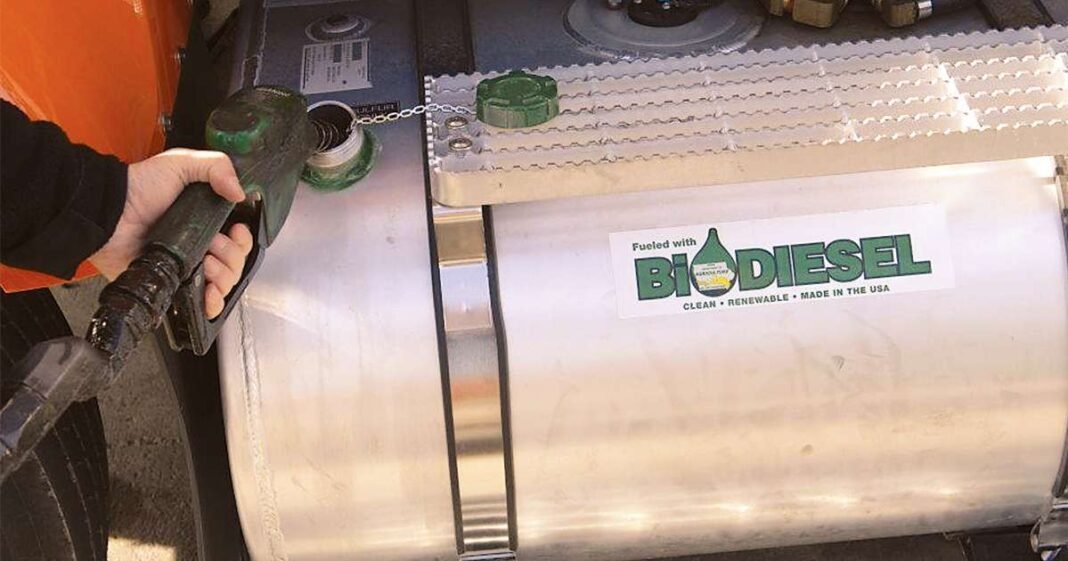

Biodiesel output in Iowa tumbled 31% in 2025. (Iowa Biodiesel via Facebook)
February 17, 2026 12:28 PM, EST
Key Takeaways:
- The Treasury Department and Internal Revenue Service issued proposed regulations for the 45Z Clean Fuel Production Credit on Feb. 4, offering long-awaited guidance for U.S. renewable fuel producers.
- Industry groups said the lack of earlier guidance and low RFS levels drove a sharp biodiesel downturn, including a 31% output drop in Iowa.
- The department of Agriculture and Energy must now finalize carbon intensity scoring rules before the credit’s full benefits can be realized, according to farm and biofuel leaders.
Biodiesel producers are hailing new federal tax credit guidance for U.S.-manufactured renewable fuels as last year’s uncertainty contributed to a double-digit output drop.
Proposed regulations for the 45Z Clean Fuel Production Credit issued Feb. 4 by the U.S. Department of the Treasury and Internal Revenue Service were welcomed in the renewable fuel and agriculture industries.
The 45Z Clean Fuel Production Credit was enacted by the Inflation Reduction Act of 2022 to replace other renewable fuel tax credits (such as biodiesel) and amended by the One, Big, Beautiful Bill Act.
Section 45Z provides a technology-neutral production tax credit (enacted in August 2022 within the Inflation Reduction Act) that was amended in July by the One, Big, Beautiful Bill Act to provide financial incentives for U.S. renewable fuel production and sales.
The IRS stated that the proposed regulations provide guidance on how to determine clean fuel production credits, emissions rates and requirements for certification/registration.
The clean fuel production credit is a business income tax credit for clean transportation fuel produced domestically after Dec. 31, 2024, and sold by Dec. 31, 2029. Taxpayers must be registered with the IRS (Form 637) at the time of production to claim credit.
Grant Kimberley, executive director of the Iowa Biodiesel Board, said the guidance gives the industry more certainty and responds to taxpayer comments on prior guidance amid the formal rulemaking process.
“Although the credit has been available since January 2025, the minimal guidance made it virtually impossible for producers and farmers to capitalize on it,” Kimberley said, calling the new guidance “a positive step in restoring the health of the biodiesel industry.” The Clean Fuels Alliance America echoed the sentiments approving the federal guidance, while voicing concern about the state of the biofuel industry.
“The delay in rulemaking led to market uncertainty that took a heavy toll on our industry, undercutting fuel production and the value added to agriculture,” noted Kurt Kovarik, vice president of federal affairs at Clean Fuels. “We anticipate this proposal will provide additional market certainty for biodiesel and renewable diesel producers. The proposed rules provide taxpayers with safe harbors, clarify questions on qualified sales, tolling arrangements, and qualifying fuels used in nontransportation applications.”
Iowa Biodiesel Board Welcomes Published Guidance on Federal Tax Credit: https://t.co/ADddprBhXI
— Iowa Biodiesel Board (@IowaBiodiesel) February 3, 2026
The top U.S. biodiesel producer, Iowa sustained a 31% drop last year in annual output to 266 million gallons compared with 2024. According to the Iowa Renewable Fuels Association, only eight facilities reported biodiesel production last year with several others working sporadically due to uncertainty about both the 45Z Clean Fuel Production Credit and Renewable Fuel Standard (RFS) blending levels under the U.S. Environmental Protection Agency.
Monte Shaw, IRFA executive director, said, “2025 was a real gut punch for biodiesel everywhere, and Iowa was no exception. Lack of tax policy coupled with low RFS numbers sent producers into a tailspin. We have plants trying to hang on by their fingertips waiting for clarity from D.C.”
American Farm Bureau President Zippy Duvall reacted positively, characterizing the new guidance as “moving the needle.”
However, this is just the first step. The departments of Agriculture and Energy must now finalize guidance and resources for calculating carbon intensity scores so that the full range of congressionally mandated improvements to the credit can be realized,” he said.
Duvall added that American farmers and ranchers are ready to support U.S. energy independence.
“Encouraging the production of homegrown biofuels will not only help meet the demand for renewable energy but also fortify a farm economy that desperately needs a boost,” he said. “We look forward to working with USDA and DOE to ensure farmers are recognized as partners in taking on the challenge.”

