
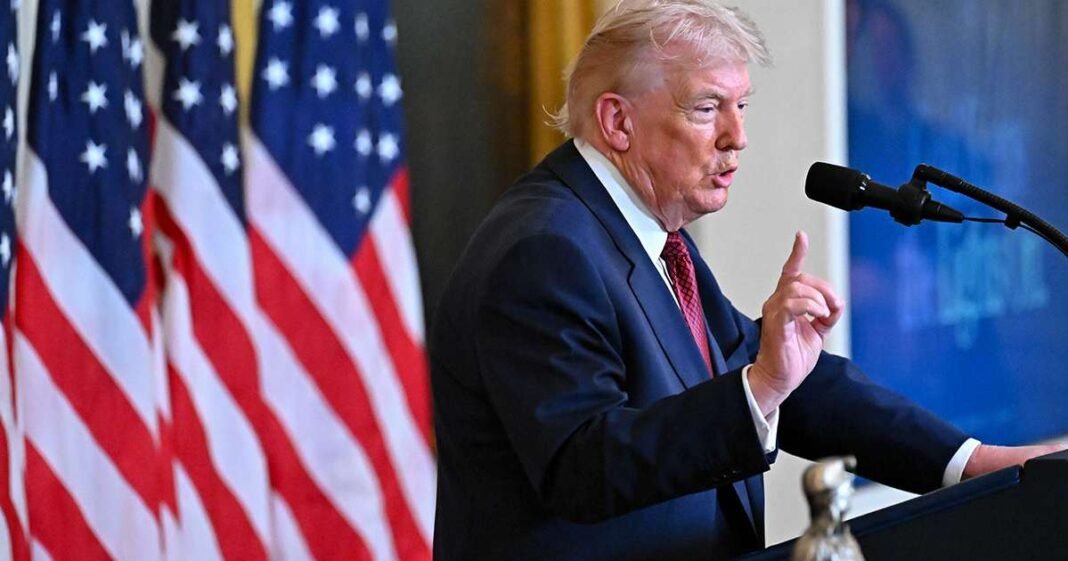

President Donald Trump and Japanese Prime Minister Sanae Takaichi are scheduled to meet in Washington on March 19. (Graeme Sloan/Bloomberg)
February 17, 2026 4:30 PM, EST
The U.S. and Japan unveiled the debut projects of a $550 billion investment fund, pressing ahead with a trade and economic pact in the weeks before Japan’s Prime Minister Sanae Takaichi is set to meet President Donald Trump.
Trump said that the first tranche of money would go toward an Ohio gas power plant, a critical minerals site in Georgia and a liquefied natural gas facility in Texas in a Feb. 17 social media post. The announcement did not specify how the projects would be financed or which companies would be involved.
“The scale of these projects are so large, and could not be done without one very special word, TARIFFS,” Trump wrote.
The selection comes after a joint panel first met in December to consider projects, which are ultimately selected by Trump himself based on recommendations from an investment committee he established, along with input from Japanese officials.
The fund is meant to spur a wave of Japanese investment in key U.S. industries and was a central pillar of a tariff deal struck last year, where the U.S. president agreed to set levies at 15% on imports from Japan, lowering the tariff for automobiles, a critical driver for Japan’s economy.
The implementation of the trade and economic agreement is likely to be a top agenda item for a scheduled meeting between Trump and Takaichi in Washington on March 19.
— Rapid Response 47 (@RapidResponse47) February 17, 2026
U.S. Commerce Secretary Howard Lutnick and Japanese Trade Minister Ryosei Akazawa met in Washington last week to hash out the details of the first tranche of investment announcements. Akazawa said he doesn’t expect projects backed by the $550 billion fund to be high-risk, high-return, signaling the Japanese are seeking initiatives with safe returns, rather than less-certain investments.
The two nations identified potential projects ranging from $350 million to as much as $100 billion during Trump’s visit to Japan last year. That framework included energy, artificial intelligence and critical minerals investments involving SoftBank Group, Westinghouse, Toshiba Corp., among other companies.
The government-owned Japan Bank for International Cooperation and Nippon Export and Investment Insurance are expected to play leading roles in financing the projects. It’s unclear how much money will be committed in the form of direct investment. Akazawa said last year that only 1%-2% of the $550 billion mechanism would consist of cash investments, with the majority coming from loans and loan guarantees.
After a selection is made, Japan has 45 business days to fund the effort, according to an agreement between the countries.
If Japan elects not to fund a project, the U.S. could claw back certain revenues or reimpose tariffs, according to the agreement. That could risk significantly higher duties on Japanese imports into the U.S. Trump threatened to raise tariffs to 25%, then scaled that back to 15% after Japan agreed to boost investment in the U.S. through the $550 billion fund.
Trump has grumbled about the pace of implementation of a similar deal with South Korea, a key competitor with Japan on auto manufacturing and threatened to hike tariffs once again. That saga underscores the link between the investment pledges and the tariff changes that accompanied them.
The announcement follows a historic electoral victory for Takaichi earlier this month. She has vowed to prioritize strong ties with the U.S. Trump has praised Takaichi, wishing her “great success” in her “Conservative, Peace Through Strength Agenda.”

