
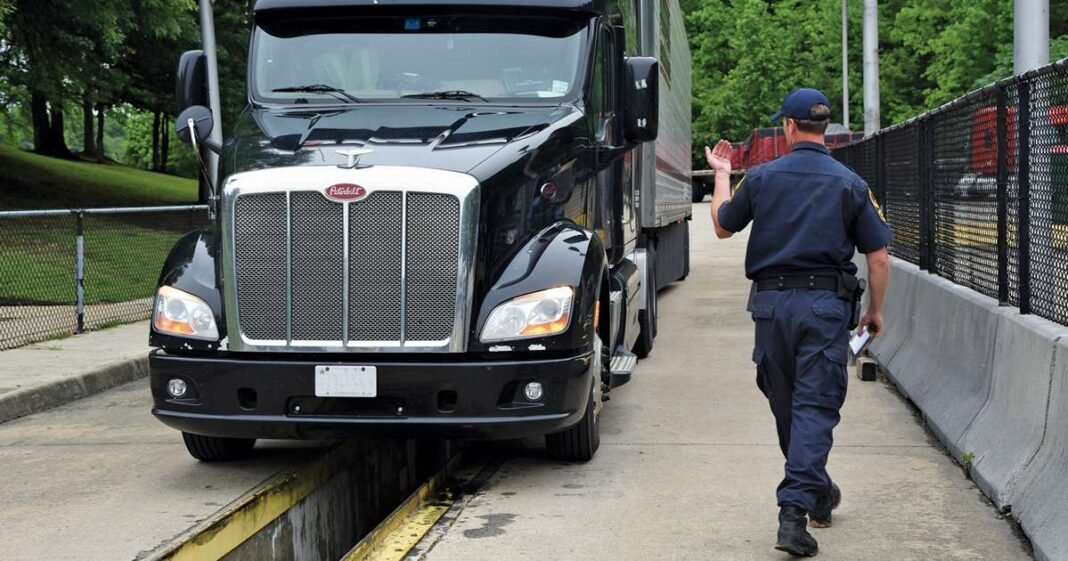

This year’s driver focus area will center on ELD manipulation, falsification and tampering. (Commercial Vehicle Safety Alliance via Facebook)
February 17, 2026 12:10 PM, EST
Key Takeaways:
- CVSA’s May 12-14 Roadcheck will focus on detecting falsified or tampered electronic logging device records.
- Inspectors will review both driver qualifications and mechanical safety, including cargo securement and critical vehicle systems.
- Rising incidents of ELD manipulation have prompted enhanced scrutiny and can lead to immediate out-of-service orders.
Commercial Vehicle Safety Alliance’s annual International Roadcheck in May will focus on drivers who falsify or tamper with their electronic logging devices to manipulate hours of service.
“Last year, falsification of record of duty status was the second most-cited driver violation, at 58,382 violations. And five out of the top 10 driver violations were related to hours of service or ELDs,” CVSA noted Feb. 12 in its inspection announcement.
For a 72-hour period from May 12-14, CVSA roadside inspectors will fan out across the nation at weigh and inspection stations and spot-check areas. The main goal is to conduct a 37-step North American Standard Level I Inspection on commercial vehicles, examining a driver’s operating requirements and evaluating a vehicle’s mechanical fitness.
Spotlight on ELD Fraud
This year’s driver focus area will center on ELD manipulation, falsification and tampering. Roadside inspectors will review a driver’s record of duty status as in past years but with specific scrutiny to determine if ELD tampering has occurred.
“Inaccurate ELD entries may result from a driver’s lack of understanding of the federal regulations and exemptions,” CVSA noted. “However, in some cases, inaccurate entries are purposefully used to conceal hours-of-service violations, and some records are manipulated to conceal driving time (with no indication the record was edited as required by federal regulations).”
Last year, Jeremy Disbrow, CVSA roadside inspection specialist, told Transport Topics that inspectors in many states were reporting new ELD falsification methods by drivers, carriers or other third parties that make it difficult for roadside safety inspectors to identify when driving and rest breaks occurred.
“The falsifications are often many hours or days off from what actually occurred. For example, a fuel receipt and bill of lading may say the driver was in Fargo, N.D., on Jan. 1 at 11 a.m., but the record of duty status shows the driver picked up in Fargo on Dec. 30 and was in Santa Fe, N.M., on Jan. 1,” Disbrow said.
(Federal Motor Carrier Safety Administration via X)
“The inspector can prove the ROD is false but cannot determine when the driver was actually driving or resting because the entire record is inaccurate,” he added. “Many of these ELDs are not showing any indication they were edited, which is required by federal regulations. As inspectors are learning of this tactic, they are discovering these types of falsifications on a regular basis.”
ELD tampering ranked among the top seven issues that bad actors exploit in the industry recently identified by a group of state trucking associations. The group released a plan in December with solutions to eliminate fraud and illegal operators, called “The Fight for Fairness and Safety: Paving the Way for a Trucking Resurgence.” The plan emphasizes what can be done without new legislation or rules.
It noted that electronic log integrity is needed to end ELD manipulation and hours-of-service fraud.
Vehicle Inspection Focus
This year, CVSA inspectors also will check a driver’s qualifications, license, record of duty status, medical examiner’s certificate, seat belt usage, skill performance evaluation certificate (if applicable), and status in the Drug and Alcohol Clearinghouse if driving in the U.S.
Additionally, CVSA inspectors plan to see if drivers display apparent signs of alcohol or drug impairment.
“If an inspector identifies driver out-of-service violations, they will place the driver out of service, restricting that driver from operating their vehicle,” CVSA added.
Vehicle checks this year will focus on cargo securement due to safety risks posed to drivers and other motorists. Improper or inadequate cargo securement can adversely affect a commercial motor vehicle’s maneuverability or cause unsecured loads to fall or become dislodged, resulting in roadway hazards and crashes.
(Commercial Vehicle Safety Alliance)
“In 2025, 18,108 violations were issued because cargo was not secured to prevent leaking/spilling/blowing/falling, and 16,054 violations were issued for vehicle components or dunnage not being secured,” CVSA stated.
Inspectors also will check a vehicle’s brake systems, coupling devices, driveline and driveshaft components, driver’s seat, fuel and exhaust systems, frames, lighting devices, steering mechanisms, suspensions, tires, wheels, rims, hubs and windshield wipers.
If out-of-service violations are found during an inspection, the vehicle will be restricted from movement until all violations are addressed.
A vehicle that successfully passes a Level I or V inspection without critical vehicle violations may receive a CVSA decal valid for up to three months. The decals let enforcement personnel know the vehicle was recently inspected and had no out-of-service violations.

