
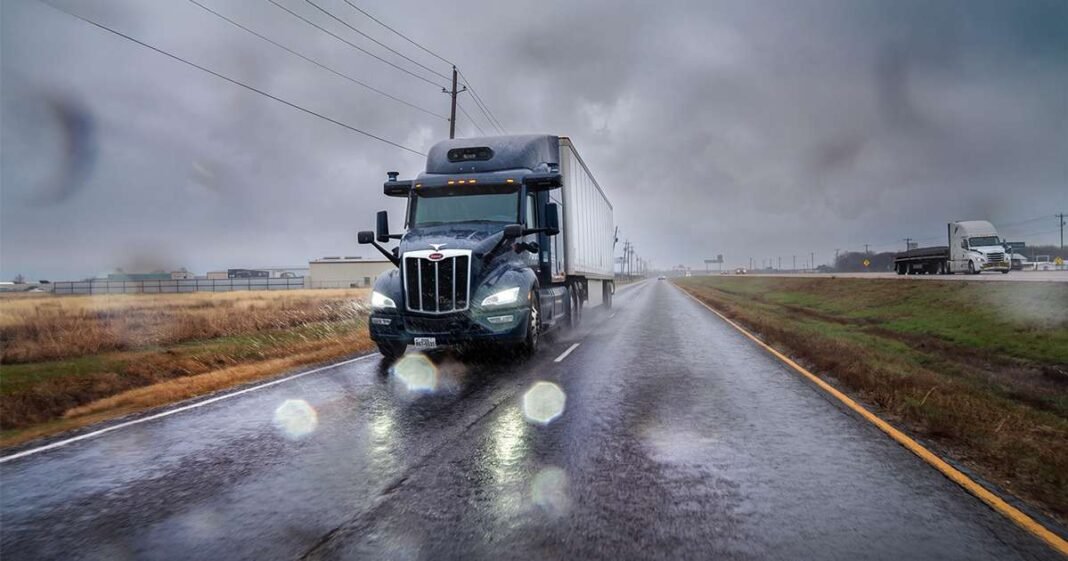

“The era of superhuman logistics has arrived,” Urmson said. (Aurora Innovation)
February 12, 2026 1:09 PM, EST
Key Takeaways:
- Aurora Innovation said Feb. 11 it will triple its driverless truck network to 10 routes after validating operations between Fort Worth and Phoenix.
- The company expects more than 200 driverless trucks by year-end and reported 2025 losses of $816 million as it scales its transportation-as-a-service model.
- Aurora plans to launch full driverless operations in Q2 2026 and a driver-as-a-service offering in 2027 as revenue rises with expanded Sun Belt coverage.
Aurora Innovation is about to triple its driverless truck network, expanding to 10 routes, after validating operations between Fort Worth, Texas, and Phoenix, the company said Feb. 11.
Pittsburgh-based self-driving truck technology developer Aurora is now able to move freight between Dallas and Houston; Fort Worth and El Paso; El Paso and Phoenix; Fort Worth and Phoenix; and Laredo and Dallas.
“The era of superhuman logistics has arrived,” said Aurora CEO Chris Urmson.
Aurora operates a transportation-as-a-service (TaaS) business — using the Aurora Driver software — and plans to expand rapidly as 2026 and 2027 progress.
All of Aurora’s TaaS commercial truck capacity — with a human currently in the cab and driverless operations beginning in the second quarter of 2026 — is now fully committed through the third quarter of 2026, it said.
The company expects to have more than 200 driverless trucks in operation by the end of the year.
Aurora on Oct. 28 revealed its purchase of International Motors LT Series tractors, but the company is keeping how many vehicles it bought under wraps.
Commercial loads in driverless and vehicle operator-supervised tractors are currently being carried for FedEx, Hirschbach Motor Lines, Schneider, Uber Freight, Volvo Autonomous Solutions and Werner Enterprises.
FedEx, Hirschbach, Schneider and Werner rank Nos. 2, 58, 10 and 18, respectively, on the Transport Topics Top 100 list of the largest for-hire carriers in North America.
Hirschbach is an early customer on the Phoenix route, allowing Aurora to support the Dubuque, Iowa-based carrier’s expedited operations, the company said.
Volvo Group unit VAS and Paccar are both working with Aurora on factory-produced driverless vehicles.
The company also launched its latest software release Feb. 11, which provides Aurora Driver with the ability to begin expanding across the southern U.S. and serve customer endpoints in 2026.
“Expanding across the Sun Belt and introducing customer endpoints enables us to provide our customers with the capacity they need to move goods at a scale that wasn’t possible before,” Urmson said in a statement accompanying the announcement. “Being a carrier is a game of margins and if autonomy can work around the clock, it will be key to growing our customers’ businesses.”
The company’s latest software release is its fourth since April 2025. The first release validated initial operations between Dallas and Houston, the second operations at night, and the third runs to El Paso.
Aurora was operating 10 trucks in December, Urmson said in a letter to shareholders.
The fleet size was reduced in early 2026, however, to prioritize capacity for lane validation and prepare for the launch of Aurora’s second-generation commercial hardware kit, he added.
(Aurora via YouTube)
The letter accompanied the release of Aurora’s fourth-quarter 2025 earnings, a period in which the company said it posted a loss of $206 million, 6.3% greater than the $193 million loss posted in the year-ago quarter. Aurora posted a $201 million loss in the third quarter of 2025.
Overall in 2025, Aurora posted a loss of $816 million, up 8.3% compared with a loss of $748 million in 2024.
The company’s Q4 revenue totaled $1 million, matching the Q3 total, but in 2026, Aurora expects revenue between $14 million and $16 million, compared with $3 million in 2025.
Aurora said the revenue will be back-end loaded — with Q4 2026 expected to contribute more than half the total — as the company scales its driverless operations without an observer.
The company expects to launch a driver-as-a-service operation in 2027 after the 200-truck fleet is rolled out.

