
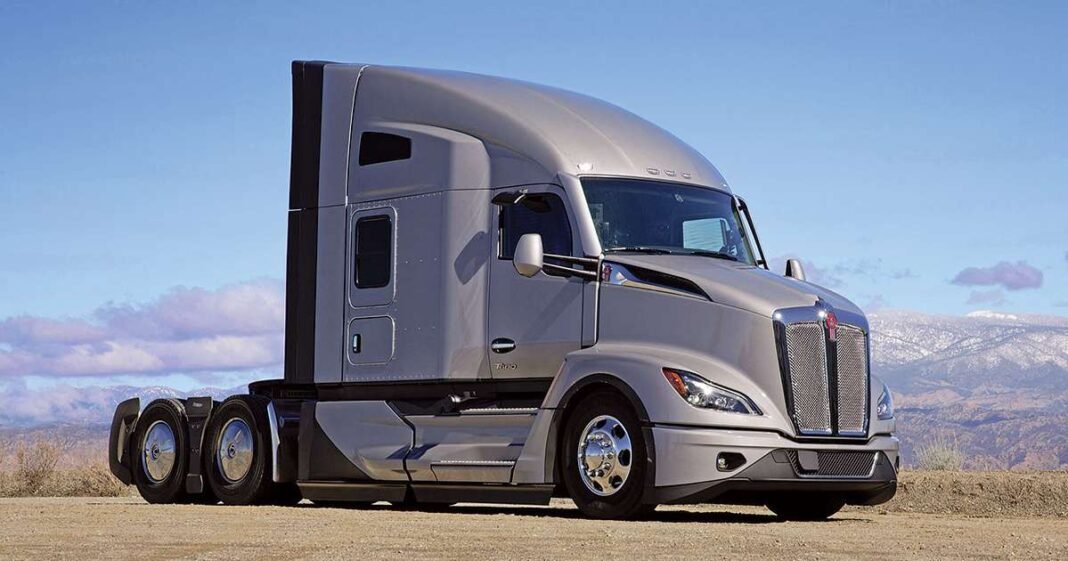

Kenworth’s flagship T680 on-highway tractor. (Kenworth Truck Co.)
February 11, 2026 2:05 PM, EST
Key Takeaways:
- Paccar said it will launch two new proprietary engine platforms to meet the EPA’s 2027 35-milligram NOx standard, calling the rule the world’s most stringent.
- Executives said the tougher emissions limits will raise truck costs and noted ongoing uncertainty as EPA finalizes rule flexibilities on warranty and useful life requirements.
- Paccar plans to detail the engines later this year while continuing development of battery-electric models and monitoring hydrogen options as regulatory updates are expected to arrive in March.
Paccar Inc. is set to unveil two engine platforms ahead of the introduction of tighter Environmental Protection Agency nitrogen oxide emissions in 2027, senior executives said Feb. 10.
The executives teased the introduction of the engines at the truck maker’s analyst day in Denton, Texas, while also warning that the minutiae of the regulations would have a substantial impact on the cost of trucks and engines for carriers in the coming months and years.
“So, diesel, as you know, moves the world today. And we believe clean, efficient diesel solutions will continue to have an important place in the heavy-duty market for the foreseeable future,” Chief Technology Officer John Rich told analysts.
“Proprietary engines are Paccar’s core competency, and the upcoming 35-milligram NOx standard is the most stringent in the world. We view challenging emission standards as a strong barrier to entry in our most important markets,” he said.
“To meet the 35-milligram mandate, we will introduce two all-new proprietary engine platforms. These are by far the most advanced powertrains in our history, simultaneously improving emissions, fuel economy and durability,” he added.
Paccar’s Peterbilt plant in Denton, Texas. (Peterbilt Motors Co.)
The engines are in the final phase of development, said the executive in charge of the parent company of Kenworth Truck Co. and Peterbilt Motors Co.’s powertrain operations as well as the latter truck brand, adding that they were being tested in the Arctic Circle, Death Valley, Calif., and elsewhere.
“The standard remains extremely challenging, and the required technology will add to the transaction price of the new truck,” Rich said.
EPA is set to leave in place a Biden-era requirement that NOx emissions for heavy-duty trucks drop to 35 milligrams per horsepower-hour from 200 mg/hp-hr.
“Over the last 15 years, Paccar Powertrain has systemically driven a 40% improvement in fuel economy, bringing down operating costs for our customers. The EPA has walked back [carbon dioxide]-based regulatory standards, but NHTSA’s mile per gallon-based requirements remain in place,” said Rich. “These will take a final step in 2027. Our new engines will meet this final step without requiring electrification. Our new proprietary engines will continue our proud tradition of improving fuel economy to drive value for our customers.”
However, truck makers and therefore fleets are still waiting on the final details surrounding the regulations, and the fine print is likely to be significant.
“The EPA right now has indicated that they will have introduced some flexibilities to the previously announced regulatory mandates. Those flexibilities are likely to be around warranty and full useful life at a minimum. They have indicated also that they will hold 35 milligrams as the numerical standard for criteria emissions. Depending on how they roll those out. And we expect that at the end of March, it will dramatically affect what the cost to the customer is of the new engine families,” said Rich.
“No matter how you slice it, fully complying with 35 milligrams is a massive technical challenge, and it does require new equipment. There are multiple approaches to it. They all have some level of pros and cons to them, but we’re very happy with the robustness of our path that we’re taking,” he said, adding: “We’ll have more about that later in the year — and specifics on the engine — but we have a tremendous track record in emissions compliance and … meeting the emissions intervals.”
While the Trump administration is tweaking rules for diesel engines and vaporizing backing for alternative powertrains, Rich acknowledged that the road to low- and zero-emissions products for truck makers remains open, if a little bumpier.
“So much has changed in the past year, but our powertrain strategy has not. Clean and efficient internal combustion engines remain the core of our lineup. In time, our proprietary engines will be complemented by hybrid electric solutions,” Rich said.
“Battery-electric trucks remained the pragmatic zero-emissions solution, and we continue to expand offerings where the use case is appropriate. We continue to investigate hydrogen solutions, including fuel cells and hydrogen combustion, but we have not committed capital to these applications,” he added.
Peterbilt’s flagship Model 579 on-highway tractor. (Peterbilt Motors Co.)
Kenworth and Peterbilt each launched three new battery-electric truck and tractor models in December.
Earlier in 2025, Kenworth unveiled a revamped version of the battery-electric configuration of its flagship T680 tractor at the 2025 Advanced Clean Transportation Expo in Anaheim, Calif. It also launched a battery-electric T880E, the brand’s first Class 8 battery-electric vocational truck.
Denton, Texas-based Peterbilt also launched a 579EV update and debuted the 567EV at ACT 2025 too.
However, Kenworth and Peterbilt delayed plans for the launch of hydrogen fuel cell electric versions of their flagship tractors.

