
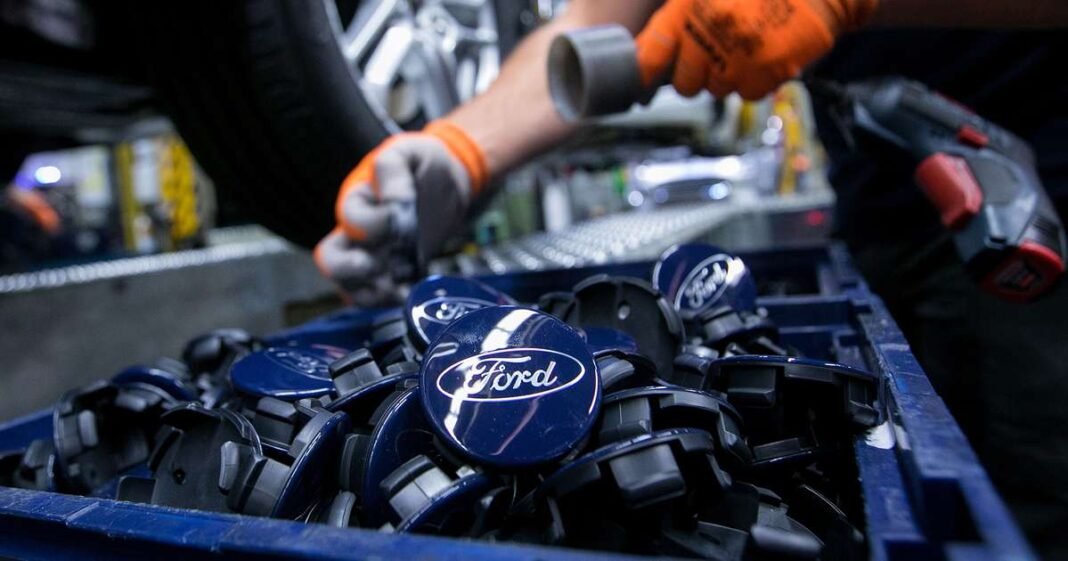

Ford’s adjusted earnings were 13 cents a share in the fourth quarter, the company said Feb. 10. That’s less than the 18 cents expected by Wall Street. (Krisztian Bocsi/Bloomberg)
February 10, 2026 4:37 PM, EST
Key Takeaways:
- Ford says a late-year tariff change from the Trump administration erased $900 million in expected savings.
- The automaker forecasts adjusted Ebit of $8 billion to $10 billion in 2026, up from $6.8 billion last year.
- Investors remain upbeat as Ford cuts costs and anticipates higher production of high-margin SUVs and pickups.
Ford Motor Co. expects profit to jump in 2026 after being saddled with a surprise tariff bill at the end of last year.
An unexpected change in tariff provisions cost Ford about $900 million in savings it expected last year, Chief Financial Officer Sherry House told reporters on Feb. 10. The Trump administration informed Ford on Dec. 23 about the matter, which effectively doubled Ford’s tariff toll to $2 billion.
“We were notified very late in the year by the Trump administration of an unexpected change” related to how automakers can trim what they pay in tariffs, House said. “Due to that late communication, we learned that we would not be able to bring in $900 million associated with that.”
Ford’s adjusted earnings were 13 cents a share in the fourth quarter, the company said Feb. 10. That’s less than the 18 cents expected by Wall Street.
Adjusted earnings before interest and taxes will be $8 billion to $10 billion in 2026, up from $6.8 billion last year. The midpoint of Ford’s outlook is slightly ahead of the $8.86 billion average of analyst estimates compiled by Bloomberg.
Ford’s shares were little changed at 4:06 p.m. in after-hours trading in New York. The stock had gained about 47% in the 12 months through Feb. 9, outpacing the S&P 500 Index’s 15% advance.
The mixed results highlight how Ford expects profit will rise even as it contends with ongoing turmoil tied to tariffs, its money-losing EV business and fallout from a supplier fire last year that cost the company billions in lost production of its top-selling F-Series pickup trucks.
Without the late-December tariff bill, Ford’s adjusted Ebit would have been $7.7 billion last year, House said.
Investors were anticipating a profit rebound as Ford plans to crank out more high-margin sport-utility vehicles and pickups after Republican-led moves to eliminate cash penalties for failing to meet fuel economy and emissions regulations, which is expected to save Ford billions. The regulatory reprieve in effect allows automakers to sell as many high-profit, low-mileage SUVs and pickups as they can build.
“We’re seeing our profitability improve,” CEO Jim Farley told reporters on the sidelines of the Detroit Auto Show in January. “I’ve been here for five years as a CEO. I’m really looking forward to this year.”
(Bloomberg Television via YouTube)
Sentiment also has been improving on Ford because it looks to be finally chipping away at high costs that have bedeviled the automaker for years, putting it at a disadvantage to rivals that Farley once pegged at $8 billion a year. House said Ford cut $1.5 billion in costs last year, 50% above the company’s target.
“The stock’s had good momentum,” David Whiston, an analyst with Morningstar Inc., said in an interview prior to Ford’s announcement. “It seems like they’re making a lot of progress on turning their costs around.”

