
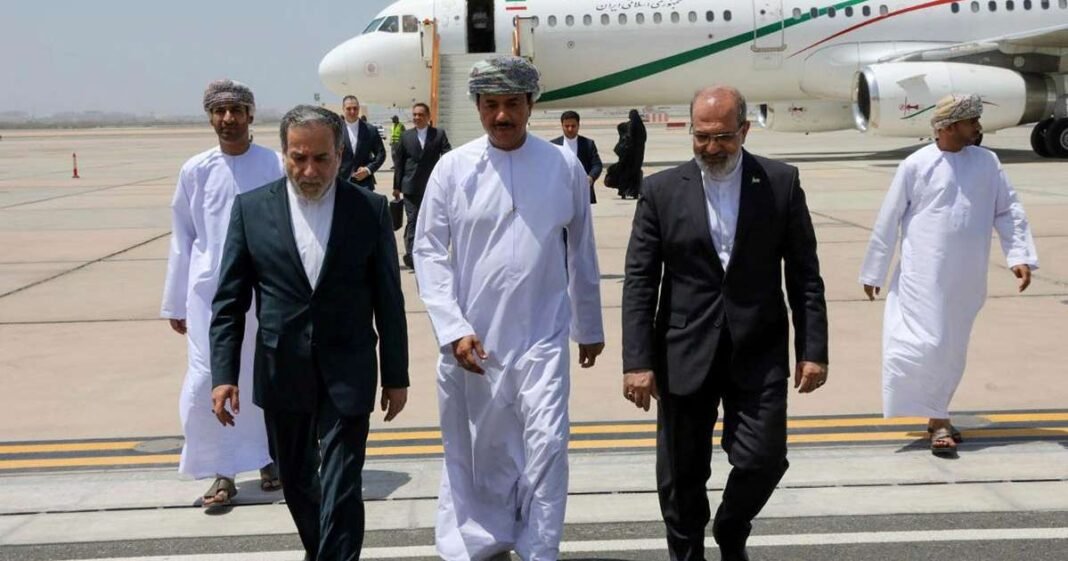

Iranian Foreign Minister Abbas Araghchi (left) arrives at Muscat, Oman, for negotiations with U.S. Mideast envoy Steve Witkoff, as Iranian Ambassador to Oman Mousa Farhang walks at right, on May 11, 2025. (Iranian Foreign Ministry via AP/File)
February 9, 2026 11:36 AM, EST
The U.S. said in an advisory that American-flagged ships should stay as far as possible from Iranian waters when navigating the Strait of Hormuz after a vessel was harassed last week, with tensions remaining high between Washington and Tehran.
Iranian forces historically have utilized small boats and helicopters during boarding operations and have attempted to force commercial vessels into Iranian territorial waters, including as recently as Feb. 3, the U.S. government said in a maritime advisory on Feb. 9.
The warning comes just days after U.S. and Iranian officials held diplomatic talks in Oman on Feb. 6, following President Donald Trump’s repeated threats on Tehran with airstrikes over both the violent suppression of Iranian protests and the country’s nuclear program. The U.S. also downed an Iranian drone last week, with the U.S. Central Command claiming the unmanned aircraft “aggressively approached” a U.S. Navy ship.
Both sides sounded positive about the talks and agreed to speak again. But analysts believe the chances of a deal are slim and that U.S. strikes on Iran remain likely, with Tehran actually escalating its crackdown over the weekend.
The U.S. threats of military action against Iran spooked oil markets, and seemed more credible coming just weeks after U.S. forces stormed into Caracas on Jan. 3 and captured Venezuelan leader Nicolas Maduro. Separately on Feb. 9, U.S. forces boarded an oil tanker in the Indian Ocean, underscoring how far Washington is prepared to go to enforce its energy quarantine on Venezuela.
The maritime advisory on Iran cites a long-standing risk to commercial vessels in the area “of being hailed, queried, boarded, detained, or seized by Iranian forces.” The Feb. 9 advisory updates language from a prior notice that stated there was “no specific threat to U.S.-flagged vessels in this location.”
If hailed, commercial vessels should advise Iranian forces that they are proceeding in accordance with international law, the advisory states. They should deny Iranian forces permission to board the vessel if possible while ensuring crew safety, but should not forcibly resist boarding.
Hormuz is a trade artery for Middle East oil shipments to global markets and one that Iran has threatened to close during times of geopolitical tension.
“When transiting eastbound in the Strait of Hormuz, it is recommended that vessels transit close to Oman’s territorial sea,” the advisory said.
Vessels should “remain as far as possible from Iran’s territorial sea without compromising navigational safety,” it said.

