
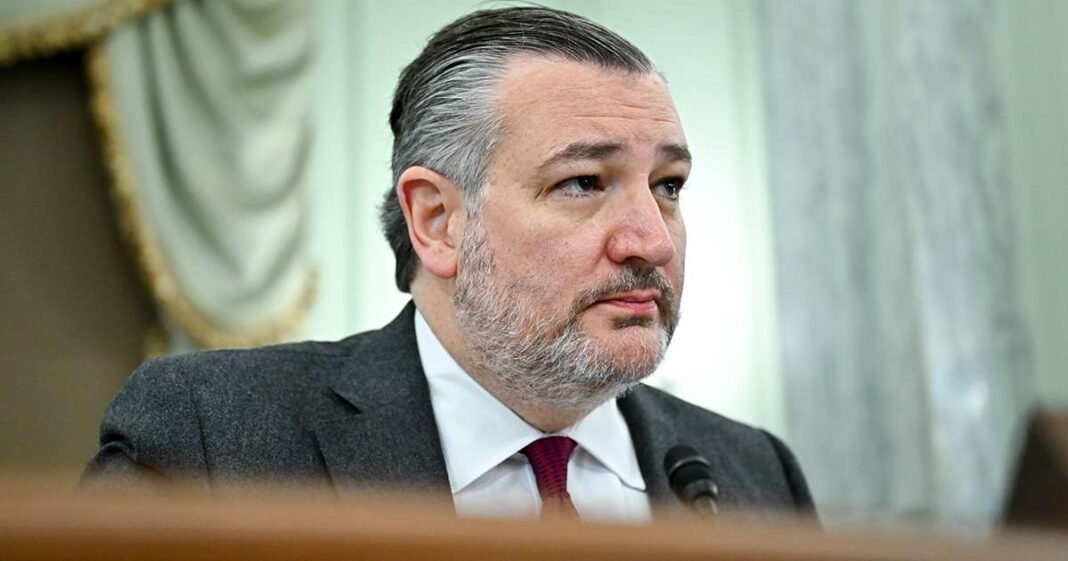

Sen. Ted Cruz is shown Feb. 4 during a Commerce Committee hearing on the future of self-driving vehicles. (Graeme Sloan/Bloomberg
February 6, 2026 5:16 PM, EST
Key Takeaways:
- Cruz said operating a modern transportation system without a federal AV framework raises the risk of decreasing economic and innovative competitiveness.
- Reps. Bob Latta (R-Ohio) and Debbie Dingell (D-Mich.) are cosponsors of the bipartisan SELF DRIVE Act.
- The Autonomous Vehicle Industry Association is among the stakeholders that supports the legislation.
WASHINGTON — Congress’ upcoming comprehensive highway policy measure would be an ideal fit for federal guidance specific to autonomous vehicles. That’s the position of Sen. Ted Cruz (R-Texas), chairman of the Commerce Committee on freight policy.
As transportation policymakers ramp up consideration this year of a multiyear surface reauthorization measure, Cruz recommended AV provisions be included in such legislative undertaking. Committees of jurisdiction intend to consider the reauthorization, referred to as the highway policy bill, as early as this spring.
At a hearing with stakeholders Feb. 4, the Commerce Committee chairman argued the moment had arrived for Congress to adopt a national AV regulatory framework. For nearly a decade, congressional lawmakers, such as members of the Commerce panel, have been unsuccessful in their aim to arrive at a final version of AV policy.
Autonomous vehicles could save tens of thousands of American lives.
I will keep fighting to unleash this new technology in a way that makes drivers and pedestrians safer. pic.twitter.com/TEtkC1fnPW
— Senator Ted Cruz (@SenTedCruz) February 5, 2026
“Autonomous vehicles, or AVs for short, are no longer theoretical,” said Cruz. “Like it or not, they are here and will be central to the future of roadways. AVs are now providing mobility to the disabled, improving auto safety and advancing technologies that have the potential to save millions of wasted hours in traffic, but most importantly, save thousands of American lives.”
“Yet Congress,” Cruz continued, “has failed to establish a clear federal framework to govern AV deployment. That inaction is no longer neutral — it is unsafe.”
The chairman further emphasized that operating a modern transportation system without a federal AV framework raises the risk of decreasing economic and innovative competitiveness as well as potentially jeopardizing safety. Trucks and cars equipped with autonomous features have enhanced safety capabilities for navigating freight and commuter corridors, policymakers explain. The technology also is capable of improving the movement of freight and providing access to disabled individuals.
Sen. Maria Cantwell (D-Wash.), the panel’s ranking member, suggested any legislation that would establish guidelines for deploying such autonomous technology must undergo careful review on Capitol Hill.
“This revolutionary technology needs a new approach to safety that provides for flexible guardrails, for beta testing and a clear path to safe, commercial deployment,” she said.
Another legislative platform besides the upcoming highway bill might serve as a better home for AV policy, Cantwell indicated.
On the other side of the Capitol, Rep. Bob Latta (R-Ohio) recently sought support for his most recent version of the Safely Ensuring Lives Future Deployment and Research in Vehicle Evolution (SELF DRIVE) Act. Co-sponsored by Rep. Debbie Dingell (D-Mich.), the bipartisan legislation would establish a national safety and regulatory framework for AVs.
At a House hearing last month, Latta sought to capture the policymaking moment with colleagues.
Reps. Debbie Dingell (D-Mich.) and Bob Latta (R-Ohio)
“I’ve said from the start, and I’ve always said this: AVs must be as safe or safer than anything on the road today,” he said.
The bill’s primary policy proposal responds to long-standing concerns about the lack of a national framework specific to the emerging technology, the U.S. Chamber of Commerce said in emphasizing its support for the SELF DRIVE Act.
“Their proposal would clarify the federal role in regulating autonomous vehicle (“AV”) technologies, prevent a patchwork of state regulations by clarifying federal, state and local responsibilities, and require the Department of Transportation to complete crucial rulemakings related to the design and safety of autonomous vehicle technologies in the United States,” per the chamber’s statement applauding the bill sponsored by Latta and Dingell. “Autonomous vehicle technology presents tremendous opportunities for consumers, businesses and the U.S. economy by enhancing road safety.”
Transport Topics reporters Eugene Mulero and Keiron Greenhalgh examine the critical trends that will define freight transportation in the year ahead. Tune in above or by going to RoadSigns.ttnews.com.
Other key industry stakeholders also have endorsed the recent legislation.
“To maintain and strengthen American leadership in the AV industry, Congress should enact federal legislation that outlines the necessary statutory and regulatory elements that are critical to the industry’s success,” Jeff Farrah, CEO of the Autonomous Vehicle Industry Association, said at the Feb. 4 Senate hearing. “This legislation should include the full universe of AV use cases, from small delivery vehicles, to robotaxis, to commercial motor vehicles.”
At this year’s Washington, DC Auto Show, Transportation Secretary Sean Duffy shared perspective about the impact associated with AVs.
“You’re going to see changes with autonomous vehicles. That technology is evolving. It’s our job to make sure we get the regulation right. I kind of talk about it as Goldilocks,” the secretary told attendees Jan. 22. “We can’t go too slow or innovators will go somewhere else to innovate.”
The country’s main highway policy law was enacted along with the Biden-era Infrastructure Investment and Jobs Act, known as the bipartisan infrastructure law. The highway policy law’s authorization expires in September. Transportation policymakers in the Republican-led House and Senate have pledged a commitment to updating the law prior to its expiration.

