
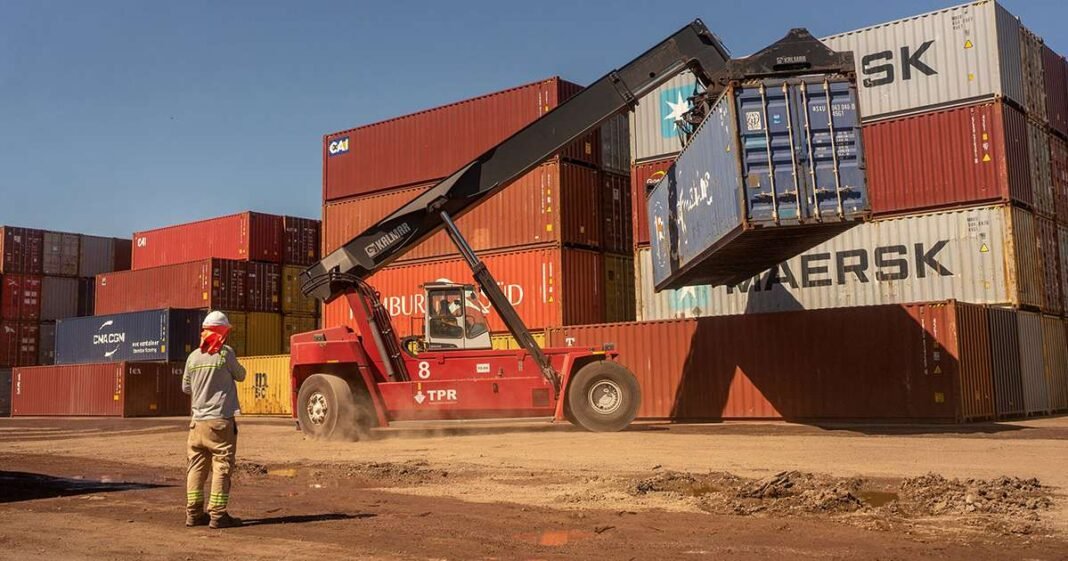

Shipping containers are unloaded at the Port of Rosario in Rosario, Argentina. (Sebastian Lopez Brach/Bloomberg)
February 5, 2026 3:12 PM, EST
| Updated: February 5, 2026 5:05 PM, EST
Argentina and the U.S. agreed to scrap hundreds of tariffs on each other’s goods in a trade and investment deal inked Feb. 5, a major step in President Javier Milei’s push to open up the historically protectionist South American economy.
The U.S. agreed to eliminate over 1,600 reciprocal tariffs on Argentine goods, while Milei’s government will terminate more than 220 levies on U.S. products, Argentina’s foreign ministry said in a statement.
Argentina Foreign Minister Pablo Quirno and U.S. Trade Representative Jamieson Greer signed the agreement in Washington, according to statements from both governments.
The agreement is a victory for Milei, one of President Donald Trump’s top Latin American allies, that will add to billions of dollars in U.S. financial aid that helped stabilize Argentina’s currency ahead of a crucial midterm vote last year. The libertarian leader has sought to bolster ties with Washington while tearing down trade barriers as part of an overhaul of the nation’s beleaguered economy.
“The deepening partnership between President Trump and President Milei serves as a model of how countries in the Americas, from Alaska to Tierra del Fuego, can advance our shared ambitions and safeguard our economic and national security,” Greer said in the statement.
Milei, meanwhile, touted the deal as proof that Argentina can rebuild its status as a global leader in political and economic affairs, saying in a statement that it has everything it needs to “recover its greatness of the past.” He said he’ll send the agreement to Argentina’s congress for approval.
The two countries had previously agreed to a framework deal in November that called for Argentina to make several concessions, while the U.S. pledged to remove some reciprocal tariffs on pharmaceutical products and “unavailable natural resources.”
Argentina will be able to export 100,000 tons of beef to the U.S. with preferential access as part the agreement, up from the current quota of 20,000 tons, according to the foreign ministry’s statement. The quota increase amounts to an extra $800 million, officials estimated.
That detail could revive tensions between Trump and some Republican lawmakers, who sought to protect U.S. ranchers from more competition from Argentine beef last year.
Argentina will also increase its imports of American beef, cars and agricultural products. It’s eliminating tariffs on U.S. machinery, medical parts, chemical products and slashing levies to just 2% on certain auto parts. The framework from November also said that Argentina committed to accepting food certified by the U.S. Food and Drug Administration.
The agreement also touches on intellectual property rights and digital trade, among other topics, according to the Argentine government statement.
Trump has repeatedly sought to aid his Argentine ally. Last September, with Milei limping toward the midterms, the U.S. Treasury unveiled a $20 billion lifeline that helped mitigate a currency sell-off and shore up market confidence in his government. Milei’s party won a landslide victory a month later, sparking a market rally.
The South American nation often ranks among the worst worldwide on trade barriers, given its tariffs averaged 13% in recent years compared with 3.5% in the U.S., according to World Bank data. Argentina’s last attempt at opening up its economy in the 1990s crushed local manufacturing and made free trade synonymous with job losses for many voters.

