
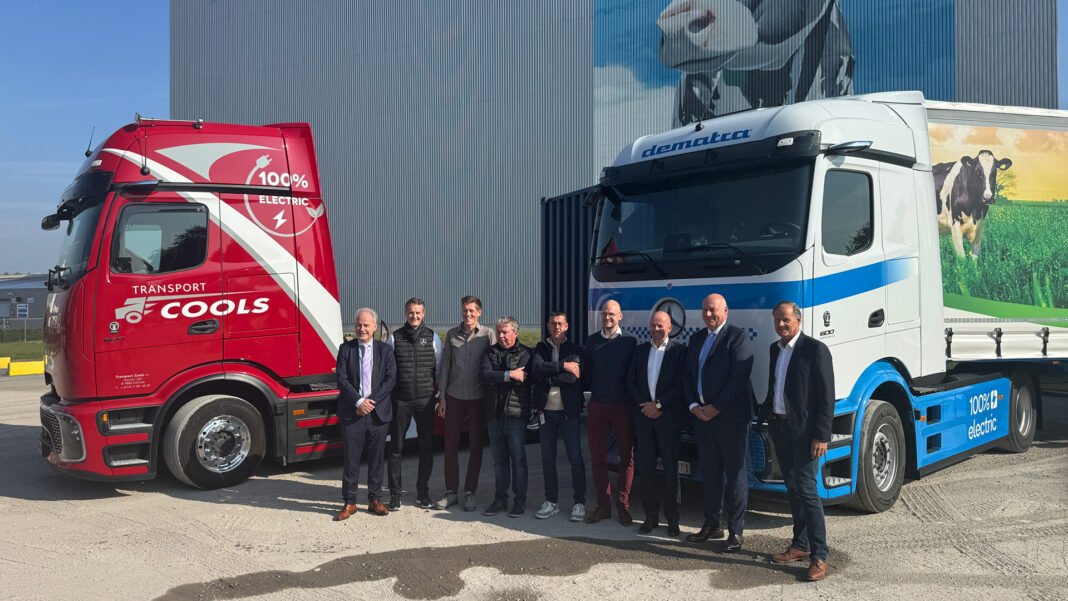

How does dairy giant FrieslandCampina organize its transport? Based on a stable network of transporters from Belgium and the Netherlands and with a lot of attention to sustainability and digitalization, according to an interview with Peter Van Renterghem, Manager LSP Warehouse & Distribution at FrieslandCampina. The company recently started a pilot project with electric transport.
FrieslandCampina, headquartered in Amersfoort, is one of the largest dairy cooperatives in the world. The company has approximately 9,000 member dairy farms and almost 14,200 member dairy farmers in the Netherlands, Belgium and Germany. In Belgium, FrieslandCampina has three production sites, in addition to the head office in Ghent: in Aalter, Bornem and Lummen.
The transport activities include collecting milk from dairy farms and transporting the manufactured, finished dairy products to distribution centers of retailers, such as Colruyt, Delhaize and Lidl. “Distribution to retail warehouses in Belgium and abroad falls under the responsibility of our team,” says Peter Van Renterghem. “On the other hand, we have a separate entity ‘Milk Logistics’ for the supply of milk to agricultural companies.”
400 million liters per year
FrieslandCampina is all about large volumes. “In Aalter we process approximately 400 million liters of milk annually, and in Bornem another 20 million liters,” explains P. Van Renterghem. “On average, 85 trucks with finished products leave per day, with peaks of up to 110 when there are promotions.” Of these, 25 to 40 travel to the Netherlands and 10 to 15 to the United Kingdom every day. Belgium represents 14 to 25 loads per day. “And via the ports of Antwerp and Rotterdam we also supply to the Middle East, Africa and Asia.”
FrieslandCampina does not have its own fleet, but works with approximately 15 transport companies, which are selected every two years through a central tender procedure in Amersfoort. “A first round with around 70 candidates results in a shortlist of 30 companies, after which approximately 15 permanent partners remain,” says P. Van Renterghem. “We work with various selection criteria. For example, we expect the drivers to load and unload the trucks themselves, but that is not possible for every transport company.”
FrieslandCampina’s transport partners must also be open to digital integration. “Our orders are increasingly processed fully automatically and digitally, directly in the carriers’ planning systems,” explains P. Van Renterghem. “It saves time, reduces errors and allows proactive planning. It increases both our efficiency and that of our partners. By sharing data, we can better anticipate peaks and promotions together.”
Stable collaboration
The price also plays a role in the choice. P. Van Renterghem: “That speaks for itself in a tender, but the rate certainly does not determine everything. We especially want to collaborate in a sustainable and stable manner with reliable partners who are willing to invest in digitalization and an environmentally friendly approach. Important partners in our network today are Dematra, Eutraco, Van der Heijden, Simon Loos, Veenstra, Rima Trans and Cools Transport. We have been working with many of those companies for a long time.”
Logical consequence: many drivers have been driving for FrieslandCampina for years. “Almost half of the truck drivers come to us every day. They know the people, the procedures and even each other’s weekend plans,” laughs P. Van Renterghem. “That is an advantage, because it creates trust and efficiency.”
FrieslandCampina supplies to distribution centers of retailers such as Colruyt, Delhaize and Lidl. There are strict requirements regarding packaging and pallet quality, especially for fully automatic DCs. “A loose piece of foil or cardboard can lead to rejection. We therefore work very closely with product development to ensure that every pallet can be processed automatically.”
The biggest challenge is balancing volumes and timely planning in a sometimes limited charging infrastructure. “We have eight loading ports and sometimes a hundred trucks per day,” says P. Van Renterghem. “Our operation runs from six in the morning to ten at night. Everything depends on tight planning and a good balance between the transporters. To bridge peak periods, such as during promotions, we use flexible capacity within the existing network.”
Sustainability is central
FrieslandCampina also imposes clear sustainability criteria on its logistics partners. During the last tender, all transporters had to submit an extensive sustainability scan, with information about fleet renewal, fuel consumption, driver training, solar panels, wind energy and electric vehicles. “We aim for a 43% CO₂ reduction by 2030,” says P. Van Renterghem. “That requires efforts from everyone, including our transport partners.”
An internal software tool collects all emission data and makes the evolution to 2030 measurable. “Our data is transparent, our direction is clear. In the coming years we will invest further in electric mobility, renewable energy and digitalization. This is necessary to remain efficient and profitable in an increasingly demanding market.”
FrieslandCampina therefore also started electric rides in collaboration with Transport Cools and Dematra. Both transport companies drive a Mercedes eActros 600 exclusively for the dairy company to and from the Aalter location.
Transport Cools drives to the port of Antwerp, approximately 320 km in total. Dematra visits two retailers every day, plus two CHEP inbounds, covering approximately 340 km. Importer Daimler Truck and dealers VDH and Ghistelinck have intensively supervised the start-up of this electric transport at FrieslandCampina.
“These electric transports should save approximately 160 tons of CO₂ per year,” says P. Van Renterghem. “Dematra and Transport Cools bear all investments in purchasing and charging infrastructure on site, but we are committed to working with them in the long term. Finding the right routes where we could deploy these electric vehicles was the biggest challenge. For our company, this is a pilot project that we will evaluate soon.”
FrieslandCampina in figures
- 400 million liters of processed milk in Aalter per year
- 85 to 110 trucks per day
- 17,000 shipments per year
- 15 transport partners, mainly Belgian and Dutch companies
- Objective: 43% CO₂ reduction by 2030

