
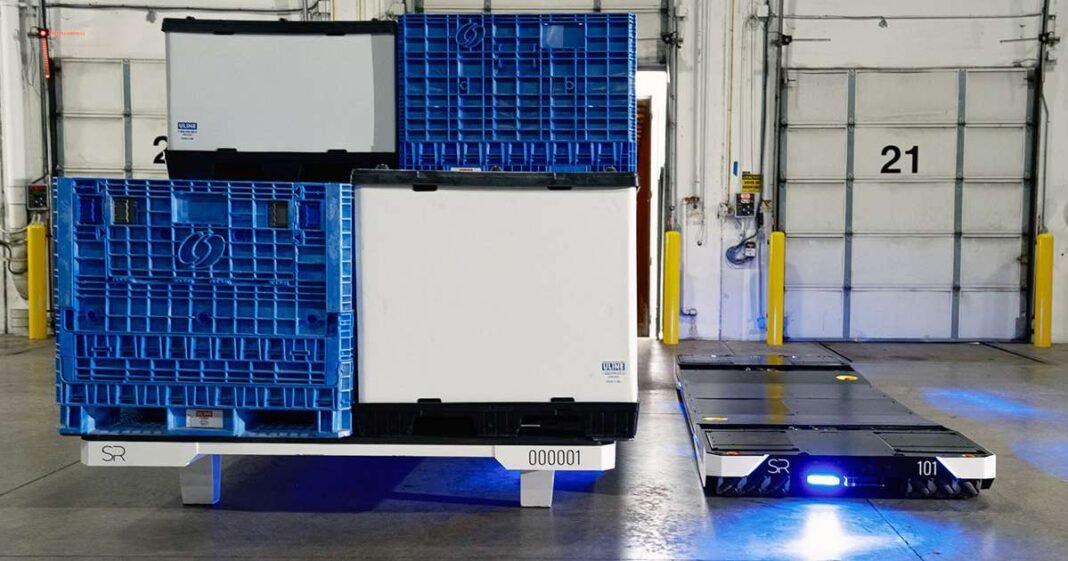

The SlipLift platform (right) can support loads of up to 20,000 pounds. (Business Wire)
February 4, 2026 4:20 PM, EST
Key Takeaways:
- Slip Robotics introduced SlipLift, a loading and unloading platform that separates robots from freight to expand automation into heavier and longer‑haul operations.
- The system enables consistent dock turns and broader route coverage by allowing fewer robots to handle more doors, according to the company.
Slip Robotics rolled out a new loading and unloading platform called SlipLift, expanding its autonomous technology into heavier freight, regional distribution and last-mile delivery operations, the company said Feb. 3.
The system shifts the company’s approach by separating the robot from the freight it moves. Slip Robotics said the design lets a smaller number of robots handle more dock doors while maintaining consistent loading and unloading times.
“We’ve always focused on removing uncertainty at the dock,” CEO Chris Smith said. “SlipLift extends that philosophy. Customers get fast, repeatable load and unload times across more routes, without adding robots or complexity.”
SlipLift builds on the company’s SlipBot system, which was developed for shorthaul, high-frequency routes where trailers are turned quickly in closed-loop operations. Slip Robotics said SlipLift brings similar speed and predictability to freight types and routes where weight, distance or dock variability had limited automation.
The platform supports loads of up to 20,000 pounds. According to the company, sectors like food and beverage, packaging, paper products and automotive assemblies could use the system to maintain more consistent dock turns.
SlipLift also is intended to support regional and medium-haul distribution networks. With robots no longer paired to individual shipments, operators working across multiple facilities can automate additional doors without deploying a robot at each one.
For last-mile carriers, the company said the system allows freight to be staged before morning departures, reducing congestion at docks and shortening driver dwell times.
“Pre-staging changes the economics of last-mile loading,” said Lauren Marneni, head of product. “When freight is ready on a SlipCarrier, loading becomes a quick, repeatable process instead of a daily scramble.”
SlipLift works by collecting a loaded SlipCarrier at the dock, placing it into a trailer or box truck and repeating the process until loading is finished. Operators stay outside the trailer and supervise with a hand-held controller.
“Our goal was to make autonomy feel natural for operators,” Marneni said. “The operator stays in control, but the robot does the hard, dangerous work inside the trailer.”
Slip Robotics plans to show SlipLift at Manifest 2026 and Modex 2026. Early deployments are underway, with broader availability expected this year.
Generative AI assisted in the creation of this article.

