
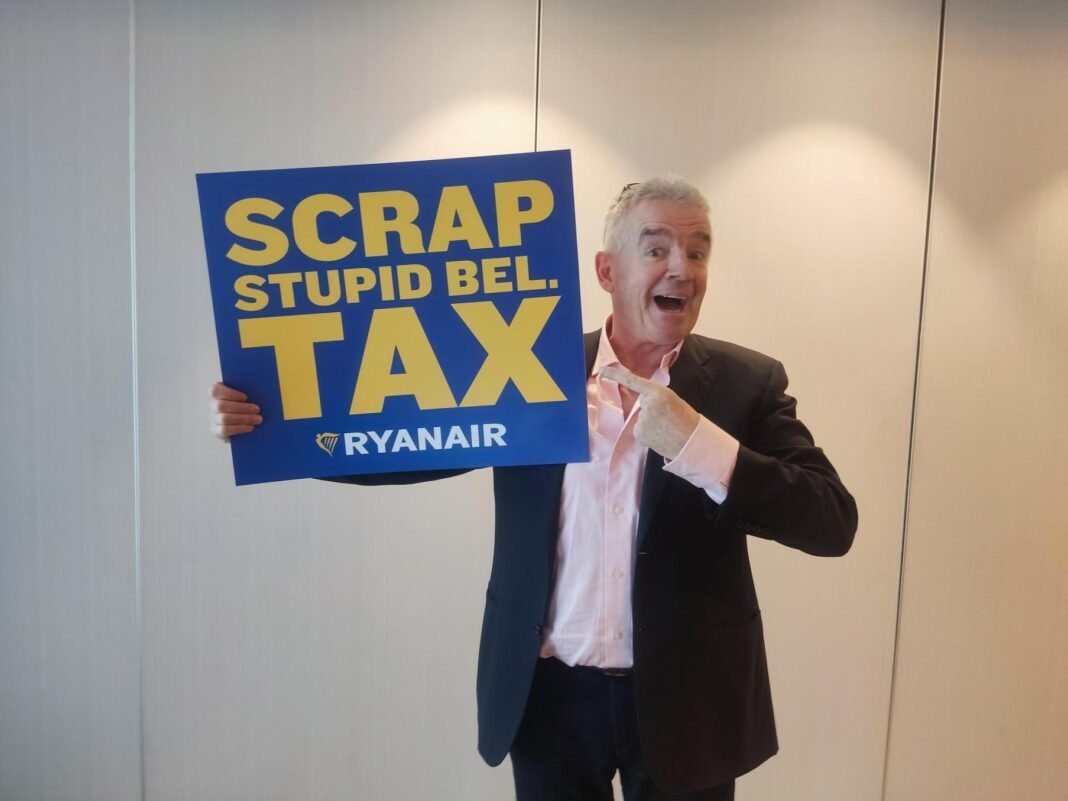

Ryanair has warned it will scale back flights in Belgium after new passenger taxes raised by federal and local authorities, arguing the measures undermine Europe’s competitiveness and risk pushing air traffic out of the EU.
The airline’s CEO, Michael O’Leary, lashed out at the tax increases at Brussels’ Zaventem and Charleroi airports during a press conference in Brussels on Wednesday.
“These environmental taxes are dumb,” he said. “Europe needs to get more competitive.”
At the end of November 2025, as part of its budget agreement, the Belgian government decided to standardise and raise the boarding tax to €10 per passenger for short-haul flights – up from previously variable rates – starting 1 January 2027.
Meanwhile, the city of Charleroi announced in early December a local tax of €3 per passenger, effective from 2026, further fueling Ryanair’s criticism.
The boarding tax has two stated objectives: one is environmental, aimed at making air transport pay for its CO₂ emissions and encouraging passengers to choose trains for short journeys; the other is to generate revenue for the state.
In response, Ryanair plans to gradually reduce flights in Belgium, removing up to 2 million of the 11 million passengers it carries there each year.
O’Leary called on the Belgian government and the European Commission to abolish aviation taxes to restore the competitiveness of European air transport.
According to him, several European countries – including Sweden, Italy, Slovakia, and Albania – are instead abolishing their aviation taxes to attract traffic and investment. He argues that Belgium’s decision is prompting airlines to move aircraft and routes to countries with lower taxes.
Ryanair calls for ETS reform
O’Leary, who said Europe has “far more pressing issues on its economic and political agenda than listening to bullshit environmental nonsense,” also criticised the EU Emission Trading System (ETS).
Originally designed to reduce greenhouse gas emissions by setting a cap and allowing companies to trade emission allowances, the ETS, he argues, penalises intra-European flights while incentivising travelers to fly outside Europe.
Passengers on long-haul flights to or from Europe operated by non-European airlines do not pay the European ETS; they are subject only to the international CORSIA system, which is less costly.
O’Leary also pointed out that non-European passengers and long-haul flights account for roughly 53% of aviation emissions linked to Europe.
Ryanair is calling for European ETS rules to be aligned, arguing that either non-European airlines should also pay the ETS, or that the European system should be reduced to match the international CORSIA standard.
(aw)

