
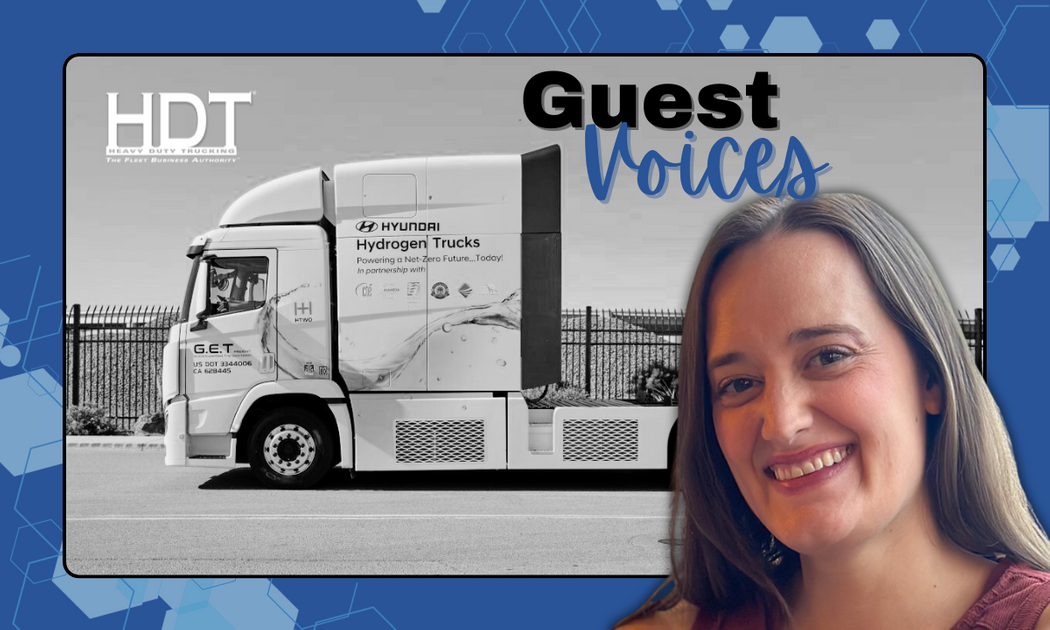

Image: HDT Graphic from CTE photos
With strong federal policy and smart fueling infrastructure investments — like those being made through the Department of Energy’s Hydrogen Hubs program — fuel cell electric trucks (FCETs) can become a cornerstone of a cleaner, more resilient freight system.
Now is the time for industry and government leaders to engage by piloting new technologies, shaping supportive policies, and building business models around clean freight, ensuring that zero-emission trucking is not only possible, but practical and profitable.
Today, 95% of U.S. hydrogen is produced using natural gas — a domestic resource that gives America a head start in building a homegrown hydrogen economy. By using freight as a key offtake market, we can strengthen domestic energy production, reduce dependence on foreign oil, and secure a leadership position in the global clean energy race — all while preserving range, payload, and uptime for the trucking industry.
Early deployment of hydrogen in freight can also help drive down production, distribution, and fueling costs through economies of scale.
As demand increases and infrastructure expands, stronger market signals will lower the barriers for cleaner hydrogen alternatives like renewable and electrolysis-based hydrogen.
Some segments of long-haul trucking are uniquely positioned to anchor the scale-up of hydrogen fuel. These trucks operate on predictable routes, centralized depots, and long daily ranges — conditions that align perfectly with early hydrogen infrastructure deployment.
FCETs also maintain the familiar refueling model that drivers and fleet operators already rely on, minimizing disruption while maximizing uptime.
By starting with freight, we gain a high-impact use case that builds immediate demand for hydrogen, accelerates infrastructure rollout, and drives down costs for other sectors to follow.
Hydrogen Fuel Cell Trucks at the Ports
Fuel-cell-electric trucks are also proving valuable in drayage operations.
Port facilities operate 24/7, and any disruption can ripple across the economy. FCETs offer quick refueling, high payload capacity, and greater energy resilience than their diesel counterparts.
FCETs can be refueled with hydrogen produced on-site, reducing a port’s dependence on the grid and enhancing reliability if there’s an extreme weather event, power outage, or wildfire that could impact the electrical grid’s availability.
The NorCAL Zero project at the Port of Oakland demonstrates the use case for FCETs in drayage operations. Funded by the California Air Resources Board (CARB) and managed by the Center for Transportation and the Environment.
This project deployed 30 Hyundai Xcient Class 8 FCETs in a demanding drayage operation, hauling freight and vehicles between the Port of Oakland and the Bay Area and Central Valley.
FirstElement Fuel opened the world’s first public high-capacity liquid hydrogen fueling station at the Port of Oakland in 2024, capable of fueling over 200 FCETs a day.
CTE/Norcal/FirstElement Fuel
To support the fleet, FirstElement Fuel opened the world’s first public high-capacity liquid hydrogen fueling station at the Port of Oakland in 2024, capable of fueling over 200 FCETs a day.
As the largest FCET deployment in the U.S., NorCAL Zero demonstrates the reliability of hydrogen-powered vehicles in real-world conditions, setting the stage for broader adoption of zero-emission freight solutions across the country.
What’s Needed to Scale Hydrogen Fuel in Trucking?
To scale nationally, the federal government has a catalytic role to play. Strategic investment in hydrogen fueling infrastructure along major freight corridors, coupled with well-aligned vehicle incentives, can create the conditions needed for widespread deployment.
Programs like the Department of Energy’s Hydrogen Hubs initiative provide a foundation for a strong hydrogen supply chain and incentivize innovation by the domestic hydrogen industry. But more coordination is needed to connect these policies with real-world fleet needs.
As this federal framework takes shape, state policies and fleet-level incentives are critical to deployment. Programs like California’s Hybrid and Zero-Emission Truck and Bus Voucher Incentive Project (HVIP) are already helping close the cost gap by offering up to $240,000 per FCET. Regulations like the Advanced Clean Trucks Rule and Multi-State ZEV MOUs send strong market signals that zero-emission trucks are the future.
Hydrogen fuel cell trucks offer a scalable, high-performance solution for the most demanding segments of the industry. With strong policy support, fuel-cell-electric trucks are poised to decarbonize long-haul and drayage freight operations while strengthening U.S. industrial leadership and energy independence.
The pieces are in place. Now it’s time to accelerate the transition and drive American freight into a zero-emission future.
About the Author: Anna Hansen is a government affairs strategic advisor with the Center for Transportation and the Environment, where she leads federal advocacy efforts to accelerate advanced technologies in transportation. A veteran of Capitol Hill and the Biden Administration, Anna brings deep expertise in federal budget policy and interagency infrastructure processes. She most recently served at the White House Office of Management and Budget.
This article was authored and edited according to Heavy Duty Trucking’s editorial standards and style to provide useful information to our readers. Opinions expressed may not reflect those of HDT.
If you are interested in partnering with CTE on a hydrogen freight project or would like to learn more about how you can transition your fleet to zero emissions, contact Anna Staddon, Delivery Freight and Logistics Market Lead at anna@cte.tv.

