
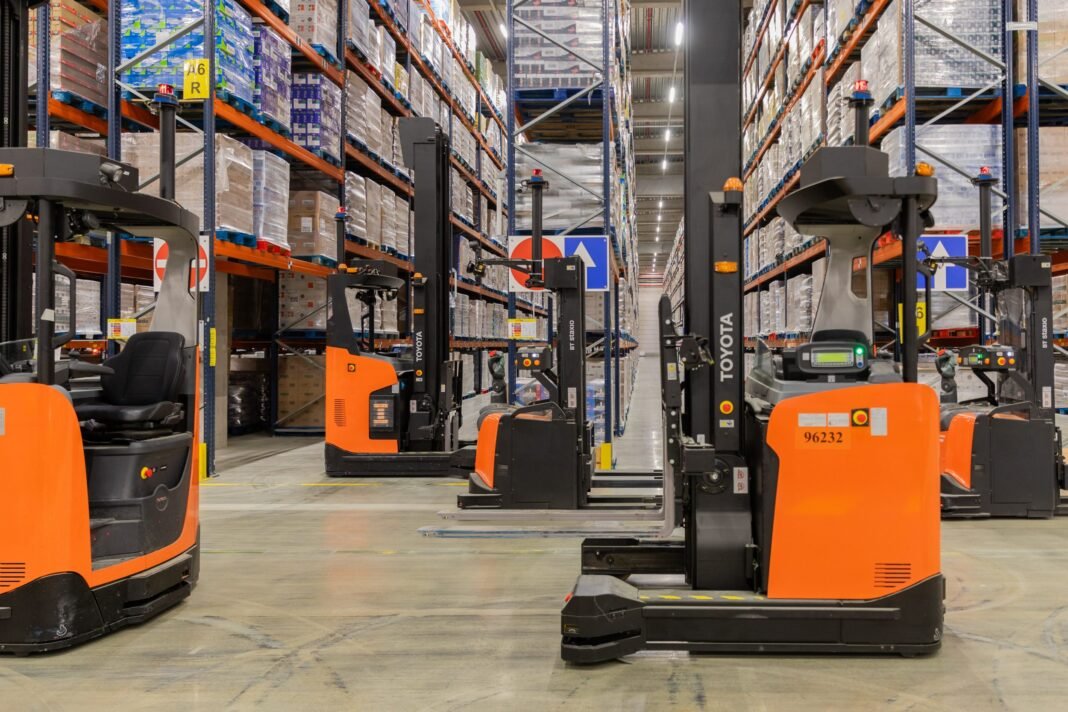

Automation increases efficiency and safety in warehouses, but also offers a solution to the shortage on the labor market. Last year, Distrilog introduced 20 AGVs from Toyota Material Handling in its warehouse in Breendonk. “Controlling those machines obviously requires an adjustment in skills from your employees,” says Continuous Improvement Manager Benjamin Van Ransbeeck of Distrilog. “But once they master that, it creates a very motivating work environment.”
Distrilog has been active as a logistics service provider in warehousing and transport for almost 35 years. The company has 21 sites, 415,000 m² of warehouse space and around 1,800 employees throughout Flanders. “Our logistics activities cover all temperature zones: ‘ambient’, ‘fresh’, ‘conditioned’ and frozen,” explains Benjamin Van Ransbeeck. “As a result, we are active in various sectors, such as retail, food, petcare, chemicals and – through the acquisition of Transport Michiels – recently also in waste and infrastructure logistics.”
How did you start that automation process at Breendonk?
B. Van Ransbeeck: The AGVs in our warehouse in Breendonk were introduced in collaboration with one specific customer in the context of a contract extension. The customer has entered into a long-term commitment that enables us to justify the investment. At the same time, it also responds to another problem, namely the tightness on the labor market and in this case more specifically reach truck drivers, a profile that is difficult to find. There are currently 12 automatic reach trucks (RAEs) and 8 stacker trucks (SAEs) active, which together account for approximately 3,000 movements per day. One employee is able to monitor these 20 AGVs simultaneously.
Reliable, scalable and flexible?
How did you specifically choose Toyota Material Handling equipment?
B. Van Ransbeeck: For Distrilog, the ‘reliability’ aspect is of crucial importance. We were looking for a system that had proven itself for quite some time. In addition, ‘scalability’ also plays a role. Is it easy to scale as the customer grows? For example, adding an AGV, such as on the site in Breendonk, is quite simple in an existing operation. ‘Flexibility’ is another important point. Could we easily use that system for another customer if the current customer were to leave? Finally, there are the costs and the expected return on investment. If you add all those things together, you soon end up with AGVs and AMRs, ‘Automated Guided Vehicles’ and ‘Autonomous Mobile Robots’. And Toyota Material Handling appears to be a very good partner in this.
How does the introduction of these AGVs change the work for employees in a warehouse?
B. Van Ransbeeck: The ‘skillset’ of the employees is changing, you cannot ignore that. Instead of driving the reach truck themselves, they will suddenly have to deal with automatically driving reach trucks, resolve ‘errors’, interpret situations, operate and steer those AGVs, etc. You need adapted skills for this. This requires training and flexibility from your employees. Some are open to this, others have more difficulty with it. It is certainly very important to involve your employees as early as possible and to communicate very clearly about what the goal is. This way you prevent a negative mindset in which AGVs are mainly seen as devices that will ‘take over’ their jobs. Because automation actually makes a job nicer and more challenging. Employees get a fantastic machine to operate. And if you know such a device well, you can do great things with it. If you manage to convey that and stimulate your operators, you will create a very nice vibe and motivating environment.
Collisions excluded
How is the safety of working with AGVs guaranteed?
B. Van Ransbeeck: They have sensors that monitor 360 degrees whether there are obstacles or employees in the area. If that’s the case, they stop immediately. Collisions are therefore excluded, which also has a positive influence on damage costs.
What tips and/or advice can you give from your own experience to companies that are on the eve of an automation process or are thinking about it?
B. Van Ransbeeck: Take the time to carefully analyze how your processes work, what the possibilities are and what you want to automate. Because you shouldn’t automate everything. We don’t do that at Distrilog in Breendonk either. The AGVs are responsible for approximately 95% of the logistics activities, which are mainly very standardized tasks. We have not automated the movements with palettes that are not so standard. These tasks are in a separate flow, but still carried out with a manual reach truck.

