
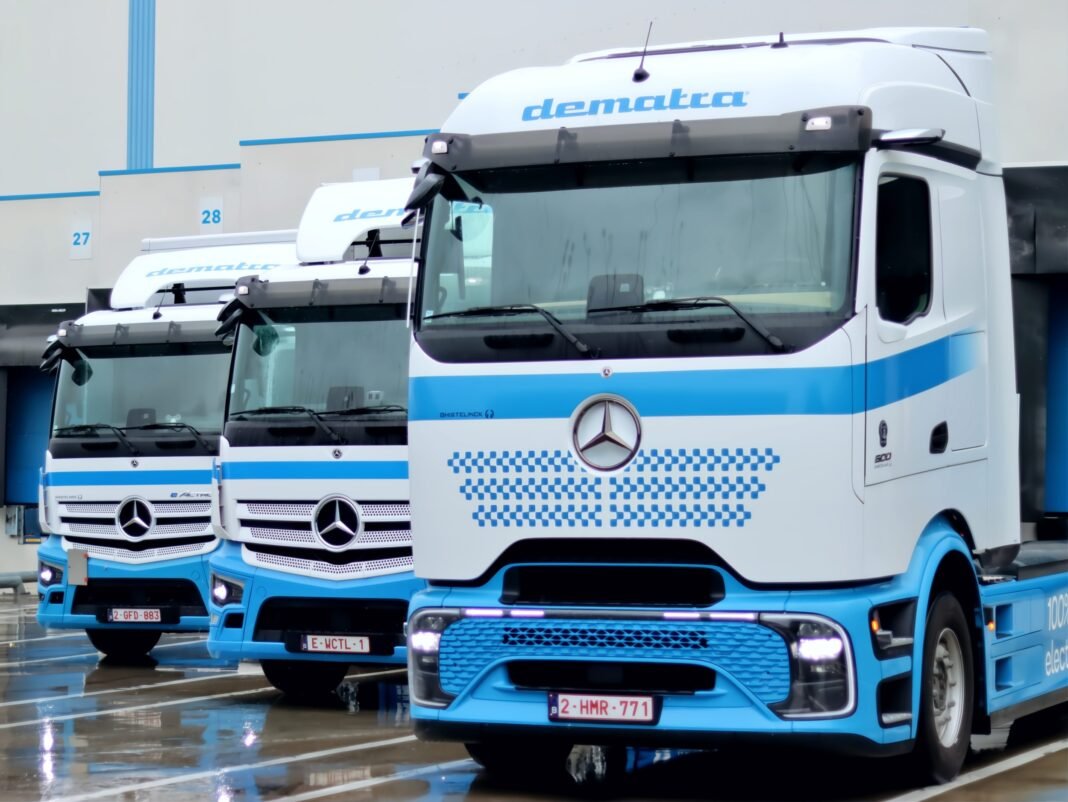

Dematra is the first fleet in Belgium to use any type of Mercedes-Benz eActros. The company uses an eActros 300, an eActros 400 and an eActros 600, with each model adapted to a different type of activity.
At the end of 2023, Dematra decided to purchase an eActros 300 and an eActros 600. The takeover of Wim Claes in Genk subsequently added an eActros 400. The eActros 300 is used in the Flemish Ardennes, the eActros 400 with double rear axle is used from Genk for distribution in Limburg and Antwerp and the eActros 600 covers a fixed route of approximately 350 kilometers in Flanders every day.
“What makes Dematra special is that the eActros 300 and 400 are not assigned to one customer: they are used flexibly. The drivers describe the eActros 300 as agile and practical in heavy traffic, while the eActros 400 is especially appreciated for its power and stability. The eActros 600 offers a completely new driving experience, thanks to its tractor configuration and its suitability for long distances. But all models have one thing in common: they have a greater range than initially expected,” explains Peter Brock, Managing Director of Daimler Truck Belux.
And as is often the case, once drivers try an electric truck, they usually don’t go back. “And when the regular driver of an e-truck is free, colleagues spontaneously sign up to replace him. Confidence in the technology clearly grows with every kilometer travelled,” says Peter Brock happily.
To charge its three electric trucks, Dematra uses an 80 kW charger at each location that operates during the drivers’ daily downtimes and mandatory rest periods. However, an application has been submitted in Nazareth for a more powerful high-voltage connection, so that additional chargers can be installed and a system can be integrated for the storage of energy produced during the day via solar panels. The company is also exploring the possibility of installing an additional charger at a customer. Thanks to Flemish subsidies and the exemption from kilometer tax, Dematra has established that its electric trucks – especially on fixed regional routes – can today run at almost the same costs as diesel trucks.

