
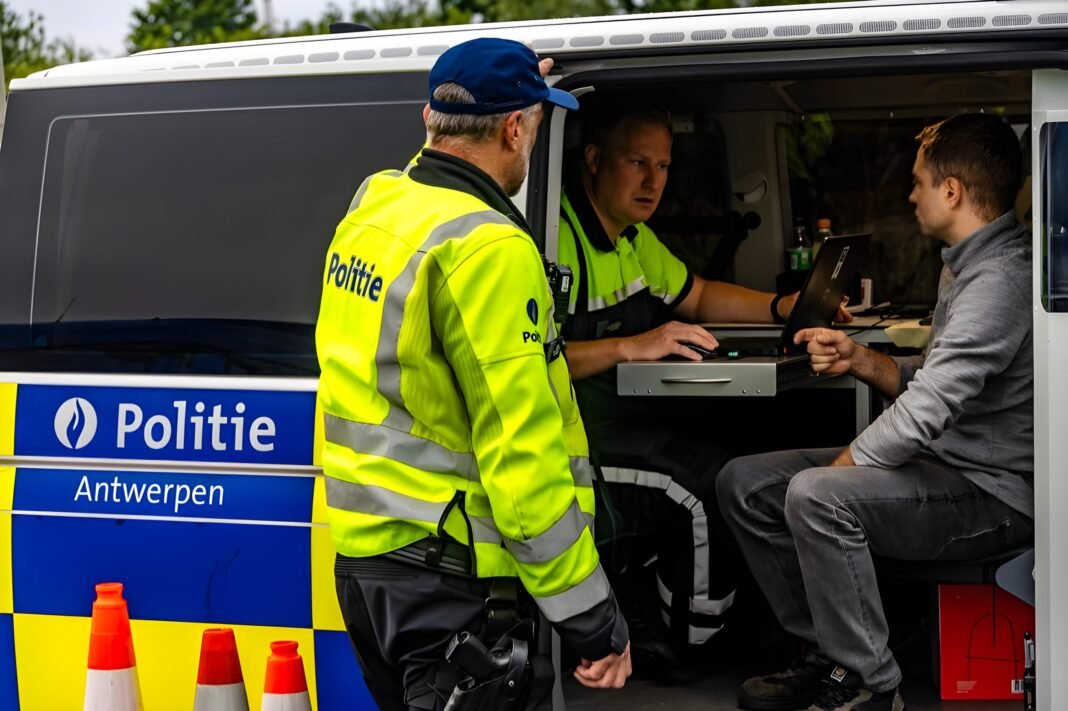

Behind the spectacular figures that occasionally appear in the general press, road checks are an indispensable link in the fight against fraud and in the interests of road safety in road transport. They are profitable… but according to many there are far too few.
Ask a transporter about roadside checks and you will get different responses: some think they are being harassed for petty things, others would like more checks… on the condition that their competitors are also checked more often. The topic divides the sector. We are not talking about company inspections here, but about checks by the Federal Road Police.
A magnifying glass
A few times a year, a major inter-service inspection is organized at sensitive locations, along a busy traffic axis or in a parking lot. The most recent took place during the Easter weekend, at nine different car parks, and produced spectacular results: of the 294 trucks, with drivers present, 243 appeared to spend the weekend in their cab. However, their employer should have provided suitable accommodation.
When the traditional media reproduces such figures, it appears as if the vast majority of transporters are committing fraud. But what do these inspections (and all the others that people don’t hear about) really say about compliance with the rules in road transport, apart from the figures? We asked Frederic Martin, chief inspector at the Federal Road Police. According to him, the figures are a magnifying glass on reality, but in some areas the situation is less serious than a few years ago.
“We are working in an increasingly targeted manner,” explains Frederic Martin. “It goes without saying that if you check a car park in the port of Zeebrugge during the weekend, there is a good chance that you will catch drivers spending their weekly rest in the cabin. But even during regular roadside checks, we conduct our checks in a much more targeted manner than five years ago.”
The tachograph, a valuable ally of the inspectors
An important adjustment is the evolution of the tachograph and the arrival of the infamous module C, which has allowed the police to ‘read’ the data from a digital tachograph remotely for about three years now. “You have to put the actual scope of this technological evolution into perspective,” Martin qualifies. “The ‘smart’ digital tachograph, with its GPS and GNSS functions, makes our work easier, but initially it also had teething problems. It was worse than in 2008 with the first digital tachograph. Moreover, it took a while before there were enough new tachographs in circulation to make our devices effective. Technically, this has now been resolved and since August 25, 2025, all trucks in traffic must be equipped with the new digital Smart 2 tachograph.”
This latest version also has the advantage that border crossings are registered automatically, while drivers previously had to do this manually to comply with the new cabotage rules.
Yet not everything is perfect: there remain conflicts with certain tachograph registrations and some things can only be checked during a physical check with the stationary vehicle. Such a check usually takes half an hour, so it is important to take a targeted approach.
More inspectors please!
However spectacular, the major checks do not succeed in completely curbing social fraud. Belgium is often seen as a diligent student in Europe, but the same cannot be said of our northern neighbors. “More controls are needed.” That message is heard by both the transport federations and the unions. In November 2024, after an inspection in Zeebrugge, Philippe Degraef (director of Febetra) stated: “Bonafide transporters who work hard should not fall victim to competitors who do not comply with the rules. Anyone who wants fair competition can only applaud these actions.”
The same opinion is expressed by Ludovic Moussebois, who has more or less taken over the torch from Roberto Parillo at the Christian union CSC-Transcom (ACV-Transcom): “I applaud the more intense cooperation between different control services, as well as the actions in which police services from several countries work together. But there are also far too few checks in Belgium. They should take place daily, and there should be more unexpected checks.”
The message has been passed on to the Ministry of the Interior… but for the time being there does not seem to be a major increase in the number of police officers. We will therefore have to rely even more on technology and on cooperation between the different Member States to target potential fraudsters even more specifically.

