
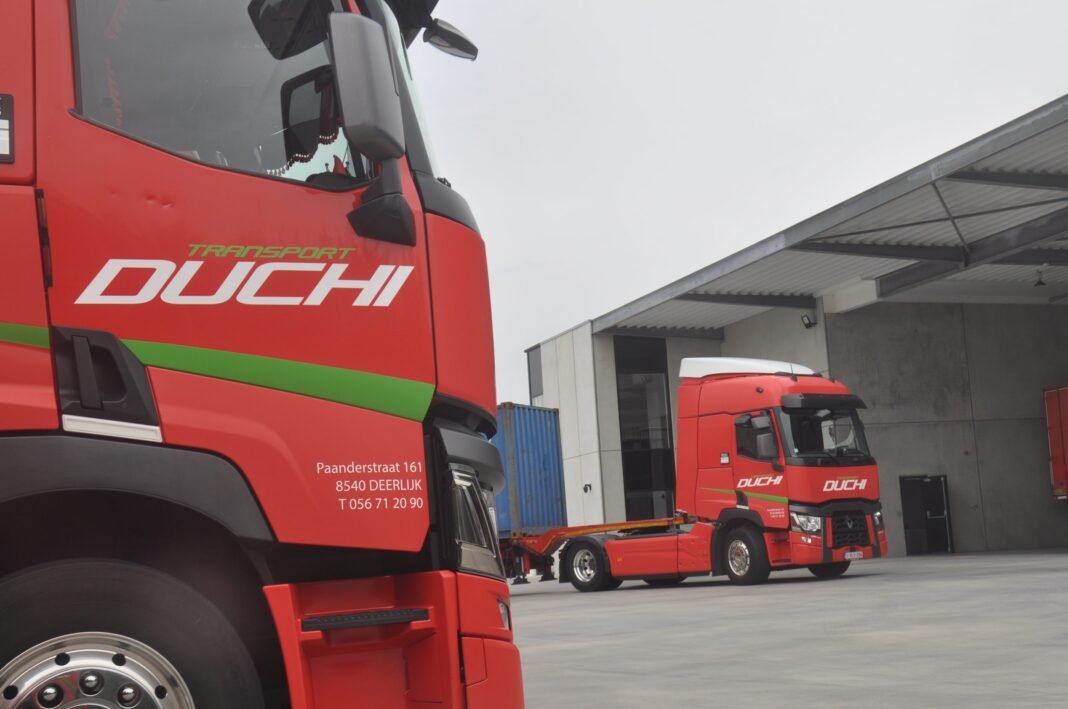

Patience is a virtue, the proverb says. This certainly applies in and around Antwerp. The introduction of time slots was intended to put a stop to this. Unfortunately, transport companies such as Duchi that specialize in container transport still experience the harsh reality of the long wait every day.
As with many transport companies in the Kortrijk region, the flax trade is the basis for the creation of Transport Duchi. The company was founded in Deerlijk in 1961 by the father of the current managers Marnix and Patrick Duchi. The flax trade and the associated transport were phased out and replaced by national transport. After a short intermezzo in the transport of agricultural products in the early years, this was fully focused on with the rise of sea containers.
The introduction of time slots was intended to ensure a greater spread in port traffic. Was the goal achieved?
Patrick Duchi: The idea was a noble one, but unfortunately the system is not watertight and we all too often end up waiting in queues for hours. The planning must reserve a time slot within which you must register, with a certain time margin. This, depending on the quay you need to be at, can vary from one to three hours. You will draw up your schedule based on the time slot. Unfortunately, it is quite common for the time slot to be canceled or adjusted at the last minute, which means that the planning is ruined. The cause of this can be of various kinds: from overcrowded terminals to delays in mooring or unloading a ship. The consequences of this are increasing waiting times. Not pleasant for us, but also not for our customers and not for the container terminals themselves.
Who says Antwerp, says traffic jams. How do you deal with this as a transporter?
P. Duchi: Under normal circumstances and to be economically viable, you should normally be able to visit Antwerp twice a day from here. If everything goes smoothly, this is a feasible option, taking into account the time slots and the fact that we have twice as many container chassis as tractors, so that we can often limit ourselves to recoupling the semi-trailer at the customer’s location.
In reality, however, the Antwerp region has become a major traffic jam zone. The introduction of the distribution allowance should provide relief here. In concrete terms, you pay around 20 euros if you register at the terminals between 6 am and 9 pm. It is free before and after this time. So you can save on this if you can register outside these peak hours, but then you will be on the road as a driver during the night. Strictly speaking, this does offer advantages, not only in terms of costs, but the traffic is also much calmer and smoother. The other side of the coin is that not everyone can handle this way of working.
Who are your clients?
M. Duchi: Half of our traffic is on behalf of forwarders, the other half is on behalf of our own customers, with whom we have often been working for decades. A number of them are still active in the textile sector, which remains prominent here, despite the many reorganizations in recent years. In addition to container work, we also have three of our own tilt-trailers that we use for our customers.
The transport of sea containers is undoubtedly linked to the economic situation on a global scale. Are you bothered by this?
M. Duchi: The announcement of the tariffs by the American president has caused a shock wave. There was a shortage of transport capacity to ship as many containers as possible. In more than half a century that we have existed, we had not experienced this much. But since mid-August we have seen a clear decline. You clearly feel that the economy is sputtering and international trade is under pressure. Which also translates into the relatively many bankruptcies, including within the transport sector.
This is where our conservative attitude comes to the fore. We have seen it happen several times that companies appear out of nowhere, grow very quickly and charge completely unrealistic prices, but then fail at the slightest slowdown in the economy because they have not created a buffer at all. It may still be ingrained in our mentality, but we only invest with our own resources and with a healthy financial buffer as a back-up.
If a truck may have to stand still for a while, we still have the necessary reserves to bridge that period. We also drive daily with five permanent drivers and three subcontractors. Marnix’s wife and his son, Hilde and Maxim, take care of the planning and administration. By still being behind the wheel ourselves every day, we know exactly how everything works and we have a close relationship with our clients.
Does the investment in a new business premises indicate that you look to the future with confidence?
P. Duchi: Two years ago we moved into the current location with new offices, covered space for storing the trucks, sufficient parking space for all rolling stock, car wash and garage, in addition to the necessary investments in green energy and water management.
In this way we want to ensure that the next generation can start on a solid basis and expand further if they wish. I think there will always be a place for companies of our size that do not take unnecessary risks and that direct contact with customers is of paramount importance.
Duchi Transport in short
• Founded: 1961
• Management: Marnix and Patrick Duchi
• Headquarters: Deerlijk
• Specialty: sea container transport
• Vehicle fleet: 7 tractors (5 Renault T 460 hp, 1 Renault T 480 hp, 2 Renault T High 480 hp, 1 Ford F-Max, 17 container chassis and 3 tilt-trailers

