
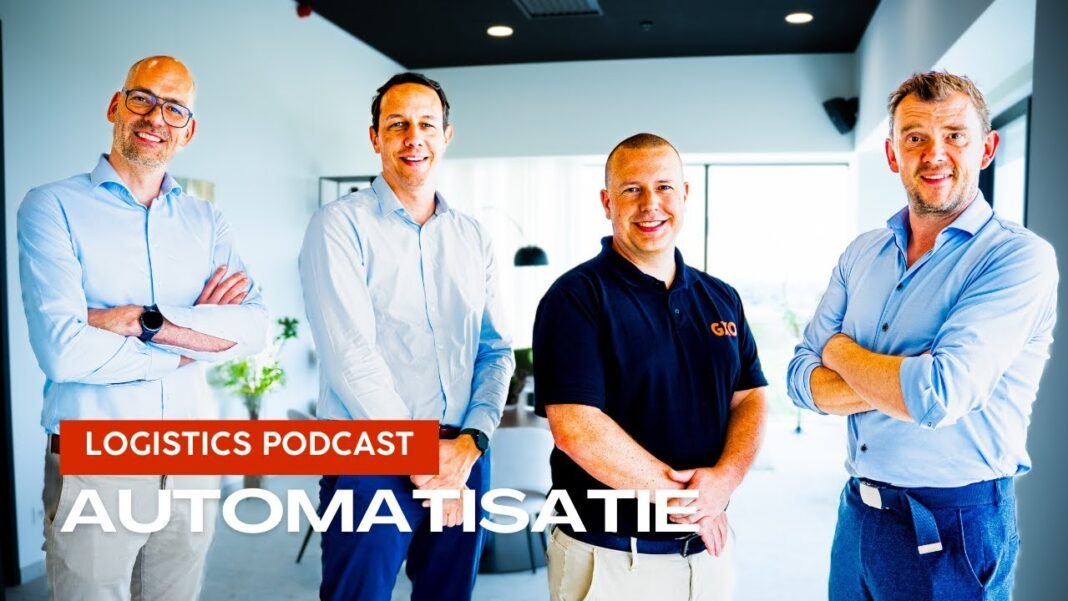

Automation in logistics is currently receiving a lot of attention. Among other things, it ensures greater efficiency and offers a solution to the shortage on the labor market. But how do you start? How big are the investments? And what is the ‘return on investment’? Frank Slangen from GXO Logistics, Hannes Dekeyzer from machine builder Fraxinus and Jelle Celis from Jungheinrich answer these and other questions.
Logistics Management: Why are more and more companies opting for automation?
Frank Slangen (GXO Logistics): “Automation is essential today to remain competitive as a logistics company. It not only ensures cost efficiency, but also more safety on the work floor and lower CO₂ emissions. Our customers are increasingly demanding, automation is simply a must today.”
Hannes Dekeyzer (Fraxinus): “For many companies, automation is also an answer to the structural shortage on the labor market. Finding the right employees for logistics tasks is no longer possible today. By automating, companies can continue to grow, without being dependent on additional staff.”
LM: In addition to the tightness on the labor market, companies are focusing on sustainability and speed. Does automation offer a solution for this?
Jelle Celis (Jungheinrich): “I think so, provided you do it right. What are the customer’s objectives? And is he willing to think along with us to not only automate his current process, but perhaps also adjust it towards the goal?”
F. Slangen: “What is certain: without automation you will never solve those challenges. But does it solve all problems? No, not that either.”
Quick payback
LM: Is automation complex? And does it require major investments?
J. Celis: “No, automation does not have to be complicated or expensive at all. It can range from a single AMR, an Autonomous Mobile Robot, or an AGV, an Automated Guided Vehicle, to a fully automatic warehouse, with order picking, conveyor belts and lifts. But with Jungheinrich we also have standard AGVs that transport a pallet from A to B: neither complex nor expensive. It all depends on the purpose, context and budget. It is important that the solution is scalable and future-proof.”
F. Slangen: “Smaller automation projects can pay for themselves quite quickly, within one to two years. For larger systems, you have to take longer terms of five, six or seven years into account for the ROI, the ‘return on investment’.”
J. Celis: “The number of shifts also plays a role: with one eight-hour shift per day, the ROI is obviously lower than for a company that works 24/7 in three shifts.”
LM: And is it about customization or not? That might also play a role?
Hannes Dekeyzer: “Absolutely. At Fraxinus, almost every project is tailor-made. Every warehouse, every production flow is different. Our strength lies in combining our engineering knowledge with the specific needs and objectives of the customer. We work step by step and guide him from concept to commissioning.”
F. Slangen: “The various components of the automation may be standard, but the customization lies in the way you connect them into a working whole. That coordination determines its efficiency and ROI.”
J. Celis: “Customers usually first focus on well-defined processes for automation. To achieve this, you look for a more or less ‘mainstream’ solution, which is preferably also ‘scalable’ and flexible. But the further you push automation, the more specific the solution becomes for the customer’s specific needs. And then it becomes customization. The software is of course also crucial. Your hardware is only as good as the software that controls it all. This requires a piece of efficient software on the manufacturer’s and the customer’s side. In an automation project, you have to define and discuss everything well in advance.”
LM: Does automation reduce the number of jobs?
F. Slangen: “No, no jobs will be eliminated, but the profiles will change. The range of tasks will evolve.”
J. Celis: “It is also a matter of training. Our sector will have to guide and retrain employees. Because in addition to machines, you will always need people who understand and maintain them. It is not possible without human supervision and knowledge.”
H. Dekeyzer: “Our systems are designed as intuitively as possible, with clear visualizations and 3D displays. Operators can therefore understand and resolve faults independently. This way we lower the barrier to working with them.”
“By automating, companies can continue to grow without being dependent on additional staff.” (Hannes Dekeyzer, Fraxinus)
Fewer accidents
LM: What are the safety benefits?
J. Celis: “Our AMRs and AGVs have to move between forklifts and employees, who may or may not be on a forklift. They are therefore equipped with numerous sensors that allow them to move safely in hybrid environments. This increases safety.”
H. Dekeyzer: “Automated installations often operate in closed zones. This drastically reduces the risk of incidents.”
F. Slangen: “The ergonomic advantage should not be underestimated either: employees have to walk or lift less. Goods come to them, not the other way around.”
LM: Does automation increase the sustainability of logistics processes?
F. Slangen: “Sustainability is indeed an important driver for automation. By automating packaging processes, we save space by reducing the size of packaging, which also allows you to transport more boxes per truck. In addition, more compact storage also ensures lower energy requirements in the warehouse.”
J. Celis: “We use lithium-ion technology in combination with battery storage and smart chargers for our electrical appliances. This allows us to avoid peak consumption and use energy more efficiently.”
H. Dekeyzer: “Automation ensures fewer errors, and fewer errors means less waste. Waste always costs money and energy.”
‘Digital twins’
LM: What trends are you still noticing in automation?
F. Slangen: “The breakthrough of ‘digital twins’ stands out. This is a second version of an ERP or Warehouse Management system, which runs parallel to it like a shadow and can determine in milliseconds the most efficient route for an order picker or which machine is available the fastest.”
H. Dekeyzer: “We are also seeing more and more combinations of fixed installations with mobile systems, such as AGVs, especially in environments where space is scarce. Flexibility is crucial there.”
LM: What message do you give to companies that are still in doubt?
F. Slangen: “Automation is really necessary today if you want to remain competitive. You simply cannot do without it.”
J. Celis: “Don’t be afraid of it. And start small, get advice. Automation doesn’t have to be complex. It can be a very small part of your internal logistics, with a very short ROI. And with little impact on your infrastructure and your employees.”
H. Dekeyzer: “Automation helps your company grow. You sometimes have to look at the payback effect broadly. It is not just about replacing tasks that someone is currently responsible for, no, it can also increase your output. You have to look at this from different perspectives.”
“Automation produces smaller packages, which means you can transport more boxes per truck.” (Frank Slangen, GXO Logistics)
The participants
- Frank Slangen is senior director Customer Solutions at GXO Logistics, a large international 3PL (contract logistics) player with a focus on customized solutions, innovation, AI and sustainability.
- Hannes Dekeyzer is sales manager at Fraxinus, a Belgian machine builder from Roeselare, specialized in custom machines for internal logistics and production. Fraxinus has all its engineering and production in-house.
- Jelle Celis has been working as director Logistics Systems at Jungheinrich, active in intralogistics for more than 60 years, with more than 18,000 employees in about 40 countries. Itproduct range ranges from conventional forklift trucks to fully automated logistics systems to connect machines and processes.

